
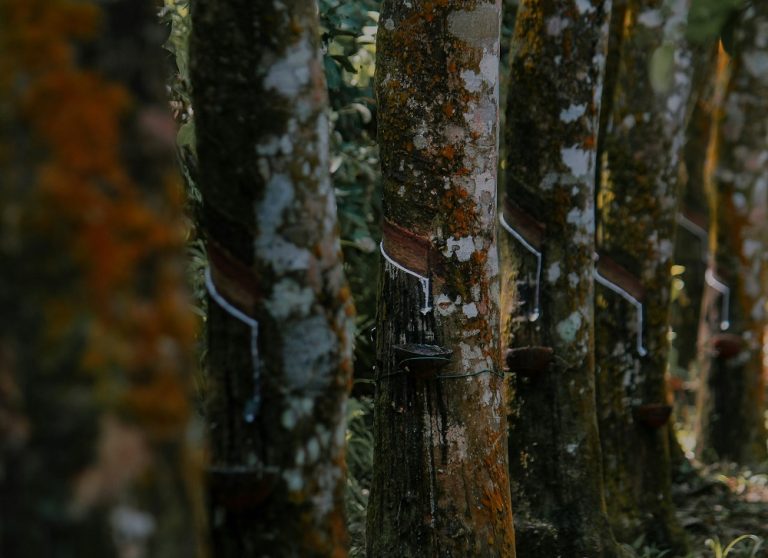
The narrative surrounding natural rubber is broken and has created a negative perception of it.
The dominant story has been of chainsaws and cleared forests. While the link between irresponsible expansion and deforestation is undeniable, this singular focus drowns out crucial nuances and obscures a vital truth.
Sustainably produced natural rubber is not the villain. It is an indispensable ally in the global quest for sustainability. It’s time for producing nations to unite and reclaim this narrative, especially on platforms like the 30th United Nations Climate Change Conference (COP30) from Nov 10-21, in Belem, Brazil, the original home of this wonder material.
The current perception crisis is damaging on multiple fronts. Consumers, bombarded with images of rainforest destruction, increasingly view natural rubber as inherently unsustainable. Brands, under pressure, scramble for synthetic alternatives derived from fossil fuels, trading one environmental problem for another – the climate crisis.
This ignores a fundamental reality. Many critical products rely irreplaceably on the unique properties of natural rubber. From life-saving medical gloves and tubing to essential aircraft tyres, seismic bearings protecting infrastructure, and countless everyday items, natural rubber offers performance and safety that synthetics often cannot match.
A collapse in sustainable natural rubber supply chains isn’t just an economic concern. It’s a threat to public health, safety, and technological resilience.
Furthermore, this skewed narrative threatens the livelihoods of millions of smallholder farmers. Across Southeast Asia and Africa, families cultivate rubber trees on small plots, often integrated into complex agroforestry systems. For them, rubber isn’t a driver of destruction. It’s a vital lifeline, a source of income that supports education, healthcare, and community stability.
Demonising their crop without offering viable, sustainable pathways undermines global development goals and risks pushing vulnerable communities deeper into poverty. The primary sustainable development goal is ending world poverty.
So, what’s missing from the conversation? The Carbon story is one.
Mature rubber trees are significant carbon sinks. Well-managed plantations, particularly those employing agroforestry models (intercropping with timber, fruit, or spices), sequester substantial amounts of CO₂, contributing positively to climate mitigation.
This contrasts sharply with the carbon footprint of synthetic rubber production. The renewability factor needs telling. Natural rubber is derived from a renewable resource – the Hevea brasiliensis tree. Unlike fossil-fuel-based synthetics, it doesn’t deplete finite geological resources.
At the end of its productive life, rubberwood becomes a valuable timber resource. In construction, it serves as a low-carbon alternative to concrete.
Sustainable production models do exist. Significant progress is being made. Initiatives like the sustainable natural rubber certification schemes are driving standards for deforestation-free supply chains, improved labour practices, and biodiversity conservation.
Under the agroforestry models, improved yields on existing land, and satellite monitoring are proving that sustainable NR is achievable and scalable.
Supporting smallholders in adopting sustainable practices is crucial. This requires investment, training, fair pricing, and access to technology – efforts that contribute directly to rural development and poverty alleviation, aligning perfectly with the UN Sustainable Development Goals.
It is time for natural rubber-producing nations – Thailand, Indonesia, Vietnam, Malaysia, India, Cote d’Ivoire, and others – to launch a coordinated offensive against misinformation.
They must pool resources, data, and voices to amplify the full picture.
They need to proactively communicate the essential role of natural rubber, the carbon sequestration potential of well-managed plantations, the socio-economic benefits for millions, and the concrete actions being taken towards sustainability. They should showcase best practices.
Highlight successful agroforestry projects like in Sabah, smallholder certification programmes, and technological innovations reducing environmental impact.
Demonstrate that deforestation is not inherent to natural rubber, but a consequence of poor practices that are being addressed.
They must demand a fair hearing at the UN Climate Change Conference, as it is the paramount global stage for sustainability. Natural rubber-producing nations must strategically position sustainable natural rubber as a renewable, carbon-sequestering, essential commodity, supporting rural livelihoods.
They must advocate for the recognition of sustainably managed natural rubber as a climate-positive land use, along with financial mechanisms to support smallholders in transitioning to and maintaining sustainable practices, policies that incentivise deforestation-free supply chains and responsible sourcing by global brands, and research funding to improve yields, disease resistance, and ecosystem services within rubber landscapes
Ignoring or vilifying natural rubber is not a sustainable solution. Abandoning it for fossil-fuel synthetics is a step backwards.
The real path forward lies in transforming its production. Producing nations hold the key to this transformation, but they must first transform the narrative.
By uniting to tell the full, complex story of natural rubber – acknowledging past problems while championing present solutions and future potential – they can secure its rightful place as a positive force within the global sustainability agenda.
The COP30 stage awaits; it’s time for the rubber-producing world to step up and be heard. The future of millions of farmers, critical industries, and a truly sustainable bioeconomy depends on it.
The views expressed here are the personal opinion of the writer and do not necessarily represent that of Twentytwo13.


