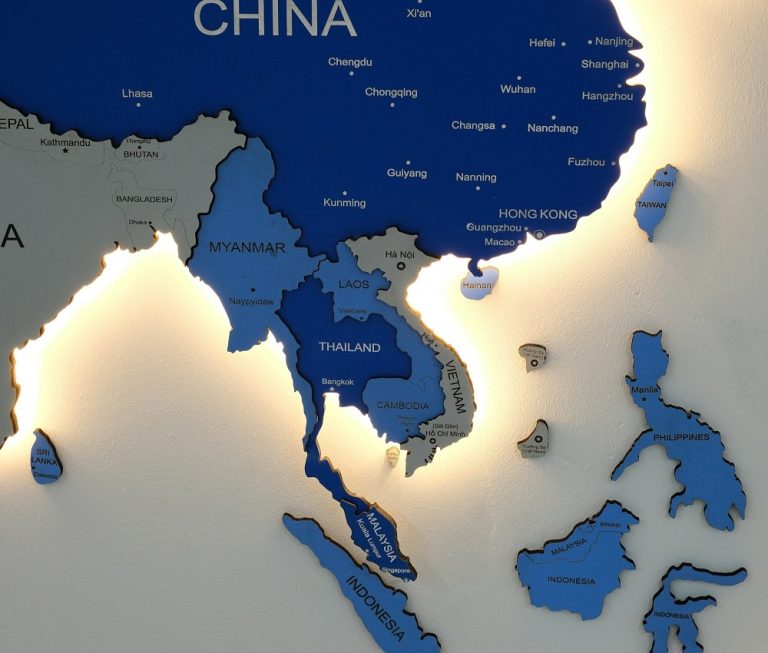
Almost every story told about the South China Sea has the same two characters. On one side stands China, its sweeping “nine-dash line” now redrawn with ten dashes on the 2023 official map, curling around nearly the entire sea. On the other stands the rules-based order it appears to defy.
Squeezed out of this drama are the four Southeast Asian states with the most to lose: Vietnam, the Philippines, Malaysia and Brunei. Too often, they are lumped together as a single, helpless bloc.
That picture does not accurately represent the situation. Underneath China’s one bold line lies a patchwork of competing claims, and each of these four states defends its corner with a strategy all its own. This is not a simple contest of China against the rest. It is a layered grey-zone struggle, a fight deliberately waged below the threshold of open war in which even the weaker players retain real, if narrow, room to act.
To clearly understand their choices, four ideas are helpful. Hedging is a strategy used by a small state neighbouring a rising giant: instead of choosing a side too early, it makes two simultaneous bets. This allows the state to benefit from strong ties with Beijing while quietly maintaining security partnerships as a backup. Grey-zone contestation covers coercion just short of war: coast guard patrols, militia swarms and water cannons, and, crucially, it cuts both ways as the smaller states field their own white-hull fleets and publicity campaigns. ‘Lawfare’ turns international law into a weapon, most famously in the 2016 arbitration ruling that gutted the nine-dash line. Institutional balancing is Asean’s attempt to tie China down through the long-stalled Code of Conduct. Every claimant mixes these tools in its own proportions.
The result is a spectrum of responses. At one extreme is the Philippines. Under President Marcos Jr, Manila has adopted a policy of “assertive transparency”, actively documenting incidents where Chinese ships collide with and attack its vessels near Second Thomas Shoal, then sharing this footage to garner international support. This position is bolstered by a strong alliance with Washington. The advantages are considerable: the Philippines has maintained its presence on the international stage and gained unexpected global sympathy. However, this strategy is also the riskiest, as it places the country just one dangerous confrontation away from war, and its effectiveness largely depends on America’s resolve.
Vietnam plays the opposite game with quiet skill. Since 2021, it has dredged and built across all its occupied reefs, piling up more than 2,700 acres and even laying a runway at Barque Canada Reef, all while protesting softly and befriending everyone at once: the United States, China, Russia and Japan alike. By building steadily and speaking little, Hanoi has secured more ground than any louder rival while drawing far less punishment. Its gamble is that fortified islands, so useful in peacetime, may turn into traps in a real war.
Malaysia sits further towards accommodation, practising what one scholar calls “triadic maritime diplomacy”: file a quiet legal protest, keep the gas flowing and never escalate in public. Petronas drills at the Kasawari field even as Chinese coast guard ships loiter almost permanently around the Luconia Shoals. Kuala Lumpur protects its resources and its lucrative trade with Beijing but pays in slow erosion; every unchallenged patrol chips away at its jurisdiction.
At the far, silent end lies Brunei. It claims Louisa Reef but occupies nothing, patrols nothing and rarely speaks. For a micro-state with no security guarantor and an economy leaning on Chinese investment, near-total accommodation may be the only rational path. It stays safe today by quietly trading away tomorrow’s standing.
Set side by side, these four cases reveal patterns that reshape how the whole dispute should be read.
· The claimants represent a spectrum of differences, not a bloc. Their variations arise from cold calculations of capability, geography and economic exposure, rather than differing nerves. Any policy that treats them as one reactive mass will misjudge how the contest really works.
· Second, China’s pressure follows visibility and alignment, not size. Beijing leaned hard on small Philippine resupply runs yet let Vietnam’s far larger construction pass with a shrug. It presses where resistance is loud and backed by an alliance and tolerates what stays quiet and unaligned. That hands claimants a lever: how they act shapes China’s response more than what they actually do.
· Third, the Code of Conduct is a test of unity, not a fix. The very diversity mapped here is why it keeps stalling. States that read the threat so differently – from Manila’s defiance to Brunei’s silence – cannot easily agree on binding terms. The code is better judged by whether Asean can manage risk together than by whether it settles who owns what.
· Fourth, strategy under imbalance is a trade-off, never a winning move. Outside security widens a state’s options; economic dependence narrows them. Assertiveness pays only when backed by credible support and careful escalation control; accommodation buys calm only by slowly surrendering rights. Vietnam’s blend of quiet self-help, restraint and many partners points to the steadiest ground: a calibrated middle that keeps presence high and provocation low.
Ultimately, the most profound lesson revolves around the true meaning of winning. None of the four entities can reclaim territory from China due to the overwhelming power imbalance. In this context, success is defined not as victory but rather as survival – maintaining presence, entitlement, resources and independence despite immense pressure. When evaluated this way, each strategy is effective on its own terms, and none is superior to the others.
The shadows between the dashes, then, hold a contest far richer than the headlines suggest. Its future will be shaped less by dramatic clashes than by the slow interplay of visibility, alliances and economic dependence that sets each state’s room to manoeuvre. Whether one of the world’s busiest and most militarised waterways is steadily managed or drifts towards confrontation will hinge on one thing: whether Asean can turn four very different national strategies into a shared restraint.
Colonel Ridzwan Abdul Majid is a course member of the National Resilience College, Puspahanas. These are his personal views.