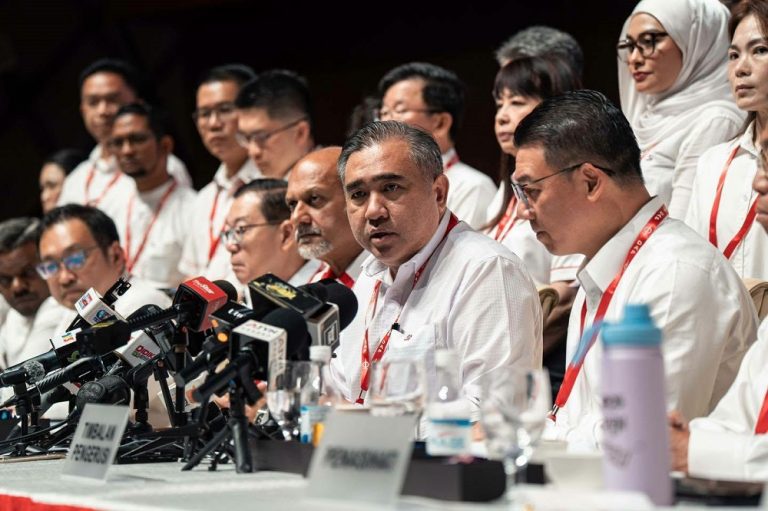
The Democratic Action Party’s (DAP) Congress on Aug 16 was far more than a routine organisational meeting.
Coming after disappointing electoral results and amid growing uncertainty within Prime Minister Datuk Seri Anwar Ibrahim’s unity government, it represented a critical moment of political reckoning.
The central issue was whether DAP should remain in government, where it could exercise executive influence, or withdraw to regain political leverage and reinforce its reformist identity.
The decision was particularly consequential because DAP sits at the heart of Pakatan Harapan (PH). Its 40 parliamentary seats and strong non-Malay support make it indispensable to PH, but its participation in government also exposes it to the weaknesses and compromises of the coalition.
The Congress, therefore, raised a broader question: can DAP remain in power without losing the political identity that brought it to power?
Electoral setbacks and the Barisan Nasional (BN) resurgence
DAP entered the Congress with weakened electoral momentum. It suffered a complete defeat in Sabah, won only six of the 17 seats it contested in Johor and lost two seats in Negeri Sembilan. Most symbolically, its secretary-general Anthony Loke lost his Chennah constituency to BN’s MCA Youth chief, Siow Kong Choo.
These results demonstrated that DAP can no longer assume that its traditional support is secure. They also occurred alongside the resurgence of BN, particularly Umno, through what has been described as the “Southern Wave”.
BN represents a different challenge from Perikatan Nasional’s (PN) “Green Wave”. PN’s appeal is heavily rooted in Malay-Muslim conservatism, whereas a revitalised BN can present itself as moderate, pragmatic and development-oriented. This allows BN to compete directly with PH for centrist and middle-ground voters.
For DAP, this creates a fundamental contradiction. It must cooperate with BN to sustain the unity government while competing against it electorally. Excessive confrontation could weaken government stability, but excessive cooperation could undermine DAP’s political distinctiveness.
This is particularly sensitive because part of DAP’s support, especially among younger voters, has historically been rooted in opposition to the old BN order.
Principle versus pragmatism
DAP’s deeper challenge is reconciling its reformist principles with the compromises of government. Its political identity has traditionally rested on democratic reform, good governance, institutional accountability and opposition to corruption. Government participation inevitably requires compromise, but prolonged compromise without visible reform risks alienating the party’s own supporters.
The Congress offered an opportunity to redefine cabinet participation as a negotiated relationship with Anwar. Rather than supporting the government unconditionally, DAP could establish specific reform benchmarks involving institutional accountability, parliamentary reform, anti-corruption measures and limits on executive power.
Proposals such as a 10-year limit for the prime minister and stronger parliamentary allocations point towards such an approach. A negotiated strategy could allow DAP to combine political stability with reformist pressure. However, repeated delays would reinforce the perception that DAP has exchanged principle for ministerial office.
Managing Anwar and PKR
DAP must also manage its increasingly complex relationship with Anwar and PKR. The two parties are mutually dependent but politically different. Anwar provides PH with a Malay-majority political face that DAP cannot provide, while DAP remains indispensable to PH’s non-Malay electoral support and parliamentary strength.
DAP, therefore, needs sufficient independence from Anwar without destabilising the coalition. If it becomes too closely associated with the prime minister, it risks becoming responsible for every government failure. If it becomes excessively confrontational, it could undermine PH and strengthen its opponents.
This is especially important on issues involving Malay rights, Islam and affirmative action. DAP must defend constitutional pluralism while avoiding a political posture that enables PN to portray it as anti-Malay or anti-Islam.
Responding to PN and retaining its base
DAP is simultaneously squeezed by PN and BN. PN remains formidable among Malay-Muslim voters, while BN is rebuilding its position among moderate voters. DAP cannot respond simply by returning to traditional opposition rhetoric.
Instead, it needs to strengthen PH’s multiracial proposition around competent government, economic opportunity, institutional integrity and social justice. Its challenge is to retain its established non-Malay base while demonstrating that it represents national rather than merely communal interests.
This is increasingly important as younger voters become less attached to historical political loyalties. Issues such as wages, housing, employment, education, digitalisation and the cost of living increasingly influence political choices. DAP needs to translate its reformist traditions into policies addressing these everyday concerns.
Leadership renewal
Loke’s defeat in Negeri Sembilan is particularly symbolic. Seniority and established political reputation can no longer guarantee electoral security. As such, DAP needs broader leadership renewal and a stronger second tier capable of connecting with younger Malaysians.
Generational renewal is not simply about replacing older leaders. It requires developing a new political narrative that links DAP’s historical commitment to reform with contemporary concerns such as technological change, economic insecurity and environmental sustainability.
The Congress vote: A warning signal?
The voting figures at the Congress also deserve closer scrutiny. A total of 4,264 eligible delegates of the 1,704 eligible branches were registered to vote at the national Congress. Of these, 2,106 delegates cast their ballots, with 1,857, or 88.4 per cent, supporting the motion to remain in government, while 242, or 11.52 per cent, supported leaving, with seven invalid votes.
The headline figure is therefore an overwhelming 88.4 per cent majority. But another interpretation is possible. The 1,857 votes supporting continued government participation represented only 43.55 per cent of all eligible delegates. More than half of the eligible delegates did not participate – a strange anomaly for a political party that calls itself “democratic”.
This does not necessarily mean that the absent delegates were boycotting the Congress. There is insufficient evidence to establish that. Nevertheless, the low participation rate is politically noteworthy. It suggests the overwhelming majority reported from the ballot should not automatically be interpreted as overwhelming enthusiasm among the entire party membership.
The distinction is important as DAP enters the next electoral cycle. The party must determine whether its grassroots are genuinely satisfied with continued participation in government or whether significant disengagement reflects deeper uncertainty about its political direction.
Preparing for GE16
All these challenges converge on GE16. DAP needs a serious electoral reassessment, including vulnerable constituencies, candidate selection, seat negotiations and campaign strategy.
Its objective should not simply be to defend existing seats or maximise its parliamentary numbers. It must consolidate its traditional constituencies while selectively expanding into mixed and competitive seats. This will require careful negotiations with PKR and BN to avoid multi-cornered contests that could benefit PN.
The party must also recognise that electoral geography is becoming more fluid. Traditional assumptions about safe seats and permanent ethnic voting blocs are increasingly unreliable.
From survival to renewal
The recent Congress placed DAP at a strategic crossroads. Remaining in government offers stability, influence and access to executive power, but carries the risk of further weakening its reformist identity. Leaving could restore political independence and bargaining power but could also reduce its influence and destabilise the Unity Government.
The paradox is clear: DAP may need government participation to protect its influence while needing greater distance from government to restore its credibility.
The most viable strategy is therefore neither unconditional loyalty nor abrupt withdrawal. If DAP remains in government, it must use its position to secure clearly defined and measurable reforms. If reforms are repeatedly delayed, the party will need to reconsider the political cost of remaining in cabinet.
The August 2026 Congress should consequently be viewed as the beginning rather than the conclusion of DAP’s political reassessment. The defeats in Sabah, Johor and Negeri Sembilan, the rise of BN’s “Southern Wave”, the continuing strength of PN and changing voter expectations have exposed vulnerabilities that can no longer be dismissed as temporary.
DAP remains indispensable to PH, but it is not invulnerable. Its future depends on whether it can combine reformist principles with governing competence, pragmatism with political independence, and traditional support with a broader national appeal.
Ultimately, the party must demonstrate that participation in government has not changed what it stands for. If it can turn political influence into meaningful reform, rebuild grassroots confidence and prepare effectively for GE16, the August Congress may become a turning point towards renewal. If not, it may come to be remembered as the moment when DAP recognised its problems but failed to resolve them.
Image: DAP / Facebook