

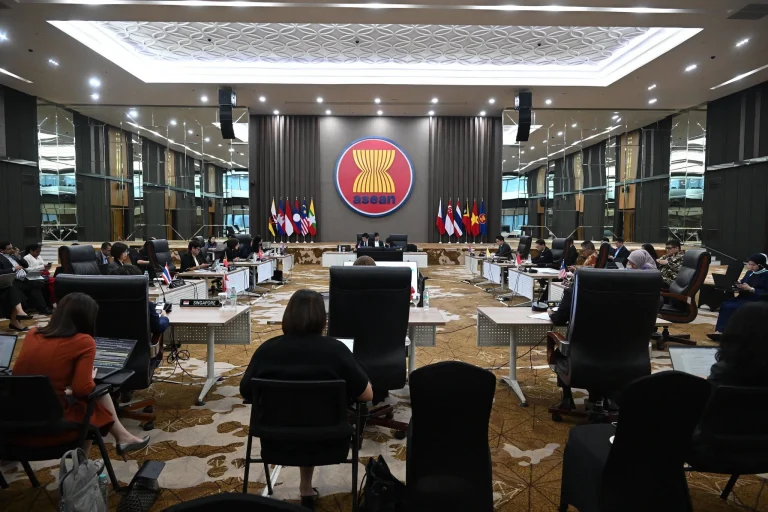
As Asean marked its 59th anniversary on Aug 8 under the banner “Navigating Our Future Together”, the celebrations masked a harder truth: the bloc is rowing between two reefs – unity on paper, rivalry in practice. The question is whether Asean can still steer the Indo-Pacific or whether superpower pressure is quietly splintering its hull.
For decades, Asean’s strength lay not in military might but in process. The Asean Regional Forum, established in 1994, brought the United States, China and Russia into regular dialogue. The East Asia Summit followed in 2005, the Asean Charter enshrined “centrality” in 2007, and ADMM-Plus added eight defence partners in 2010.
The formula was simple: keep everyone talking, keep everyone included, and consensus – the “Asean Way” – would turn smallness into leverage. For years, this was how the bloc navigated the reefs of US-China rivalry.
But that machinery now falters. In the South China Sea, years of negotiations have yet to produce a binding Code of Conduct. Cambodia, under Chinese pressure, blocked a joint communique in 2012 and again muted Asean’s response after the Hague tribunal rejected Beijing’s nine-dash line claims in 2016. Analysts say consensus is increasingly losing ground to unilateral expansion.
Myanmar tells a similar story. After the 2021 coup, Asean announced a Five-Point Consensus. By late 2022, four of its points remained unmet or only partially implemented. The oars of consensus, once steady, now catch on the rocks.
China’s trade gravity
As Asean struggles to maintain cohesion, economic dependence presents another challenge. By 2023, Asean had overtaken both the European Union and the US to become China’s largest trading partner. Two-way trade neared US$1 trillion in 2024, rising 9 per cent in a year.
Dependence is uneven. Cambodia and Laos rank among the most exposed, with China taking nearly a third of Laos’s exports and accounting for a substantial share of its foreign investment. Debt held by Beijing hovers around a fifth of gross domestic product in both states. Malaysia, Myanmar and the Philippines show mid-level dependence, while Vietnam remains less vulnerable.
Analysts warn that such dependence could give Beijing quiet veto power within Asean, constraining the bloc as a whole. The reefs of economic gravity pull the boat closer to one side.
Meanwhile, other powers are building alternative security arrangements. The Quad was revived in 2017 amid concerns over China’s growing influence. AUKUS, announced in 2021, brought Australia, Britain and the US together in a nuclear-powered submarine partnership. In 2023, Washington, Tokyo and Seoul deepened trilateral security cooperation at Camp David.
Together, these arrangements increasingly bypass Asean’s inclusive forums in favour of smaller, exclusive groupings. Analysts warn that US-led alliances now compete directly with Asean’s mechanisms. The bloc rows harder, but the reefs are closing in.
Members chart their own course
Individual states are charting their own paths. Manila has expanded US military access and staged record Balikatan exercises. Hanoi reinforced its independent posture by upgrading ties with Washington to a comprehensive strategic partnership in 2023. Jakarta pushed the Asean Outlook on the Indo-Pacific to keep all major powers under one tent.
Malaysia, as Asean chair in 2025, sought to balance inclusivity with sustainability. Under Prime Minister Datuk Seri Anwar Ibrahim, Kuala Lumpur hosted two summits that prioritised narrowing development gaps, advancing digital transformation and embedding climate resilience in Asean’s agenda. Malaysia also presided over Timor-Leste’s accession as Asean’s 11th member.
By championing the bloc’s Post-2025 Vision and Asean 2045 roadmap, Malaysia cast itself as a bridge-builder – defending centrality while pushing for reform.
Regional strategists have prescribed “flexible consensus” – an Asean Minus X formula that allows willing members to act without a single-state veto. Malaysia’s chairmanship echoed this spirit, stressing unity while embracing pragmatism amid widening geopolitical fractures.
August also carries a deeper regional significance. The restoration of Indonesia-Malaysia ties in August 1966, following the years of Konfrontasi, reminds the region that peace in Southeast Asia is hard-won, often tested and never guaranteed. Together, these anniversaries underscore a shared resilience – proof that rowing between reefs has always been part of Asean’s story.
The choice ahead
As Asean enters its sixth decade, the stakes are clear. Its inclusive forums are being bypassed, its consensus rules exploited, and its members pulled in different directions by trade and security ties. Yet the bloc retains one crucial asset: its ability to convene. If it can adapt its consensus model and empower middle powers, Asean may yet steer its own course.
The metaphor remains apt: Asean is rowing between two reefs. One side pulls towards Chinese economic gravity, the other towards US-led security alliances. The real danger is not choosing the wrong side, but drifting without steering.
As the anniversary confetti fades, Asean must decide whether to navigate its future together or let the reefs decide for it.
Colonel Aria Sanggita Saleh, S.E, M.Si is a member of the Indonesian Armed Forces and is currently attending the National Resilience Course at the National Centre of Defence Studies, Putrajaya.



