
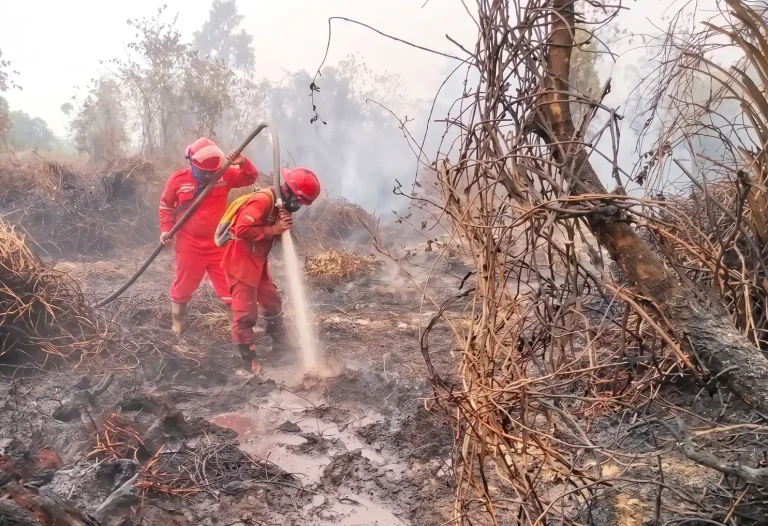
KUALA LUMPUR: Indonesia must adopt firmer preventive measures to stop recurring forest and land fires, rather than continuing to rely heavily on prosecutions and firefighting after the damage has been done.
Sahabat Alam Malaysia (SAM) president Meena Raman said Indonesia’s record of investigations, prosecutions, convictions, corporate sanctions and restoration orders had failed to prevent the haze crisis from recurring, despite the country’s ratification of the Asean Agreement on Transboundary Haze Pollution (AATHP).
Her assessment comes as Indonesia battles another major fire season, with smoke from Kalimantan affecting neighbouring countries, including Malaysia.
“The largest enforcement gap is the failure to develop and implement sufficient preventive measures, before the first fire burns,” she told Twentytwo13, arguing that Indonesia had failed to stop what she described as a human-made crisis that had persisted for four decades.
The problem, she said, long pre-dated the AATHP, which was signed by Asean countries in 2002.
Indonesia ratified the agreement in 2014 and deposited its instrument of ratification with Asean in January 2015, making it the last Asean member to ratify the regional haze pact.
The agreement requires parties to cooperate in preventing and monitoring transboundary haze, controlling sources of fires, developing early-warning systems and providing mutual assistance.
But the persistence of large-scale fires more than a decade after Indonesia became a party to the agreement raises a fundamental question – has the regional framework translated into sufficient action on the ground?
Meena pointed to the 1982-83 El Niño episode in Kalimantan, when more than 3.2 million hectares of forest and land were affected, as an early warning of the scale of the problem.
Since then, recurring fires and transboundary smoke have become a familiar feature of the region, particularly during prolonged dry periods.
SAM argues that degraded peatlands and forests are particularly vulnerable because logging, drainage, plantation development and industrial agricultural activities can leave them much drier and more susceptible to fire.
She acknowledged that prosecution, conviction, punishment, compensation and restoration remain important, but argued that these measures come only after fires have already damaged ecosystems and exposed communities to smoke.
“Prevention is better than cure,” she said, stressing that Indonesia needs policies and enforcement capable of ensuring that forests and peatlands are not allowed to become highly fire-prone in the first place.
Enforcement record under scrutiny
Indonesia has not been inactive on enforcement.
During the devastating 2015 fire crisis, Indonesian police said they had identified 140 suspects, including individuals linked to seven corporations, while investigations had been opened into 27 corporations.
There have also been cases in which company executives or managers were imprisoned.
One example is Frans Katihokang, an operational manager of PT Langgam Inti Hibrindo in Riau, who was initially acquitted over a 2015 fire affecting more than 500 hectares. The prosecution appealed, and Indonesia’s Supreme Court sentenced him to one year in prison and a Rp1 billion fine.
Another case involved Sutrisno, an assistant manager of PT Tesso Indah, who was convicted over a 2020 fire affecting about 65-70 hectares and sentenced to one year and four months in prison.
In 2021, Misno, director of PT Duta Swakarya Indah, was sentenced to one year in prison and fined Rp1 billion over fires in Riau.
Such cases demonstrate that criminal liability is possible.
Yet they also illustrate the wider enforcement challenge – the number of individual convictions remains small compared with the scale and recurrence of the fires.
Greenpeace’s analysis of government data found that between 2015 and 2019, Indonesia issued 258 administrative sanctions, while 51 criminal charges and 21 civil lawsuits were filed against companies in the plantation and pulp sectors.
The organisation said the figures raised questions about whether enforcement was sufficiently strong to deter companies, particularly when compared with the millions of hectares affected by fires during the same period.
Civil enforcement has also produced substantial judgments, but collection remains a problem.
Since 2013, Indonesia’s environment ministry has sued 22 companies over fires on their concessions. Fourteen had been found liable after exhausting their avenues of appeal, with courts ordering them to pay a combined Rp5.6 trillion (RM1.2 billion) in environmental compensation and related penalties.
But the enforcement process does not necessarily end with a court judgment.
Reports have highlighted difficulties in collecting the money, with only one of the 14 companies having paid its judgment in full at the time of a 2023 assessment. None had restored their burnt concessions.
This gap between identifying responsibility, obtaining a judgment and actually securing payment or restoration goes directly to SAM’s concern about deterrence.
The question is therefore not simply how many suspects Indonesia can identify or how many cases can be brought to court.
It is whether the overall enforcement system changes corporate behaviour and prevents the next fire.
Malaysia’s legal options
The latest crisis has also revived a more difficult question for Malaysia. What can an affected neighbouring country do beyond offering firefighters and aircraft?
Universiti Kebangsaan Malaysia associate professor of law Dr Shahrul Mizan Ismail argues that Malaysia should examine the possibility of pursuing an international claim where evidence establishes that Indonesia failed to meet its obligations.
He cautioned, however, that the presence of smoke across the border does not automatically establish Indonesia’s legal responsibility for every Malaysian loss.
The key issue, he said in a statement, would be whether Indonesian authorities exercised the level of due diligence expected under international law.
That could include examining whether known fire risks were addressed before the dry season, whether recurring violations were properly investigated, whether enforcement orders were implemented and whether available preventive measures were reasonably deployed.
The AATHP already provides a legal framework for cooperation. It requires parties to take measures to prevent and monitor transboundary haze and, where haze originates within their territory, to respond promptly to requests for information or consultations.
However, the treaty does not provide Malaysia with a straightforward automatic route to binding adjudication.
Shahrul suggested that Malaysia could first build an evidence dossier establishing the connection between fires, smoke movement and harm suffered in Malaysia, while quantifying losses and seeking consultations with Indonesia.
Any eventual international legal action would still have to overcome questions of jurisdiction, causation and evidence.
That makes the issue considerably more complex than simply identifying hotspots on satellite imagery.
From firefighting to accountability
For now, Malaysia is continuing with the more immediate response.
On Saturday, Deputy Prime Minister Datuk Seri Ahmad Zahid Hamidi said Indonesia had approved Malaysia’s offer to assist in tackling fires in Kalimantan.
The assistance includes a Bombardier CL-415MP aircraft, three helicopters and 52 personnel from NADMA, the Malaysian Maritime Enforcement Agency and the Royal Malaysian Air Force.
Zahid said the operation should not be viewed merely as short-term firefighting, noting that Malaysia and Indonesia had also discussed longer-term measures to prevent the haze from recurring.
He said Indonesian President Prabowo Subianto had informed him that there were still 1,426 hotspots in Kalimantan and that Indonesian authorities had taken legal action against 95 companies involved in open burning in the Borneo region.
That figure, however, again highlights the distinction between action taken and outcomes achieved.
The Human Rights Commission of Malaysia (Suhakam) has similarly warned that the recurring crisis cannot be addressed through reactive measures alone.
In a recent statement, the commission said haze threatens rights including life, health, education, safe working conditions and a clean, healthy and sustainable environment.
It called for stronger Asean cooperation under the AATHP, improved hotspot monitoring and enforcement, greater corporate accountability and faster progress on Malaysia’s proposed Clean Air Act.
The regional agreement was created precisely because haze does not respect national borders.
More than two decades after it was signed, and more than a decade after Indonesia became a party to it, the continuing fires suggest that the region’s biggest challenge may no longer be knowing what the problem is.
It is making prevention, accountability and enforcement strong enough to ensure the same crisis does not return year after year.
For Malaysia, the question is increasingly whether cooperation should remain focused primarily on helping to put out the fires – or whether the region must also develop stronger mechanisms to make those responsible for allowing them to burn answerable for the consequences.
Main image: Kementerian Kehutanan Republik Indonesia


