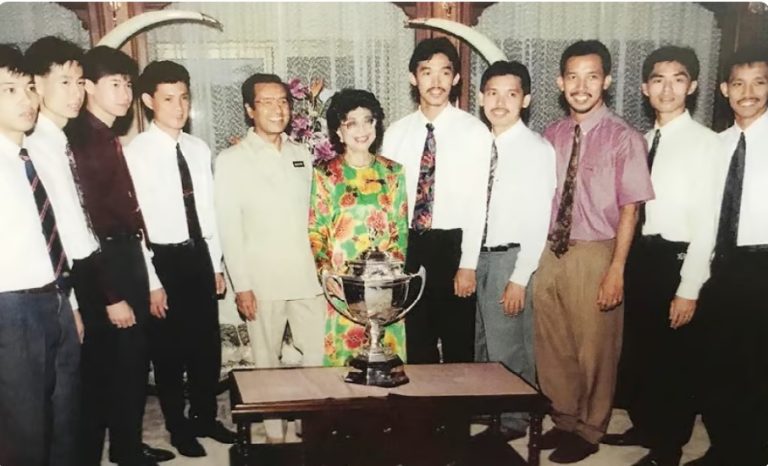
KUALA LUMPUR: Would Malaysia have won the 1992 Thomas Cup if it weren’t for Tun Dr Hasmah Mohamad Ali’s intervention? That is the question that has been on Datuk Cheah Soon Kit’s mind for over 30 years.
The former national shuttler was emotional as he spoke to Twentytwo13 about “the mother of badminton”, who passed away earlier today. Dr Hasmah was 100.
The wife of Malaysia’s longest-serving prime minister, Tun Dr Mahathir Mohamad, Dr Hasmah died at 9.20am at the National Heart Institute (IJN) in Kuala Lumpur. She is survived by her husband, their seven children – three girls and four boys, 18 grandchildren and four great-grandchildren.
While many Malaysians will mourn the loss of a trailblazing medical pioneer, public health advocate and the ‘human face’ of Dr Mahathir’s political career, Cheah remembers Dr Hasmah simply as a humble, passionate and loving ‘mother’.
“She was a very passionate badminton fan, and was the BAM (Badminton Association of Malaysia) patron for nearly 30 years,” said Cheah.
“Before the 1992 Thomas Cup campaign, my doubles partner (Datuk Soo Beng Kiang) and I had a disagreement. We were both young and maybe a little too eager to make a name for ourselves.
“It was Dr Hasmah who sat us down and gave us motherly advice. She told us to look at the bigger picture, to think about the nation, and what winning the Thomas Cup would mean to its people.”
Her pep talk was the motivation Malaysia’s second doubles pair needed. In the final against Indonesia’s Ricky Subagja and Rexy Mainaky, the Malaysians won 15–12, 10–15, 15–8 to clinch the trophy after a 25-year wait.
Cheah, who plans to attend Dr Hasmah’s funeral later today, said he received the sad news around 10.30am and was still processing it.
“All of us badminton players will be forever grateful to Dr Hasmah, as she was always there for us. I was quite close to her, but I would say all of us were,” said Cheah.
“I appreciate her support and kindness. She has all our love and respect. Another thing I would add is that she never interfered in how the coaches or BAM did things. She just showed up to support us whenever she could.”
Cheah said the team organised a reunion in 2019 to thank Dr Hasmah.
“We became the players and men we are today because of her, and we wanted to thank her,” he said.
He said Dr Hasmah’s presence at training camps and competitions reflected a genuine concern for the athletes beyond their performances.
“In victory or defeat, her support remained constant, much like that of a mother watching her children pursue their dreams,” he added.
Besides BAM, Dr Hasmah was also the patron of the Malaysian Philharmonic Orchestra since its inception in 1997, as music had been a lifelong passion that she generously shared with others.
An accomplished violinist, she would often take up her bow to perform at charity events and private gatherings. Her music reflected her belief that harmony could bring people together and offer comfort in difficult times.
Seeing the elegant Dr Hasmah playing the violin or sitting at a piano brought a sense of warmth and humanity to the highest levels of Malaysian public life.
Music was, for Dr Hasmah, a language beyond words, a quiet expression of beauty, patience, compassion and cultural pride.
Dr Hasmah was one of the first Malay women to enrol at the King Edward VII College of Medicine in Singapore. It was here that she would meet her future husband.
She graduated in 1955. After joining the Health Ministry, she served as a medical officer in several parts of the country, including Kedah, with much of her work focused on public health, maternal and child healthcare.
In 1965, she became the first woman to be appointed Medical Officer in the Maternal and Child Health Department, and later, in 1974, she was the first woman to be appointed the State Maternal and Child Health Officer.
Dr Hasmah served in various positions such as the president of the Malaysian Girl Guides Association, chairman of the Kedah Family Planning Association, president of the Malaysian Medical Association Foundation, president of the Association for the Rehabilitation of Handicapped Children and vice-president of the Federation of Family Planning Associations of Malaysia.
She was also the patron of the Malaysian Association of Maternal Health and Neonate, Malaysian Pediatric Association and Wheelchair Association Malaysia.
But beyond the halls of medicine and governance, her love for music and deep affection for Malaysian badminton revealed a softer, deeply personal connection with the people she served.
A love that endured through the years
Hamzah Osman, a freelance journalist based in Langkawi, said he covered Dr Hasmah for over two decades.
He spent many years covering Dr Hasmah whenever she accompanied Dr Mahathir to events in Kedah, especially Langkawi.
He said there was one side of Dr Hasmah that would always remain in his memory.
“Despite her position as the wife of a former prime minister, she was a remarkably down-to-earth person, approachable and never awkward about greeting members of the public in her gentle manner,” Hamzah shared with Twentytwo13.
“What left the deepest impression on me was the way she interacted with children. Whenever they approached her, her eyes would be completely focused on the little ones in front of her. At times, she would gently stroke or massage a child’s head. Such small gestures might have appeared ordinary, but to me, they revealed a natural and sincere maternal warmth.”
He said another event that would be etched in his memory was when Dr Hasmah performed on the violin at Galeria Perdana, Kampung Kilim, Langkawi. In front of a large gathering of guests, she revealed another side of herself.
“The sound of her violin was truly captivating, creating a beautiful moment that remains vivid in my memory to this day as a journalist who was there to witness it.”
Hamzah said when her health still permitted, Dr Hasmah was hardly ever apart from Dr Mahathir whenever the former prime minister attended official functions in Langkawi.
“I often saw them arriving together, walking together and leaving together. After decades of sharing a life, their togetherness was not merely something visible at official events; it was something that seemed to reflect a bond of profound depth.”
“Today, Tun Dr Hasmah Mohamad Ali has left behind the man she loved, her family and the people of Malaysia. As someone who had the opportunity to see the couple up close on many occasions through the eyes of a journalist, to me, Tun Dr Mahathir and Tun Dr Hasmah embodied a love that blossomed from the heart – a love that grew with time, endured both joy and hardship, and remained steadfast until they were parted by death.”
Dr Hasmah will be accorded a state funeral, Prime Minister Datuk Seri Anwar Ibrahim has said.
In a statement, Anwar said he had directed the Chief Secretary to the Government and Armed Forces chief to make the necessary arrangements for the state funeral.
The funeral prayers for Dr Hasmah will be held at Masjid As-Syarif in Taman Sungai Besi Indah, Seri Kembangan, Selangor, at 4.15pm, followed by burial at 4.30pm at Pusara Negara, Precinct 20, Putrajaya.
Main image: Cheah (third from left) and the 1992 Thomas Cup team with Dr Hasmah and Dr Mahathir. Image: Perdana Leadership Foundation.