Formula One’s return to Sepang earlier this month, with record crowds attending the Bahrain Grand Prix weekend, has rekindled memories of Malaysia’s racing days.
Around this time, I found myself watching Netflix’s documentary, ‘Schumacher ’94 – The Birth of a Legend’. What began as a nostalgic look at one of Formula One’s greatest drivers soon had me thinking about something beyond motorsport: the personas we create, the reputations we protect and the increasingly unforgiving world in which both are judged.
The year was 1994, when Nelson Mandela became South Africa’s first Black president, Amazon began life as an online bookstore, and some 95 million Americans watched O.J. Simpson’s white Ford Bronco being pursued along a Los Angeles freeway.
This was long before TikTok, Instagram or the ability to broadcast our lives to the world using a smartphone.
That same year, a 25-year-old Michael Schumacher won his first F1 world championship driving for Benetton, in a season overshadowed by the tragic deaths of Roland Ratzenberger and Ayrton Senna, allegations of technical irregularities and a controversial championship finale.
Yet what fascinated me most about the documentary was not the racing but Schumacher himself. In the earlier footage, he appeared youthful, relaxed and rather cheeky, particularly in scenes with Corinna, his then-girlfriend and future wife.
As the season unfolded, however, I thought I detected a change in his demeanour, with the carefree young man appearing more guarded, perhaps shaped by tragedy, pressure and the relentless scrutiny that accompanied his rise to fame. It reminded me how easily we form impressions of people from the fragments of themselves that we are allowed to see.
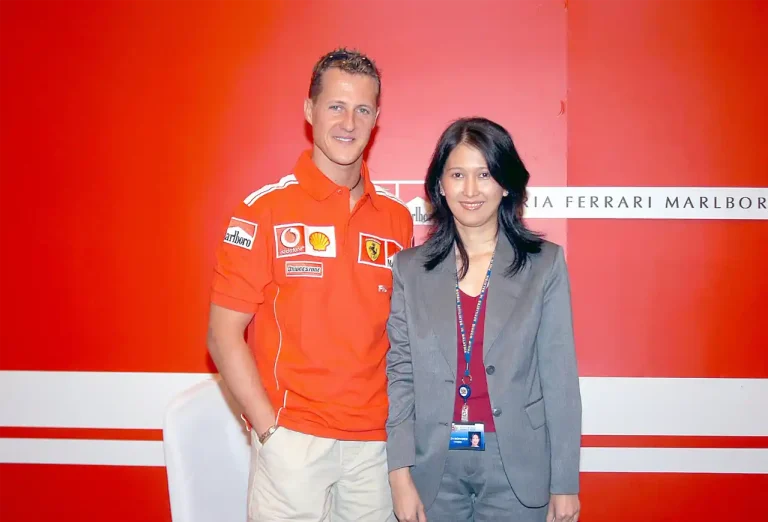
Fast forward ten years to March 2004. I was working in corporate communications for a multinational company associated with F1 when I had the opportunity to interview Schumacher ahead of the Malaysian Grand Prix in Sepang (pictured).
By then, he was a six-time world champion, arguably the biggest name in motorsport and a man whose reputation for discipline, precision and an almost clinical approach to racing preceded him.
I remember him walking into the auditorium surrounded by photographers, journalists and the inevitable entourage.
Dressed casually in a red polo shirt and khaki shorts, he was not particularly tall, but there was something unmistakable about his presence. He looked cool and elegant, almost prim and studious, although I must confess that one of the first things I noticed was his skin.
It was immaculate, glowing and beautifully tanned, perhaps from all those years racing around the world. Whatever the reason, he had the sort of complexion many of us would happily spend a small fortune trying to achieve!
What surprised me more, however, was his manner. Despite the commotion outside and his minders keeping a watchful eye on the clock, he was quick to sit down and get on with the interview. He was serious, certainly, but also polite, amiable and unexpectedly warm, quite unlike the arrogant and unemotional personality that some media portrayals had led me to anticipate.
We spoke about the new one-engine rule introduced that season, the pressure of maintaining his dominance, whether F1 was becoming less exciting because of his consistent victories, and how he managed to balance his professional commitments with family life.
When I asked whether he still found the sport challenging, he reminded me that every season was different and that he was fortunate to be part of a team with a fantastic atmosphere. As he told me: “This is the sport I love.”
On the subject of work and family, he was equally forthcoming. He acknowledged that the pressure was intense yet manageable and explained that his decision to move to Switzerland was partly motivated by a desire to maintain his family’s privacy.
Despite his extraordinary success and hectic schedule, spending time with his wife and two children remained important to him.
There were lighter moments too. He told me how much he enjoyed Langkawi, where he could holiday and ride around relatively unnoticed. When I asked whether he drove on public roads the way he raced on the circuit, he laughed and said he drove like “normal people”. I also ventured a question about women in Formula One, to which he jokingly suggested that perhaps I should give it a try!
I remember leaving that interview with a rather different impression of Schumacher from the one I had formed through years of watching him race and reading about him. What struck me was how remarkably modest he seemed, despite all that he had achieved, and how little he felt the need to reveal about himself.
Schumacher was intensely private, but that did not make him unfriendly or inaccessible, nor did his discipline and seriousness mean that he lacked warmth or humour.
He had spoken candidly about his family and the pressures of his profession. He was comfortable sharing certain things, but equally comfortable keeping others to himself. And therein lies a distinction we are increasingly inclined to overlook today.
Of course, Schumacher was hardly unique in managing his public persona. Politicians, corporate leaders and celebrities have always been selective about what they reveal, while corporations invest considerable resources in shaping and protecting their reputations.
But does greater openness necessarily lead to greater trust, or does it simply invite more questions? And where does legitimate public scrutiny end and the right to personal privacy begin?
Today, the rules of reputation management have changed almost beyond recognition. Anyone with a smartphone can become a broadcaster, commentator, critic or judge, and something as seemingly innocuous as a restaurant menu, an employee’s remark or an unfortunate photograph can become a national controversy before the organisation concerned has even understood what happened.
Public pressure has exposed misconduct, challenged discriminatory practices and forced institutions to confront issues they might otherwise have preferred to ignore.
Consumers and citizens now have greater power to hold organisations and public figures accountable, and that is surely a positive development.
But there is another side to this newfound power, because the public can also be an atrocious bunch. We demand answers before the facts are established, insist on apologies only to dissect their wording, and call for authenticity while showing remarkably little tolerance for human imperfection.
Once a narrative takes hold online, a few seconds of video stripped of context can turn a misunderstanding into an accusation and, before long, a verdict.
Every spontaneous remark, candid photograph or supposedly unguarded moment becomes something else for people to pick apart. And there is a delicious irony here: the more we demand authenticity from public figures, the more compelled they may feel to script it.
Silence can invite suspicion, yet responding too quickly without verified facts can make matters worse. An apology, however sincere, may invite another round of interrogation, while a mistake made years earlier can be resurrected and judged without regard for the circumstances in which it occurred.
We have become extraordinarily skilled at preserving evidence of people’s mistakes, but I am less convinced we are as willing to let them learn from those mistakes, let alone move on.
Which brings me back to Schumacher, and the contrast between the young driver I watched in the documentary and the man I met a decade later.
People are not static, but public perception has a peculiar tendency to freeze them in time. Someone labelled arrogant may struggle to be seen differently, while qualities once admired can become grounds for criticism as circumstances change.
Perhaps Schumacher understood something about public life long before the rest of us had to confront it. He knew that he could give everything to his sport without surrendering everything about himself.
Following his skiing accident in December 2013, his family has maintained a deeply guarded boundary around his private life and medical condition, despite enormous public interest.
That curiosity is understandable, but admiration does not confer ownership. The fact that millions of people care about someone does not necessarily entitle them to know everything about that person’s life.
In 2004, I met a man whose success had created an almost impenetrable public image. Yet he could laugh about driving like an ordinary motorist, enjoy the relative anonymity of Langkawi and speak warmly about his family.
Today, a new generation of drivers navigates a very different public landscape, where every remark, photograph and fleeting expression can be scrutinised and judged by millions of strangers online.
Somewhere along the way, we may have confused the right to hold people accountable with the right to know everything about them. After all, there is a difference between having something to hide and having something worth protecting.
And as for Schumacher, I ended the 2004 interview predicting that he would claim his seventh World Championship that year.
He went on to win the Malaysian Grand Prix at Sepang that very weekend, and later secured his seventh title. At least that was one prediction I got right!
The views expressed here are the personal opinion of the writer and do not represent those of Twentytwo13.