KUALA LUMPUR: Malaysia is home to numerous world-class archaeological heritage sites, including the Mulu and Niah Cave complexes, the Pinnacles in Sarawak, Bujang Valley and the ancient remains of Kedah Tua, the karst landscape of Langkawi Geopark, Mount Kinabalu Geopark and the Sipadan diving site.
All these sites fall under the jurisdiction of their respective state governments, which exercise sovereign rights over them and manage them with the assistance of the National Heritage Department under the Tourism, Arts and Culture Ministry. Consequently, their development and promotion as archaeological museums, educational facilities and tourist attractions depend largely on the initiative of the respective state governments.
However, in almost all cases, there has been little initiative to maintain and develop these sites as educational, cultural and economic assets. The authorities merely acknowledge their existence, showing little concern for their preservation and conservation. More alarmingly, there is no strategic planning to enhance their value as historical and cultural assets. Worse still, they are left exposed to the ravages of the elements and human encroachment.
Some state governments are also reluctant to promote or even acknowledge the historical, cultural and heritage significance of certain archaeological sites because of religious and political sensitivities. A case in point is the Chandi Batu Pahat archaeological site in Bujang Valley, which the Kedah government is reluctant to recognise as part of the ancient Hindu-Buddhist settlement known as Kedaram or Kedah Tua, which existed before the advent of Islam.
One wonders whether the state government is unwilling to promote the site because doing so would contradict its position that Islam was the original religion of the Malays.
Other lesser-known archaeological sites are no less important, yet remain obscure and receive little official attention. One such site is the Pengkalan Kempas Megalithic Complex, also known as Keramat Sungai Udang, near the town of Pengkalan Kempas in Port Dickson, close to the Linggi River.
A megalith is a large stone used to construct prehistoric structures or monuments, either singly or in combination with other stones. The word originates from ancient Greek and means “great stone”. Various terms are used to describe the different forms and shapes of megaliths:
1. Menhir – a single upright stone.
2. Dolmen – a stone table.
3. Cist – a stone coffin.
4. Alignment – megaliths standing upright in a row.
5. Waruga – a stone structure with a hole.
6. Monolith – a single large stone, usually column-shaped, as exemplified by the stones at Stonehenge.
These megaliths were erected by humans and served various purposes, including rituals to placate spirits, thanksgiving ceremonies, oath-taking and other religious and necromantic practices.
Megalithic culture is a prehistoric phenomenon found in various parts of the world. One of its oldest known examples is Gobekli Tepe, a UNESCO World Heritage site in northeastern Anatolia, Turkey, believed to date from between 10,000 BC and 8,000 BC. Another UNESCO World Heritage site, Ggantija in Malta, is believed to date from between 3,500 BC and 2,500 BC.
Megalithic culture is also found on mainland Southeast Asia, including the Plain of Jars in Laos, and in Peninsular Malaysia, as well as across the islands of the Malay world, including Sumatra, Java, Sulawesi, Borneo and the Philippines. The types of megaliths found in these regions include menhirs, dolmens, stone boxes, slab graves, waruga and punden berundak, among others. One of the oldest megalithic sites in Southeast Asia is Mount Padang in West Java, Indonesia, believed to be around 5,000 years old.
In Malaysia, megalithic culture dates from the Iron Age to the 18th century and is found in Negeri Sembilan, Kelantan, Selangor, Perak and Melaka. In Sabah, megaliths have been identified in Kota Belud, Tuaran, Keningau, Sapulut, Tenom and Tambunan. In Sarawak, they are found in Long Semadoh, Long Pulung, Long Punyao, Santubong, Bintulu and Batu Lintang in the Kelabit Highlands, including Bario.
The oldest megalithic site in Malaysia is located in Lembah Bernam (Bernam Valley), along the Selangor-Perak border. It comprises a slab grave believed to date from between 500 BC and AD 500. In Kelantan, there are three megalithic sites in Jenegar. Ten large, sword-shaped megaliths have also been found in Kampung Pulau Sebang, in southern Alor Gajah, Melaka.
Negeri Sembilan has the largest concentration of megalithic sites, particularly in the Terachi Valley (Lembah Terachi), where more than 280 sites have been identified, most of them on native customary land.
Of these, 126 sites have been surveyed, with a total of 4,223 megalithic stones recorded. The breakdown is as follows: Ulu Muar has 56 sites containing 1,640 megaliths; Terachi has 38 sites with 1,840 megaliths; and Jempul, Gong Pasir and Inas have 32 sites containing 743 megaliths.
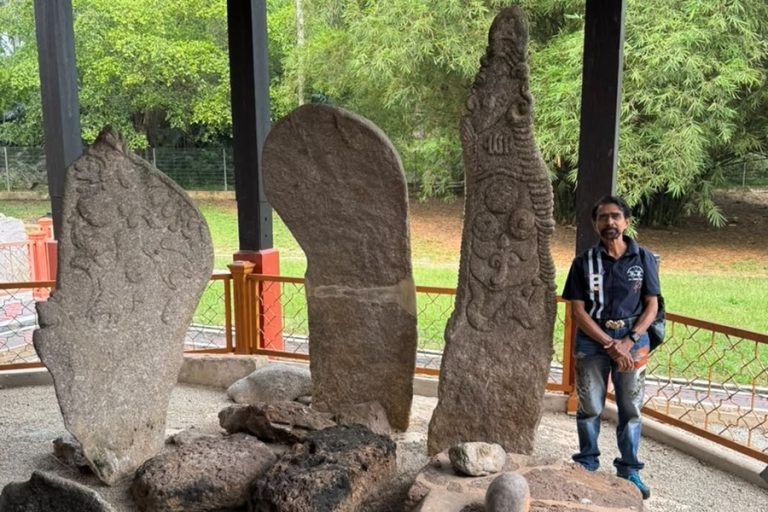
Although these megaliths are scattered across Negeri Sembilan, the focal point of this culture is the Pengkalan Kempas Historical Complex, also known as Keramat Sungai Udang, along Jalan Port Dickson in Pengkalan Kempas, near the Linggi River.
The complex houses three principal megaliths arranged in an alignment, several other individual stones and the tomb of Syeikh Ahmad Majnun, dating from the 15th century.
Its main attraction is the alignment of three megaliths shaped like a rudder, a sword (kris or dagger) and a spoon, estimated to be around 1,000 years old. The rudder and sword bear carvings, while the spoon is undecorated.
The sword-shaped megalith features carvings of a snake, animals, and sun and moon motifs, with the Jawi/Arabic inscription of Allah at the top. The combination of Islamic and Hindu motifs suggests the presence of both belief systems in the area, with Hinduism predating Islam. The rudder-shaped megalith features carvings of plants, the sun, a peacock and a horse, echoing the Hindu motifs on the sword-shaped stone.
Another attraction at the Pengkalan Kempas Historical Complex is the tomb of Syeikh Ahmad Majnun. He was a Muslim preacher and theologian who propagated Islam during the Melaka Sultanate. He died during one of his missionary journeys and was buried here in 1467-1468, making it the country’s oldest known grave site.
An intriguing account suggests that Syeikh Ahmad Majnun was accidentally killed by a local nobleman. Near the tomb, but separate from the three aligned menhirs, stands another megalith known as the Shield of the Saint. According to local belief, the megaliths are associated with Syeikh Ahmad Majnun and represent his sword, rudder, spoon and shield.
There are two sets of inscriptions on the tomb. One is in the ancient Javanese Kawi script, beginning on a slab on the northern side and continuing on another slab on the southern side. The other, in Jawi script, appears identically on the eastern and western sides.
The Kawi and Jawi inscriptions contradict each other. While the former portrays him as a traitor, the latter invokes Allah’s blessings upon his soul, reflecting his later veneration as a saint, or keramat.
The Pengkalan Kempas Historical Complex currently lacks proper promotion and marketing as an educational facility and tourist attraction. Unlike Bujang Valley’s Chandi Batu Pahat, the Mulu and Niah Cave complexes and Mount Kinabalu, the historical significance of the megalithic site and museum in Pengkalan Kempas remains largely unknown outside Negeri Sembilan. Many people are unaware of its existence, and even residents of the state may be unfamiliar with it.
Some local residents may also take these sites for granted, regarding megaliths scattered across villages in several luaks (districts) as mere rock formations. The Pengkalan Kempas Complex could be made more attractive and accessible by expanding it to house other megaliths found throughout Negeri Sembilan.
There is a general malaise in this country towards archaeological sites, with many locals regarding them as mere geomorphological features. This is compounded by state governments’ lackadaisical attitude towards archaeological heritage sites within their jurisdictions, stemming either from ignorance or reluctance to acknowledge their significance because of religious and political sensitivities, as in the case of Chandi Batu Pahat in Bujang Valley.
However, some states, such as Penang and Melaka, have taken positive steps to preserve and promote their heritage sites. Penang, for example, has restored Fort Cornwallis with the assistance of the National Heritage Department. Similarly, Melaka has preserved and promoted the Stadthuys and A Famosa as educational facilities and tourist attractions.
Despite the indifference shown by some states towards their heritage sites, the National Heritage Department continues to promote them as tourist attractions and educational facilities.
More could be done if the Federal Department of Heritage had greater control over these sites. Perhaps it is time to explore the possibility of placing all heritage sites under a single federal entity, much like the National Park Service in the United States, to ensure better management, preservation and promotion.
The obvious choice would be the Federal Department of Heritage. This would ensure that the heritage sites and their historical legacy, which form a significant part of Malaysia’s historical and cultural landscape, are preserved for future generations.
The views expressed here are the personal opinion of the writer and do not represent those of Twentytwo13.