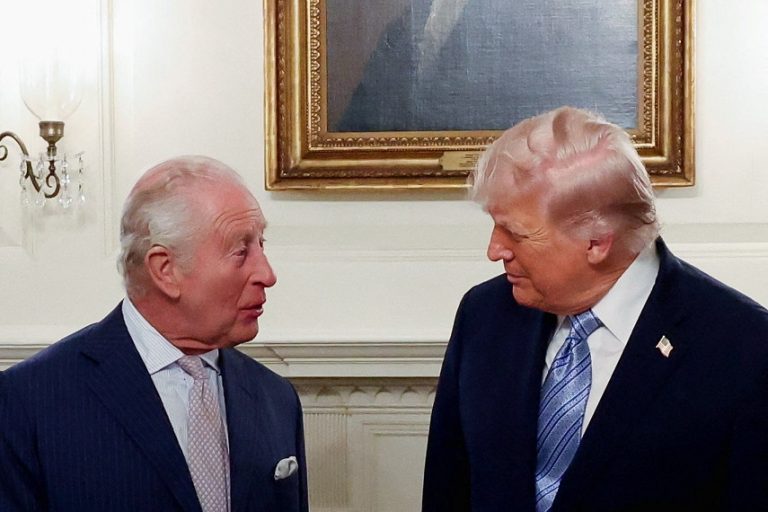
It is unprecedented that a monarch from an ancient lineage recently stooped before a man who acts like a mafia gangster to pay homage and curry favour.
What is more, the British monarch, during his visit to the White House last month, had to endure the abuse of protocols, courtly decorum, and etiquette that were breached by the United States President.
The intellectual and erudite gap between King Charles III and Donald Trump is reflected in their speeches. While King Charles’ speeches at the banquet and in the Senate were masterpieces of sarcasm, Trump’s were crude and shallow, absent of wit and insight.
Both leaders revelled in and celebrated their relationship and camaraderie in security, economy, geopolitics, and as allies in countless wars. But the sun has already set on the British Empire, while the American hegemonic agenda gained traction after World War II.
In their deliberations and speeches, there was no mention of the indigenous people of America, as if they never existed. American history, to them, began when Columbus discovered America, followed by the British sailing from England on the Mayflower to set foot on the terra nullius.
King Charles insinuated that the British were the first to colonise this land, followed by other European nations. And they brought civilisation to the savages, but he made no mention that these savages were the original indigenous owners of the land from whom the European settlers stole and against whom they committed atrocities and genocide to build the white American nation.
There were already tens of millions of indigenous people with their culture and history who had been there for thousands of years, with the Iroquois in the northeast, the Aztecs in the south, and the Cherokee in the southeast; around 500 native tribes lived in the Americas before Columbus arrived in 1492.
They had their own languages, laws, and medicines. The Haudenosaunee, also known as the Iroquois, practised a democratic form of government where people chose their own leaders. This Haudenosaunee system was studied by the whites and later formed the basis of their political system. They built a complex administrative set-up with schools and courts.
The city of Cahokia in modern-day Illinois had a larger population than London at the same time. The Pueblo people of the Southwest carved multi-storey buildings directly into the sides of cliffs, while the Amazons used farming techniques for agriculture. These were civilised people and not savages.
The Europeans called it the New World, terra nullius, but not so for the Indians, who had been there for centuries. They brought with them wars and diseases such as smallpox, measles, flu, and typhus that the natives had never encountered before; thus, they had no immunity.
Within 150 years, by the early 1600s, ninety per cent of the entire indigenous population was wiped out. Fifty million died of diseases.
From the East Coast, the European settlers – Spanish, Dutch, French, and British – pushed inland from the Atlantic. By the 1600s and 1700s, many tribes on the East Coast had been forced to sign treaties with the white settlers and were evicted from their ancestral lands or wiped out by diseases.
The Indian Removal Act of 1830 forced the Cherokee, Muscogee, Choctaw, Chickasaw, and Seminole to march 800 miles west in freezing winter storms with only the clothes on their backs in what is known in the Cherokee phrase as Nunna-da-ul-tsun-yi, meaning the path where they cried.
It is now referred to as the Trail of Tears, in which four thousand indigenous people perished.
Many eastern tribes were relocated to present-day Oklahoma and other western territories, while others in the west were put in reservations. Although the whites signed treaties with the Indians, which promised protection, land, and friendship, they reneged on them every time.
The treachery of the white European settlers is legion. They were only recognised as citizens by the white immigrants through the Indian Citizenship Act of 1924.
It is a fallacy and irony that the indigenous people who owned the land had to submit to the dictates of the immigrant administration, which confiscated the native lands through colonisation.
The whites tried to erase the identity of the indigenous people through massacre and genocide. They kidnapped indigenous children to be placed in boarding schools and mutilated their sacred long hair by cutting it. They banned their language to erase their identity.
The United States government made it a federal crime to be native. Their cultural expressions, dancing, singing, and praying were banned and made illegal through the Code of Indian Offences of 1883.
In 1800, the survivors were evicted from their homeland and marched into exile, while others were massacred in places like Sand Creek and Wounded Knee.
Today, they make up only 2.9 per cent of the United States population.
Hollywood painted the Red Indians as savages, evil, barbaric, and uncivilised while glorifying the white settlers as liberating the hostile lands of the west for the settlers.
It was never mentioned that the white European settlers confiscated the native lands, their tribal ancestral homes, and displaced and exterminated the Navajo, Cherokee, Choctaw, Sioux, Ojibwe, Apache, Blackfeet, Iroquois, and Pueblo, people of the First Nation.
In the ongoing effort to negate their existence, President Trump wanted to erase native history at Little Bighorn, where Custer and the 7th Cavalry were defeated by Lakota Indians, Northern Cheyenne, and Arapaho warriors in 1876.
The site only tells Custer’s story and is called Custer Battlefield National Monument. Trump planned to remove any remaining Native American signs and monuments at the Little Bighorn Battlefield.
Thus, King Charles and President Trump would only acknowledge the existence of the American nation after the European settlers set foot on what they referred to as terra nullius, negating the existence of the indigenous people.
The memories of the First Nation would be consigned to lore and legend that would eventually fade into oblivion and be erased forever from American history and memory.
The views expressed here are the personal opinion of the writer and do not represent that of Twentytwo13.