Malaysian police have arrested 31 men, including a 17-year-old student who earned RM76,000 from distributing child sexual abuse material online, in what authorities say is the country’s biggest operation yet against internet-based child exploitation.
The arrests come in the wake of rising public concerns over crimes involving students, including the recent fatal stabbing of a 16-year-old girl by a 14-year-old schoolmate in Bandar Utama, Petaling Jaya, Selangor, and the alleged gang rape of a Form 3 student at a school in Alor Gajah, Melaka.
Police said the sharp rise in seized material, along with the involvement of minors and educated professionals, reflects the growing scale and complexity of online child exploitation in Malaysia.
The findings also indicate that such crimes are becoming more organised and financially motivated, requiring closer cooperation between enforcement agencies and stronger digital forensic capabilities.
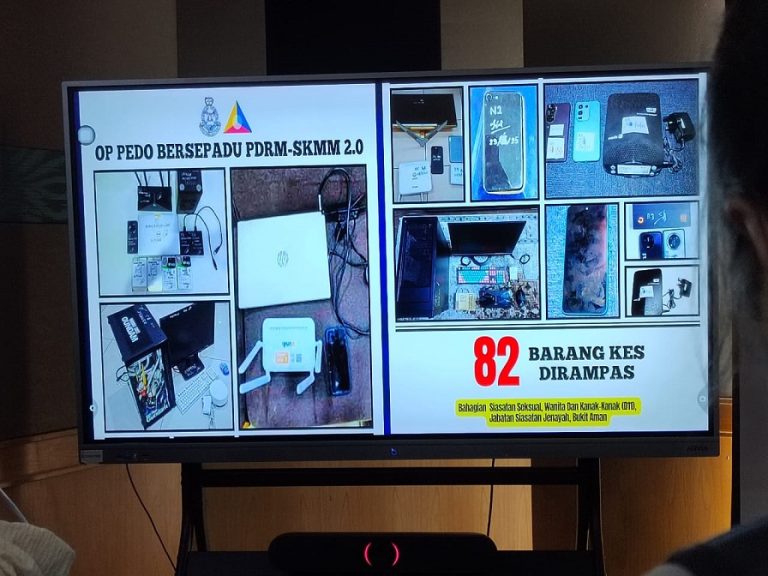
The arrests were made under Op Pedo Bersepadu 2.0, a joint operation between the Royal Malaysia Police and the Malaysian Communications and Multimedia Commission, carried out from Sept 22 to 30 at 37 locations nationwide.
Investigators seized 82 digital devices containing more than 880,000 files believed to include child sexual abuse material and adult pornography of local and foreign origin.
Police said the amount marked a twentyfold increase from Op Pedo 1.0 conducted in December 2023, which uncovered about 40,000 digital files.
Inspector-General of Police Datuk Seri Mohd Khalid Ismail said the operation followed months of digital surveillance, intelligence analysis and cooperation with foreign enforcement agencies and public informants.
“This type of crime is becoming increasingly alarming each year as it not only threatens the safety and wellbeing of children but also undermines social harmony and could trigger other violent crimes that endanger national security,” he told a press conference in Kuala Lumpur today.
The 31 suspects, all men aged between 12 and 71, included 30 Malaysians and one Indonesian national. Police said six of them were under 18. The group came from diverse backgrounds, including teachers, engineers, graphic designers, cooks, students and the unemployed.
Police said 17 individuals have been charged under Malaysia’s Sexual Offences Against Children Act 2017 and the Penal Code. Fifteen pleaded guilty and were fined between RM1,000 and RM10,000, while two others are contesting their charges in court. Fourteen others were released on bail pending further investigation.
According to police, some of the suspects acted as administrators of Telegram groups that distributed child sexual abuse material. Access to the content was sold using digital wallets and QR-based banking platforms such as e-wallet and Touch ’n Go, with individual materials priced as low as RM30.
On the 17-year-old suspect, Khalid said financial records showed transactions totalling RM76,000 between January and September this year, suggesting an emerging pattern of commercial activity linked to the online distribution of child sexual abuse material.
He said the investigation revealed that offenders used various platforms, including Telegram, WhatsApp, Facebook, Instagram, Tumblr, the dark web and cloud storage services to obtain and share the content.
Khalid described the increase in file volume as “drastic” and said it had created challenges in handling and storing digital evidence.
“The exponential rise in such material requires stronger forensic capabilities and better infrastructure,” he said.
Police opened 29 investigation papers under several laws, including Section 8 and Section 10 of the Sexual Offences Against Children Act for selling, buying or possessing child sexual abuse material; Section 292 of the Penal Code for distributing obscene content; and Section 6(1)(c) of the Immigration Act for individuals without valid travel documents.
Khalid urged parents and guardians to monitor children’s use of electronic devices and social media, and to strengthen awareness of digital safety at home.
“This is not only a law enforcement issue but also a social responsibility. Families and communities must take steps to protect children from online risks,” he said.