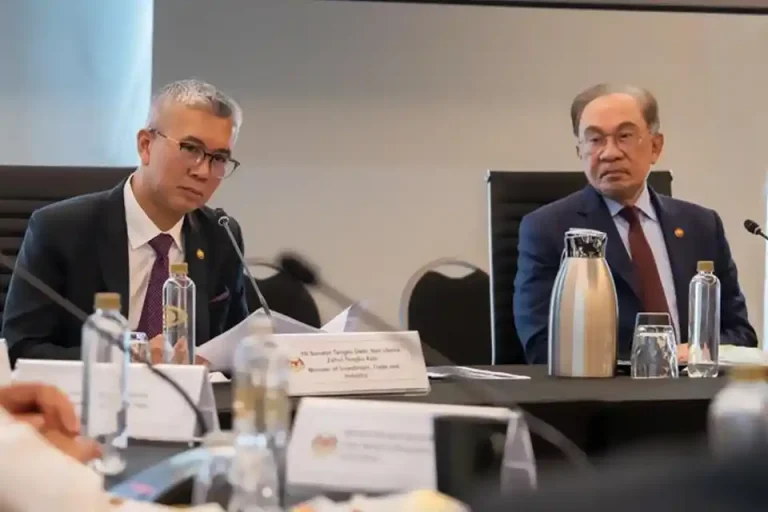
KUALA LUMPUR: Datuk Seri Anwar Ibrahim yesterday named former Investment, Trade and Industry minister Datuk Seri Tengku Zafrul Tengku Abdul Aziz as his senior political adviser.
The move, however, has raised more than a few eyebrows as the appointment appears to be an audacious gamble by the prime minister.
His appointment comes following the departure of Datuk Seri Shamsul Iskandar Mohd Akin, Anwar’s former senior political secretary who resigned from the position on Nov 25. Shamsul is facing five counts of corruption totalling RM241,753.03 involving the approval of mineral exploration licences in Sabah.
While some claim Tengku Zafrul’s corporate pedigree is undisputed, his elevation to a senior political role is rather dumbfounding.
Fact is, he lost in the general election and yet managed to serve three different governments while not being “active” in politics, and is now also said to be eyeing the Ampang parliamentary seat in the next general election.
For Anwar, who built his career on the reformasi movement, the optics of hiring a political novice who lacks a popular mandate could be interpreted as a step away from the very grassroots Parti Keadilan Rakyat (PKR) represents.
The technocrat without a base
Tengku Zafrul’s political journey is an anomaly in the Malaysian landscape. Unlike some of his former peers in the Cabinet who climbed the greasy pole of party politics, Tengku Zafrul was “parachuted” into the Finance Ministry in 2020 under a technocrat ticket during Tan Sri Muhyiddin Yassin’s administration.
His subsequent foray into electoral politics in the 15th General Election in 2022 ended in defeat in the Kuala Selangor parliamentary seat.
Traditionally, such a loss usually signals a retreat to the private sector. But not for Tengku Zafrul – he returned to the Cabinet as a Senator – a “backdoor” entry critics say was a bypass of the will of voters.
By naming a man who was unable to win a seat as a “Senior Political Adviser”, Anwar risks alienating members of his party, including those at the grassroots.
It simply makes no sense having a failed politician advising a seasoned leader about politics.
Political analyst Associate Professor Dr Azeem Fazwan Ahmad Farouk said the move could also be seen as a way to familiarise Tengku Zafrul with the PKR base, as he only joined the party in August 2025.
“Tengku Zafrul became a PKR member seven months ago after leaving Umno. He is considered a fresh face and needs to connect more with the grassroots to build his base.
“That could then pave the way for him to contest a parliamentary seat in the 16th general election,” said Azeem, director of Universiti Sains Malaysia’s Centre for Policy Research.
Azeem said while Tengku Zafrul may not be a seasoned politician, he is a technocrat who brings a wealth of experience to PKR, which has faced some internal turbulence following Datuk seri Rafizi Ramli’s resignation as economy minister.
Royal connection: Asset or liability?
Perhaps the most potent element of Tengku Zafrul’s profile is his perceived proximity to Malaysia’s royal houses. Tengku Zafrul has deep-seated ties with certain members of the royal families, often leading to the perception he serves as a bridge between Putrajaya and the palaces.
Some also call him the “royal messenger” who is able to smooth over frictions between the executive and the monarchy.
His position as such could be viewed as a vital diplomatic tool.
Unease within the government
Tengku Zafrul’s recent jump to PKR after resigning from Umno has already created internal friction within the party.
Party loyalists, many of whom spent years in the political wilderness, view the “banker-turned-politician” with suspicion.
Some also view him as a queue-jumper. Senior PKR leaders who have “paid their dues” may resent a newcomer being handed a top-tier advisory role.
Unlike true-blue PKR loyalists, Tengku Zafrul represents the neoliberal, corporate elite – a stark contrast to PKR’s traditional focus on justice, social reform and wealth distribution. This ideological clash does not resonate well.
What can Tengku Zafrul actually offer?
Despite the criticisms, Tengku Zafrul brings a specific set of skills that Anwar clearly values.
He presided over record-breaking investment figures (RM378.5 billion in 2024) during his time as Investment, Trade and Industry minister.
Having served under three different prime ministers (Muhyiddin, Datuk Seri Ismail Sabri and now Anwar), Tengku Zafrul is a master of survival and bureaucratic navigation.
While his appointment as senior political adviser to the prime minister may seem odd, some say it was only a matter of time before he was given the “elevation”.
After all, his recent appointment as Malaysian Investment Development Authority chairman may not have been the elevation “worthy” of a former Cabinet minister, whose term was simply cut short after his term as senator expired.
But will Anwar pay the price for this sophisticated economic diplomat?
The long-term cost may be the erosion of Anwar’s reformist credentials. By bypassing elected representatives to favour a technocratic ally, Anwar’s actions may test the patience of his supporters.
Ultimately, unlike before, Tengku Zafrul’s role is no longer just about “the numbers”.
He must now prove he can navigate the murky waters of Malaysian politics without drowning the very administration that threw him a lifeline.