
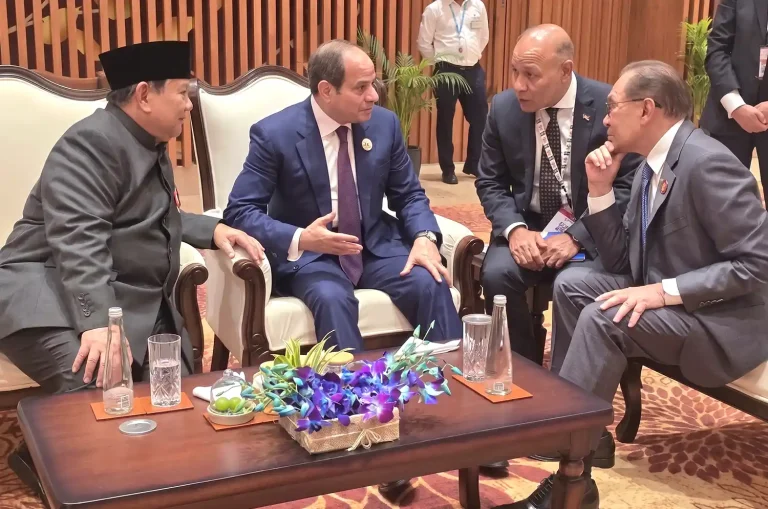
One of the most revealing moments at the 18th BRICS Leaders’ Summit in New Delhi may not have taken place in the plenary hall. It happened over dinner.
On Sept 12, Malaysian Prime Minister Datuk Seri Anwar Ibrahim and Indonesian President Prabowo Subianto pulled aside for a brief, 20-minute conversation. They discussed haze and forest fires, the war in West Asia and Gaza, and a long-delayed bilateral visit.
On the surface, it was routine diplomacy. Geopolitically, it was anything but.
The significance was not simply that the leaders of Southeast Asia’s two largest economies met. It was where they met: India, at a BRICS summit rather than an Asean gathering.
The setting captured something increasingly important about Asian diplomacy. Southeast Asian states are no longer content to navigate the world only through Asean. They are building parallel channels of influence that are pragmatic, flexible and deliberately non-exclusive.
That is not the abandonment of Asean centrality. It may be how Asean centrality survives.
Delhi was more than a BRICS Summit
India’s choice to host the summit under the banner of resilience, innovation, cooperation and sustainability reflected a changing BRICS.
The grouping that began with Brazil, Russia, India, China and South Africa has expanded into a broader coalition of emerging and middle powers. Indonesia has joined as a full member, while Malaysia is participating as a partner. Other Asian and Middle Eastern countries have added further weight.
The result is a BRICS that is increasingly Asian in population, economic weight and political influence.
That matters for Southeast Asia. For years, Asean governments have sought room to manoeuvre between competing major powers without being forced into rival camps. But the strategic environment is becoming less forgiving. US-China competition is hardening. Trade is fragmenting. Supply chains are being reorganised. Conflicts in Europe and the Middle East are reshaping energy, food and security calculations.
Remaining outside every emerging grouping is no longer a strategy. It is a constraint.
Indonesia’s membership and Malaysia’s partnership give Southeast Asia something it has long needed: additional diplomatic platforms without requiring formal strategic alignment. The Anwar-Prabowo conversation illustrated how this can work.
From symbolism to substance
The haze issue is a good example.
For Malaysia, transboundary haze is not an abstract environmental concern. It affects public health, tourism, aviation and domestic politics. For Indonesia, the fires are tied to land management, enforcement, agriculture and the difficult politics of development.
Previous efforts have often been pushed down to bureaucratic and ministerial levels. A direct conversation between the two leaders signals that Jakarta and Kuala Lumpur understand the issue requires political ownership.
If followed by a presidential visit and concrete agreements on prevention, enforcement and joint monitoring, the Delhi conversation could turn a perennial irritant into a test case for practical regional cooperation.
The same logic applies to Gaza and the wider West Asian crisis.
Malaysia and Indonesia have consistently supported the Palestinian cause and possess considerable diplomatic weight in the Muslim world. Both are members of the Organisation of Islamic Cooperation and have sought to position themselves as voices of the Global South.
Separately, their influence is limited. Together, it is harder to ignore.
A coordinated Malaysian-Indonesian position can be carried simultaneously into Asean, the OIC, the United Nations and BRICS. That creates a diplomatic multiplier, particularly as developing countries increasingly object to having global conflicts framed solely through the priorities of major powers.
Then there is the bilateral relationship itself.
Anwar’s renewed invitation for Prabowo to visit Malaysia may sound like diplomatic courtesy. It is more important than that. Malaysia-Indonesia ties contain unresolved issues ranging from maritime boundaries and migrant workers to trade, palm oil and the digital economy.
The relationship is too important to be allowed to drift.
A substantive visit could provide the political push needed to move several of these issues from bureaucratic management to strategic cooperation.
Asean is learning to operate beyond Southeast Asia
The most important lesson from Delhi is not about BRICS alone. It is about the evolution of Asean diplomacy.
Asean has always depended on consensus. That is both its strength and its weakness. Consensus prevents the organisation from being captured by any one member or great power. But it can also make collective action painfully slow when members have sharply different interests.
That does not mean Asean is becoming irrelevant. It means its members are learning to supplement it with other channels.
Indonesia can work through BRICS. Malaysia can work through its BRICS partnership. Both can engage the G20, the OIC, the United Nations and a growing web of minilateral arrangements. None of this requires abandoning Asean.
Indeed, it can strengthen Asean by giving individual member states greater leverage before they return to the regional table.
This is a distinctly Asian form of hedging: not choosing sides, but accumulating options.
Malaysia and Indonesia as middle-power axis
There is another reason the Anwar-Prabowo meeting deserves attention.
Together, Malaysia and Indonesia represent roughly 350 million people and two of the world’s most important Muslim-majority societies. They are democracies with substantial diplomatic networks and strategic positions astride some of Asia’s most important trade routes.
Neither wants to become an extension of a great power.
Malaysia needs strong economic ties with China while deepening its semiconductor and technology relationships with the United States and other advanced economies. Indonesia is pursuing industrial downstreaming, food and energy security, and defence modernisation while simultaneously seeking investment from both Washington and Beijing.
Their interests are not identical. Their diplomatic styles are different. But they share a central strategic instinct: keep their options open.
That makes their relationship potentially more important than another formal grouping.
The emerging Malaysia-Indonesia axis is not an alliance. It is not directed against China, the United States or anyone else. Its value lies precisely in its flexibility.
When two major Southeast Asian states coordinate on issues of shared concern, they demonstrate that the region is not merely an arena in which larger powers compete. It is an actor in its own right.
BRICS has been Asianised
The same principle explains why Asia now matters so much to BRICS. The original BRICS was often described as a coalition of emerging powers challenging Western dominance. That description is increasingly inadequate.
With China, India, Indonesia, Iran and the UAE among its Asian members, BRICS now possesses enormous Asian economic and strategic weight.
China provides manufacturing scale and supply-chain power. India contributes technology, services, a huge consumer market and diplomatic reach across the Global South. Indonesia brings Asean influence, critical minerals, agriculture and maritime geography. Iran brings energy and access to the Middle East. The UAE adds finance, logistics and connectivity.
Together, these countries give BRICS something it previously lacked: a dense network connecting manufacturing, finance, energy, commodities and maritime trade.
That makes the organisation more than a political talking shop.
But Asia’s dominance also imposes a limit.
India and China compete strategically. Iran and the UAE have different regional interests. Southeast Asian states generally favour consensus and strategic ambiguity, while some BRICS members are more comfortable with confrontation.
The solution is pragmatism.
Asian members have little interest in turning BRICS into a rigid anti-Western bloc. India, Indonesia, Malaysia and the UAE, in particular, have strong incentives to maintain relationships with Washington, Brussels and other Western capitals.
Their objective is not to replace one hierarchy with another. It is to create more room between them.
That is why the language of reform – of the international financial system, global institutions, trade rules and development finance – is more useful than the language of confrontation.
Real message from Delhi
Three developments will reveal whether the Delhi conversation was more than diplomatic theatre.
First, will Prabowo make the long-awaited visit to Malaysia, and will it produce concrete agreements rather than ceremonial statements?
Second, will Malaysia and Indonesia coordinate more systematically across BRICS, Asean, the OIC and the United Nations?
Third, will their shared position on Palestine evolve into sustained diplomatic action rather than parallel declarations?
Those answers matter because they will indicate whether Southeast Asia is merely participating in the new multipolar order or beginning to shape it. That is the larger story of Delhi.
The summit may have been formally about BRICS, de-dollarisation, technology, development and multipolarity. But its deeper significance was the emergence of a world in which middle powers are increasingly refusing to wait for great powers to define the agenda.
The 20-minute conversation between Anwar and Prabowo captured that shift.
They did not meet to create an alliance. They met to address problems: smoke crossing borders, a war far from Southeast Asia, and a bilateral relationship that needs renewed political attention.
That is what 21st-century Asian geopolitics increasingly looks like. Not blocs for the sake of blocs. Not a new Cold War.
Networks. Options. Partnerships. And middle powers quietly building influence wherever they can.
BRICS began with a question about whether the emerging world could challenge the established one.
In 2026, the more interesting question is different: What happens when Asia stops merely responding to the world and starts shaping it?
The answer may have been visible in Delhi, not on the summit stage, but around the dinner table.
The views expressed here are the personal opinion of the writer and do not represent that of Twentytwo13.
Image: Anwar Ibrahim / Facebook


