

“Why do you want to interview me? I’m so insignificant.”
Those were the first words uttered by Cheah Tong Kim – the man who etched his name in Malaysia’s sporting history when he became the first swimmer from Ipoh to represent the country at the Olympics.
Born in Ipoh on July 29, 1945, Cheah turned 80 last Tuesday, surrounded by friends at his ‘home’ – the Home for the Aged Simee Care Centre in Ipoh, Perak.
The home, which turns 75 in two years, takes in residents who have no family members.
Playing down his achievements, Cheah said he never won medals at any of the multisport events – the Southeast Asian Peninsular (SEAP) Games, Asian Games, or Commonwealth Games. But during his career, he was Malaysia’s best breaststroke swimmer.
Besides the 1964 Olympics, where he was the lone ‘Malaysian’ in a team dominated by Singapore-born swimmers, Cheah also competed in two Asian Games – Jakarta, Indonesia (1962), and Bangkok, Thailand (1966) – and the 1966 Commonwealth Games in Kingston, Jamaica.
Despite his lack of medals, Cheah’s journey from the streets of Ipoh to the Tokyo 1964 Olympics is a testament to the spirit of perseverance, passion, and love for sport.
From street football to the swimming pool
Cheah was a late bloomer in swimming, as he was too preoccupied with football in his youth.
“I wasn’t a great player. But since I owned the ball, the others let me play,” Cheah joked during an interview with Twentytwo13 in Ipoh on Aug 1.
“We used to play everywhere we could – school fields, by the roadside, or on the street. That was how we passed our time back then.”
When Cheah was 12, he decided to visit the famous Kinta Swimming Club and discovered a new talent.
Pretty soon, he was going to the pool every day and found it more rewarding than football. He, however, didn’t know how good he was until a swimming coach, John Lee from St Michael’s Institution, noticed him.
“He was the one who encouraged me to take up swimming seriously. I was hesitant at first. Most swimmers take up the sport when they are six or seven years old. I was 12, going on 13, and I wasn’t sure I had it in me,” recalled Cheah with a wry smile.
“But with John’s help, I trained every day, and soon became quite good in breaststroke.”
In 1962, Cheah’s school, Anglo-Chinese School (ACS) Ipoh, built a swimming pool, but he decided to continue training at Kinta Swimming Club.
“Over the years, the squad became like a family. We didn’t care that we came from rival schools. We bonded over our love for swimming,” said Cheah, the second in a family of three boys and one girl.
“It has been over 60 years, but I’m still friends with some of them – those who are still alive, that is!
“We used to go for a drink before training and then have roti canai afterwards. In those days, 10 cents was enough for a quick bite.”
Olympic inspiration
Cheah’s swimming career received a boost when Lee attended a coaching course in the United States, where he learned about the technique of 1960 Olympic gold medallist Anita Lonsbrough, who used shorter strokes.
“When Lee returned from his course, he introduced the new technique to me. It suited me perfectly. I can’t recall the year, probably just after the 1960 Olympics or a year later.
“The new style helped me become the best breaststroke swimmer in Malaysia,” said Cheah proudly.
“I won several local meets, and that eventually paved the way for me to be selected for the 1964 Olympics.”
Cheah’s biggest regret, however, was missing out on the 1962 SEAP Games, where he believed he had a good shot at winning a gold medal.
“I didn’t attend the trials as I was preparing for my Form Five examinations, but I did make the Asian Games squad that same year,” he said.
“Part of me wishes I had gone for the SEAP Games, but I always valued education. I eventually passed my examinations and went on to earn a Bachelor of Arts.”
Star-struck
Cheah was then selected for the first Olympics to be held outside of Europe or the Americas. Other members in the Malaysian team were Tan Thuan Heng, who swam in every distance possible from the 100m up to 1,500m, Michael Eu, Bernard Chan (men), and Jovina Tseng, Marny Jolly, and Molly Tay (women).
The trip to Tokyo was only Cheah’s second outside of Malaysia. The first was the Jakarta Asian Games.
“Malaya had competed in two Olympics – 1956 in Melbourne and Rome four years later – but this was Malaysia’s first since its formation in 1963,” recalled Cheah.
“I was the only ‘real Malaysian’ in the team, as the others were from Singapore – before the country broke away in 1965.
“It was a proud moment for me as I was the first swimmer from Ipoh to represent the nation at the Olympics.”
Cheah was part of the 4x100m medley team that finished seventh in the heats with a time of four minutes, 29.3 seconds. The other members of the relay were Chan, Eu, and Tan.
While he didn’t win a medal in Tokyo, Cheah struck gold when he met many of his idols at the Games Village.
“All of us stayed in the same athletes’ village. They never heard of any of us, but I knew all the big names at that time,” he said with a wide grin.
“I went around hunting for autographs. The Americans – men and women – were extremely friendly.
“I got the signature of many swimmers, but the one I cherish the most is that of three-time women’s 100m freestyle champion Dawn Fraser.”
The Australian is one of only four swimmers – Hungary’s Krisztina Egerszegi and Americans Michael Phelps and Katie Ledecky – to win the 100m freestyle event at three consecutive Olympics.
“Dawn was very friendly. I believe she could have won a fourth gold medal in 1968 if not for her suspension for alleged indiscipline,” said Cheah.
“Taking part in the Olympics was a surreal experience. I never imagined I would be there, starting from swimming in Kinta Swimming Club in Ipoh, and then competing at the Olympics.”
Family values
A lifelong bachelor, Cheah said he never found true love, although he had “many girlfriends”.
“I courted a few girls, but couldn’t find a life partner. If I had married and had kids, I wouldn’t be here in Simee, which I consider my last stop on earth,” he said with a laugh.
“My brothers Tong Giin and Tong Meng were also bachelors and have passed on. My younger sister Yean Kean is living in Canada.
“She did ask me to join her there, but it is too cold. So, I’m all alone here. I’m grateful to have a place to call home.”
Cheah said his father, Cheah Meah Liang, was a tin miner who came from China to seek his fortune.
“He settled down and married my mother, Neoh Poh Siew, who was from Teluk Intan. They taught us the importance of hard work and discipline,” said Cheah.
“My father was hardworking. He always told us that we needed to always give 100 per cent in everything we do.
“I became successful because of my parents. My brothers and sister also dabbled in sports, but I was the lucky one to represent the country.”
Lifelong friendship
Cheah received several visitors for his 80th birthday. A few of them were from his swimming team, some were his former students and others from the Toastmasters and YMCA, where he was an active member.
There was another celebration the day Twentytwo13 visited him on Aug 1, courtesy of well-wishers.
“I was a salesman after graduating, but also worked as a teacher for six years in a private school in Ipoh. Unfortunately, that school is no more,” said Cheah.
“I also kept in touch with friends from the YMCA and Toastmasters. I’m grateful that many visitors wished me well for my birthday. I have gone out for dinner several times as the home doesn’t restrict the residents’ movements – provided they can move around without assistance.
“I try to keep as active as possible. It is always important for the elderly not to let their minds go to waste.”
A gift to the nation
When Cheah moved into Simee Care Centre, he had to give away many of his possessions, as the home only gave him two lockers. He donated several of his suits to his alma mater and brought minimal items with him.
Cheah, however, kept his prized possession – the autograph book from the 1964 Olympics.
“It has followed me everywhere since then, but it’s time to let go of it,” said Cheah.
“Do you want it?”
When it was suggested that he donate it to the Olympic Council of Malaysia’s museum, Cheah immediately agreed.
“That would be perfect.”
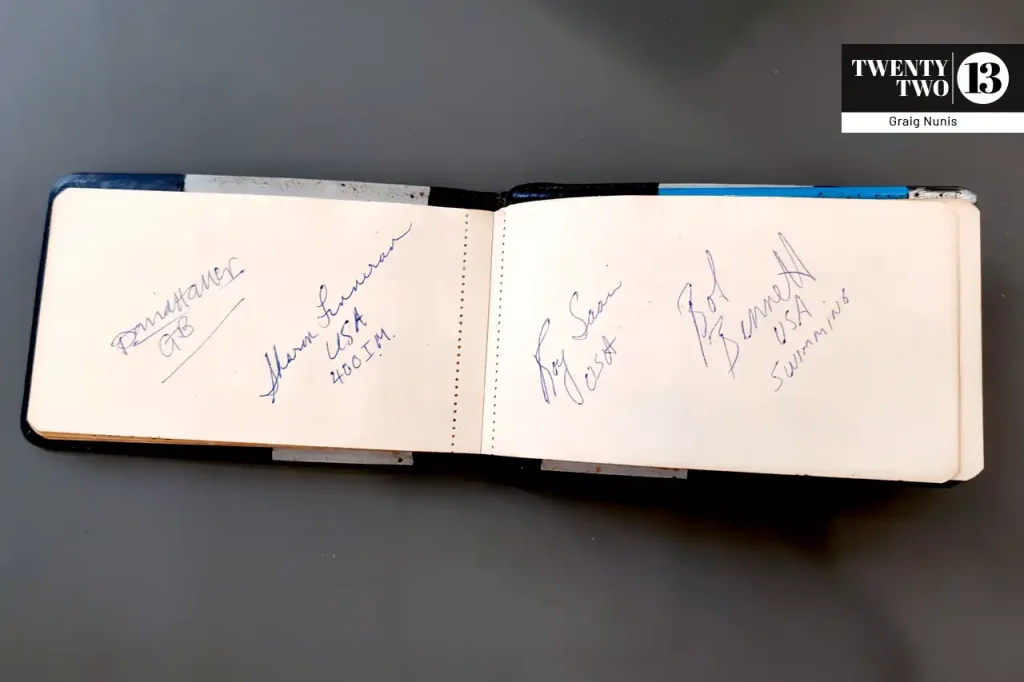
Some of the autographs Cheah collected at the 1964 Olympics.
OCM president Tan Sri Norza Zakaria welcomed the gesture and said he would arrange for the book to be displayed in the museum.
Life beyond 80
Cheah admitted his memory is slowly fading and he is blind in one eye, but said he was happy to relive his past glories one last time.
“I’ve had a good life. Eighty is a good number. I don’t want to live to 100 like our former prime minister (Tun Dr Mahathir Mohamad),” he said.
“I may not have won medals at the highest level, but I hope my story can inspire young swimmers.
“If I had one wish, it is for every school to have a swimming pool so that we can have, pardon the pun, a bigger pool of talent to choose from,” he added with a mischievous grin.
Cheah is more than an Olympian. His journey from Kinta Swimming Club to the Olympics continues to inspire. He may have been a late starter, but his name is forever in Malaysia’s sporting history.
Main image: Cheah Tong Kim shows the autograph he received from Dawn Fraser at the 1964 Olympics.


