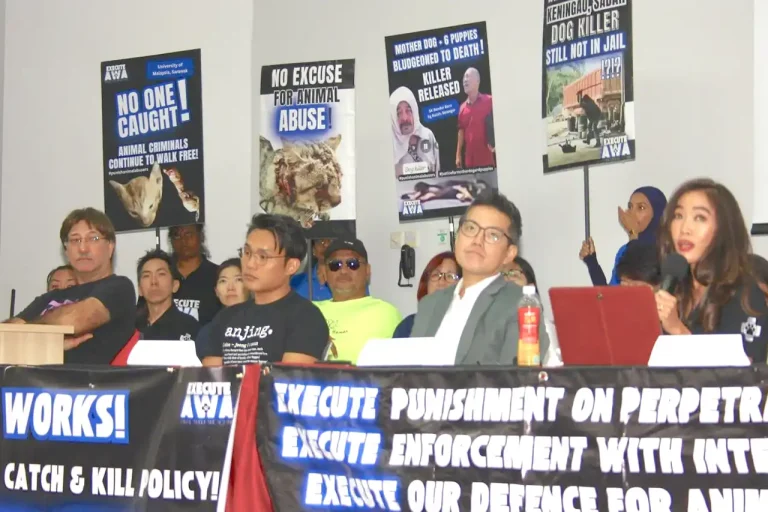
KUALA LUMPUR: Malaysia’s long-standing stray animal problem can be addressed without culling if the government adopts an evidence-based framework that has already been developed and tested, animal welfare group ExecuteAWA says.
The group is urging Putrajaya to move away from culling operations, which it says have repeatedly failed to reduce stray populations, and instead adopt a national programme backed by scientific research and practical implementation.
Speaking to Twentytwo13, ExecuteAWA said it had wanted to present its proposal to the relevant animal welfare authorities, and is awaiting for a formal response.
“We’ve been engaging with various government agencies since last year, and we have the data to show that culling does not work. The programme is already in place. The government doesn’t have to start from scratch,” said ExecuteAWA founder Sue Ann Kong.
Kong’s call comes in the wake of an alleged animal abuse case in Klang on July 29, where a dog named Rocky was allegedly beaten, strangled and dragged to death.
“Enough with performative statements after another animal suffers an unimaginable death during culling operations by local authorities.
“It’s easy to make statements, but where is the genuine action? Where is the commitment to turn evidence into solutions?”
Kong said the stray dog operation in Taman Teluk Gedung Indah, Klang, on July 29, which left one dog dead, exposed systemic failures in preventing animal cruelty, enforcing accountability and protecting vulnerable animals.
S. Roghini Devi, who claimed to be Rocky’s owner, told a press conference yesterday that she repeatedly pleaded with those who had caught the dog to remove the snare and offered to surrender Rocky to the Royal City Council of Klang, but those involved refused.
She also alleged she was struck with a wooden stick while trying to free Rocky, and that her child was prevented from cutting the snare.
Following the incident, Klang mayor Datuk Abd Hamid Hussain said the stray dog operation involved 11 enforcement personnel and 50 residents, and was conducted in accordance with the standard operating procedures issued by the Housing and Local Government Ministry.
The incident also prompted a response from the Tengku Permaisuri of Selangor, Tengku Permaisuri Norashikin, who expressed sadness, disappointment and anger, and urged the federal government to review penalties under the Animal Welfare Act 2015 to strengthen enforcement against animal cruelty.
“The incident is another data point in a pattern of systemic failures that continue to produce predictable outcomes: failed governance, the absence of justice, short-sighted stray population management, ineffective public education and disconnected inter-agency coordination,” Kong said.
While public outrage is understandable, she said lasting reform requires a national strategy driven by data, research and scientific methods.
“We want to present our research, governance analysis and preventive frameworks, demonstrating why evidence-based stray population management is more effective than repeated culling operations. We are offering a blueprint for change, and we hope the authorities will hear us out.”
Kong said ExecuteAWA was established not only to document tragedies but also to identify systemic failures and provide authorities with evidence-based solutions.
Its Projek Together Boleh initiative brings together government agencies, NGOs, veterinarians, corporate partners and communities to implement ExecuteTNVRM (Trap, Neuter, Vaccinate, Rehome, Reclaim, Release, Microchip and Manage) through a coordinated national approach.
Built around ExecuteAWA’s population model, the programme focuses on addressing the root causes of stray overpopulation instead of relying on repeated culling.
“The data has been collected. The gaps have been identified. We already have a practical framework ready for implementation.
“Professionalising animal welfare requires more than compassion. It requires objectivity, scientific methodology and political will,” Kong said.
“ExecuteAWA respectfully invites the federal government, state governments, the Department of Veterinary Services and local authorities to move beyond discussion and adopt proven solutions.
“The next chapter of Malaysia’s animal welfare governance depends on whether we continue managing consequences or finally address the root causes.”