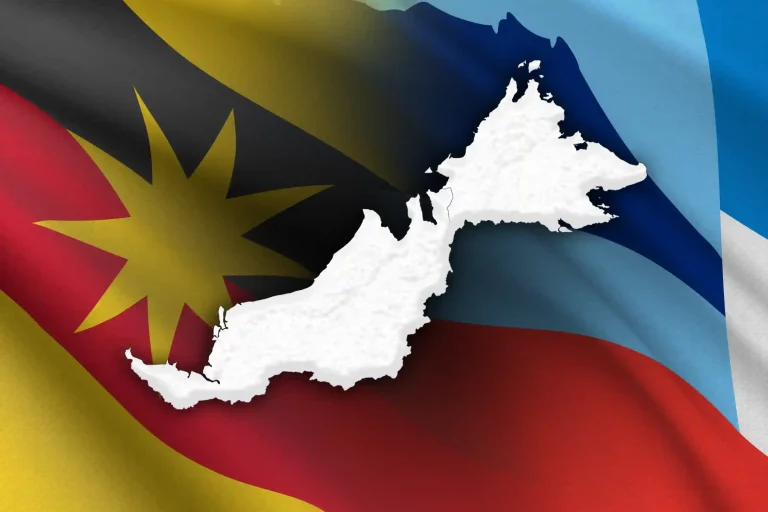
For much of Malaysia’s post-independence history, conventional wisdom treated East Malaysia – Sabah, Sarawak and Labuan – as quiet and reliable political strongholds.
Political commentators and coalition strategists routinely described the Borneo states as the nation’s “fixed deposits” – stable, predictable reservoirs of parliamentary seats that could be relied upon to support whichever coalition dominated Peninsular Malaysia.
That era, however, has decisively ended.
As Malaysia moves towards its 16th General Election (GE16), expected in late 2026 or 2027, East Malaysia is no longer merely an electoral insurance policy for power brokers in Putrajaya. Instead, the 57 parliamentary seats from Sabah, Sarawak and Labuan have emerged as decisive kingmakers in an increasingly fragmented political landscape.
The arithmetic of a hung Parliament
This transformation is not simply the result of recent coalition collapses or post-2018 political turbulence. It reflects deeper structural shifts in Malaysia’s electoral arithmetic, constitutional framework and political culture.
Where previous elections revolved around which Peninsular coalition could dominate the Malay heartland, the defining question of GE16 may instead be which alliance can secure the support – or at least the cooperation – of the Borneo bloc.
The road to Putrajaya now runs through Kuching and Kota Kinabalu.
Several factors underpin this new political geography – the normalisation of hung parliaments, the resurgence of state-based nationalism linked to the Malaysia Agreement 1963 (MA63), growing economic grievances over resource distribution, and the rise of a younger, politically assertive East Malaysian electorate.
The most immediate factor is electoral mathematics.
In an increasingly fragmented multi-party system, the 57 seats in Borneo represent the single largest regional bloc outside Peninsular Malaysia’s Malay belt. Neither Pakatan Harapan (PH), with its urban and multi-ethnic support base, nor Perikatan Nasional (PN), driven by conservative Malay-Muslim mobilisation, can realistically form a government without substantial East Malaysian backing.
Even a hypothetical Pakatan Harapan-Barisan Nasional alliance – already strained by mutual distrust – would struggle to secure a stable majority without support from Sarawak’s Gabungan Parti Sarawak (GPS) or a stable alignment among Sabahan parties.
This arithmetic transforms East Malaysian lawmakers into critical bargaining chips and elevates regional party leaders into national power brokers.
As veteran Sabah politician Datuk Seri Salleh Said Keruak has repeatedly argued, the numbers alone ensure Sabah and Sarawak now hold the decisive voice in determining who governs federally.
Their role is no longer supplementary. It is central. Beyond forming a simple majority lies the even more difficult task of securing constitutional amendments, which require a two-thirds majority in Parliament.
Under Malaysia’s current political realities, that threshold is virtually impossible without broad East Malaysian support. This effectively gives Sabah and Sarawak veto power over major constitutional changes, including reforms linked to MA63, state autonomy and federal-state relations.
Ironically, the same centralising political system that once diminished East Malaysia now depends on it for legitimacy and constitutional stability.
MA63, revenue rights and political leverage
East Malaysia’s growing leverage has fuelled stronger political assertiveness in both Sabah and Sarawak.
At the centre of this shift is MA63, increasingly viewed by East Malaysians not as a historical document but as an unfinished constitutional promise.
For decades, Putrajaya treated MA63 as largely symbolic, overtaken by later legislation and centralised federal authority. But in Sabah and Sarawak, MA63 remains the foundation of their claim to equal partnership within the federation.
The erosion of that promise – particularly through centralised control over revenue, administration and development – has shaped a distinct Bornean political consciousness.
Among the most contentious issues is oil and gas revenue. Despite contributing heavily to national wealth through hydrocarbon resources, Sabah and Sarawak continue to lag behind many Peninsular states in infrastructure, poverty reduction and human development.
Sabah has consistently demanded the return of 40 per cent of federal revenue collected from the state, as originally envisioned under MA63.
Both Sabah and Sarawak are also pushing for oil royalties to be increased from the current 5 per cent paid by Petronas to 20 per cent, alongside greater authority over downstream industries and exploration rights.
What were once fringe demands have now become core bargaining conditions in federal negotiations.
The rise of localism
Politically, MA63 has also revived demands for greater autonomy in immigration, education and state administration.
Sarawak’s “Sarawak First” slogan is not a secessionist rallying cry but a political assertion that Sarawakian interests should take priority in negotiations with Kuala Lumpur.
Similarly, Sabah’s “Sabah for Sabahans” sentiment reflects long-standing frustrations over federal neglect, ranging from weak coastal security to underdeveloped rural infrastructure.
These localisms are not signs of isolationism. They are calculated political strategies aimed at maximising leverage within a decentralised federation.
East Malaysia’s political culture also differs significantly from Peninsular Malaysia.
While Peninsular politics has become increasingly polarised along racial and religious lines, Sabah and Sarawak continue to maintain relatively plural and moderate political traditions.
Christian, Muslim and animist communities coexist within the same political coalitions, while Chinese-majority constituencies often work comfortably with indigenous-majority parties.
This pluralism makes East Malaysia less vulnerable to the identity-driven politics dominating the peninsula.
Parties that succeed in Borneo typically do so through development records, state-rights advocacy and pragmatic negotiations with Putrajaya rather than sectarian appeals.
As a result, East Malaysia increasingly functions as both a political buffer and a moderating force within the federation.
Security, geopolitics and the youth factor
East Malaysia’s importance extends beyond electoral numbers and constitutional negotiations.
Sabah and Sarawak share porous land and maritime borders with Indonesia – including areas close to Indonesia’s new capital, Nusantara – and the southern Philippines.
As Nusantara develops, the strategic significance of Sabah and Sarawak within Southeast Asia will only increase.
At the same time, security concerns in the Eastern Sabah Security Zone (ESSZone), including kidnappings and militant threats linked to groups such as Abu Sayyaf, continue to demand federal attention and resources.
These realities give East Malaysian leaders additional leverage to demand stronger defence spending, maritime security and infrastructure development.
The Undi18 reforms have further accelerated political change.
Young East Malaysians entering the electorate are digitally connected, politically aware and increasingly impatient with the old “fixed deposit” mentality.
They consume political content through TikTok, Instagram and X, while constantly comparing development gaps between the Klang Valley and rural Sabah or Sarawak.
Rather than offering blind loyalty to any coalition, they are demanding accountability, transparency and tangible progress on MA63 implementation, jobs and economic opportunity.
This generational shift is transforming East Malaysia from a passive electoral reservoir into an assertive and self-aware political force.
To describe East Malaysia as a unified kingmaker does not mean ignoring its internal divisions.
Sabah, in particular, remains vulnerable to factionalism, personality-driven politics and shifting alliances that often weaken collective bargaining.
Sarawak’s GPS, by contrast, has been far more disciplined in projecting bloc unity.
Yet despite these internal complexities, East Malaysian parties have repeatedly shown an ability to unite when negotiating with Putrajaya over issues such as MA63, revenue sharing and constitutional reform.
A shared sense of federal neglect has created a pragmatic solidarity that increasingly transcends local rivalries.
As Malaysia approaches GE16, the central political question has fundamentally changed.
For decades, the issue was how East Malaysia could be secured by the ruling coalition.
Today, the more pressing question is how any coalition can govern without East Malaysia.
The so-called “fixed deposits” have evolved into active shareholders in the federation – demanding constitutional equality, economic fairness and meaningful autonomy.
Whether Putrajaya can respond meaningfully to those demands may ultimately shape not only the outcome of GE16, but also the future character of the Malaysian federation itself.
The views expressed here are the personal opinion of the writer and do not represent that of Twentytwo13.