
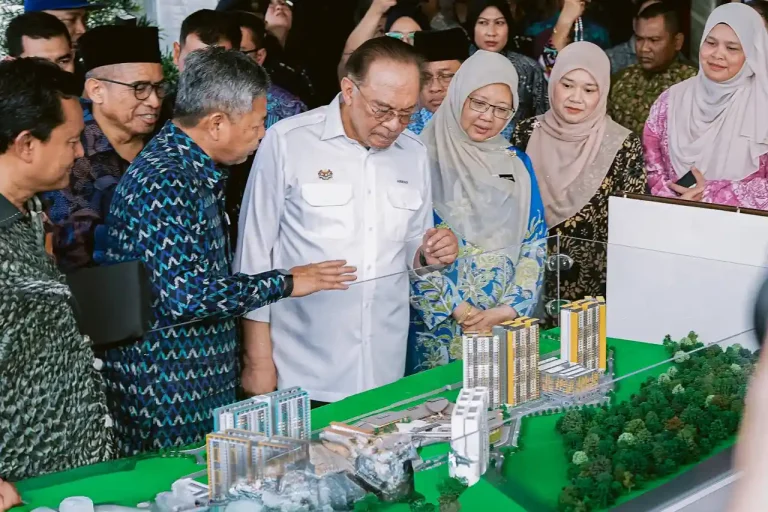
Amid mounting criticism of the proposed Kota Madani project in Precinct 19, Putrajaya, Federal Territories Minister Datuk Seri Dr Zaliha Mustafa has defended the development, saying it is designed to improve the quality of life for civil servants.
Far from replacing the administrative capital, Dr Zaliha explained that Kota Madani will complement existing infrastructure and serve as a forward-thinking extension of the city. She described the development as a “subset” of Putrajaya, making up just 0.8 per cent of the city’s overall area.
On Wednesday, Bersatu information chief Datuk Tun Faisal Ismail Aziz claimed Kota Madani was not a symbol of hope or progress, but a reflection of Prime Minister Datuk Seri Anwar Ibrahim’s failed leadership. He also argued that Putrajaya, built during Tun Dr Mahathir Mohamad’s administration, was free from political branding and functioned purely as the country’s administrative centre.
Critics have also questioned the reported RM4 billion cost of the project.
In response, Dr Zaliha said the entire project will be fully funded and maintained by developer Putrajaya Holdings under a Build-Lease-Maintain-Transfer (BLMT) model, with ownership handed over to the government 25 years after completion.
Addressing concerns over the name of the township, she clarified that “Madani” is not a political slogan but a reflection of core values such as humanity, justice, balance, and sustainability.
Speaking at the project launch in Putrajaya, Dr Zaliha said Kota Madani aims to directly benefit some 10,000 government officers through the construction of new government quarters.
“The project is envisioned as a walkable urban development, designed with sustainability and inclusivity at its core. Buildings will be located close to each other, promoting accessibility, and reducing reliance on vehicles,” she said.
“The initiative draws from the principles of the Madani and CHASE frameworks (Clean, Healthy, Advanced, Safe, and Eco-Friendly City), creating a cityscape based on integrated planning, AI technology, and pedestrian-friendly environments.”
She added that the development addresses a long-standing housing shortage in Putrajaya, which currently requires 35,000 units of government quarters – 13,000 more than are presently available.
“There are 17,000 outstanding applications on the waiting list,” said Dr Zaliha. “For more than two decades, the number of government quarters has remained at 22,000. Previous administrations failed to resolve this pressing issue. It is only under the Madani Government that real steps are being taken.”
Kota Madani, she said, would also ease the financial burden of lower-ranking civil servants, many of whom are forced to rent in surrounding areas and face high daily commuting costs.
“Those without access to government quarters often pay up to RM1,500 a month in rent, plus RM500 in fuel costs for work commutes and school runs,” she said.
“Under the Kota Madani plan, these officers can instead live in affordable government quarters. With a minimal housing and cost-of-living allowance deduction – estimated at RM400 a month – they could save significantly on transport and rent.
“They would also have access to nearby schools equipped with advanced security systems, allowing children to walk to school safely.”
Dr Zaliha said the government estimates that civil servants could save up to RM1,000 per month, giving them the opportunity to start building personal savings – a key pillar of the government’s broader strategy for long-term economic and social resilience.
“Kota Madani is not just about building homes. It’s about creating an inclusive, safe, and liveable ecosystem. It continues Putrajaya’s original vision as a symbol of modern, planned governance – but with a renewed focus on human-centred development.
“This is the realisation of Madani values.”
Besides Dr Zaliha and Anwar, others who attended the launch were the Education Minister, Fadhlina Sidek, and Public Service Department Director-General Tan Sri Wan Ahmad Dahlan Abdul Aziz.
Main image: Minister in the Prime Minister’s Department (Religious Affairs), Datuk Dr Mohd Na’im Mokhtar’s Facebook page


