A long time ago, when football was simply a sport with a massive following among people from all walks of life, there was an advertising campaign, ironically by a huge corporate entity.
It was so successful that it became a pop culture phenomenon in Malaysia, referenced on countless occasions by people from all backgrounds.
The campaign, embracing the usual Malaysian light-hearted humour, simply declared: “Makan bola, tidur bola.”
It was not difficult to understand why it became such a major hit. Football was, and still is, a big deal in Malaysia.
The campaign coincided with the 1997 Fifa World Youth Championship (now known as the Fifa U-20 World Cup). Malaysia hosted the tournament, marking the first Fifa competition staged in a Southeast Asian country.
Needless to say, it was a memorable event for many and the campaign resonated with football fans across the region. The tagline was instantly relatable. For football enthusiasts, it perfectly captured the spirit of the game. “Makan bola, tidur bola” loosely translates as “Eat football, sleep football”, which is exactly how many fans live their lives.
The different time zones where matches are played turned waking up in the early hours into an art form, requiring a delicate balance between getting enough sleep and not missing a single minute of the action.
This love for football, bordering on obsession, is shared by billions across the globe. Friendships are forged effortlessly when two strangers begin talking about football. It is almost a language of its own.
The claim that football is the world’s biggest sport is difficult to dispute.
Known as soccer in North America, football is the world’s most popular sport, boasting an estimated 3.5 to four billion fans. Its reach spans Europe, Africa, the Americas and Asia, making it both the most played and the most watched sport on the planet.
Football has brought grown men to tears. It has seen strangers embrace in packed stadiums simply because they wear the same colours. The agony of defeat and the ecstasy of victory are dissected with almost surgical precision after every match. That is football.
The World Cup is one tournament where the raw emotions of supporters and the brilliance of football’s greatest legends have been on full display. It has also become increasingly profitable.
This year’s World Cup is being jointly hosted by the United States, Mexico and Canada.
Two of the three hosts have staged the tournament before. The United States hosted it in 1994, while Mexico hosted it in 1970 and 1986.
The latest reports estimate the Fifa World Cup brand is now worth US$5.2 billion, a 244 per cent increase from the 2010 South Africa tournament, when it was valued at US$1.5 billion.
It goes without saying that the World Cup is a lucrative enterprise for hosts, sponsors and participants, though perhaps not for fans, who face historically expensive ticket prices driven by the tournament’s massive scale and Fifa’s adoption of US-style dynamic pricing.
Despite the controversies surrounding football, its growth appears unstoppable. Growth, however, also creates greater opportunities for commercialisation and profit.
Football is slowly becoming more of a money-making industry than the sport it was once known and loved for – a game where children believed in their own fairy tales and dreamed of becoming legends like Maradona or Ronaldo, both Nazario and Cristiano.
New rules and regulations have also been introduced at this World Cup, including hydration breaks around the 22nd minute of the first half and the 67th minute of the second.
Officially, the breaks are intended to help players cope with extreme heat. Unofficially, however, there is a widespread understanding that broadcasters have used these stoppages to air full-screen advertisements.
The move has drawn heavy criticism from fans, players and coaches, who argue that the interruptions disrupt the flow of the game and prioritise commercial interests over the integrity of a tournament with a 96-year history.
If excessive commercialisation were not enough, this year’s World Cup has also been overshadowed by allegations of double standards and prejudice. For decades, football has been celebrated as a sport that brings people together regardless of political or socio-economic differences. Even that ideal now appears compromised.
Visa restrictions and the treatment of players and officials are issues that should never arise at a tournament of this stature.
Among the incidents that have tarnished the spirit of sportsmanship was the treatment of the Iranian team, which faced logistical complications because of strict border and travel restrictions. The team was not allowed to remain on American soil and had to leave for Mexico immediately after its matches.
Meanwhile, Somali referee Omar Artan, regarded as one of Africa’s finest officials, was reportedly interrogated for 11 hours at Miami International Airport before his diplomatic passport and visa were rejected.
The Senegalese team also alleged heavy-handed treatment upon arriving in the United States, with players and officials subjected to unusually strict and invasive security checks on the airport tarmac. Footage of the incident quickly went viral, triggering public criticism.
In 2017, Fifa president Gianni Infantino, while discussing the bidding process for the 2026 World Cup and referring to the travel bans then imposed by the United States, said: “Teams who qualify for a World Cup need to have access to the country, otherwise there is no World Cup.”
He added: “We are now in the process of defining the bid requirements. In the world, there are many countries which have bans, visa requirements and so on and so forth.
“It’s obvious when it comes to Fifa competitions, any team, including the supporters and officials of that team, who qualify for the World Cup, need to have access to the country, otherwise there is no World Cup.”
He said the requirements would be made clear so each country could decide whether it wished to bid based on those conditions.
Those remarks were made nine years ago. Unfortunately, they appear not to apply in 2026 or, more precisely, not to the United States as one of the host nations, which seems to wield greater influence than Fifa itself.
Yet, while all this has been deeply disheartening, it will not silence the chants of football supporters. It will not stop children pretending to dribble like Messi. It will not stop fans from living by the mantra “Makan bola, tidur bola”.
Football is part of its fans’ DNA, and the only way to save it from further erosion is to let the good guys take charge for a change.
Perhaps that is merely pie in the sky. For now, we can only sit tight and savour a few more matches.
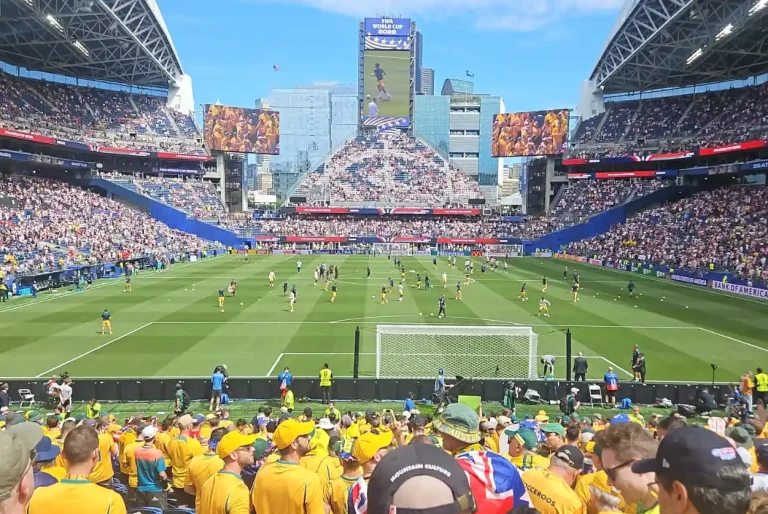
Image: Seattle Stadium – Hamish Vickers
The views expressed here are the personal opinion of the writer and do not represent that of Twentytwo13.