
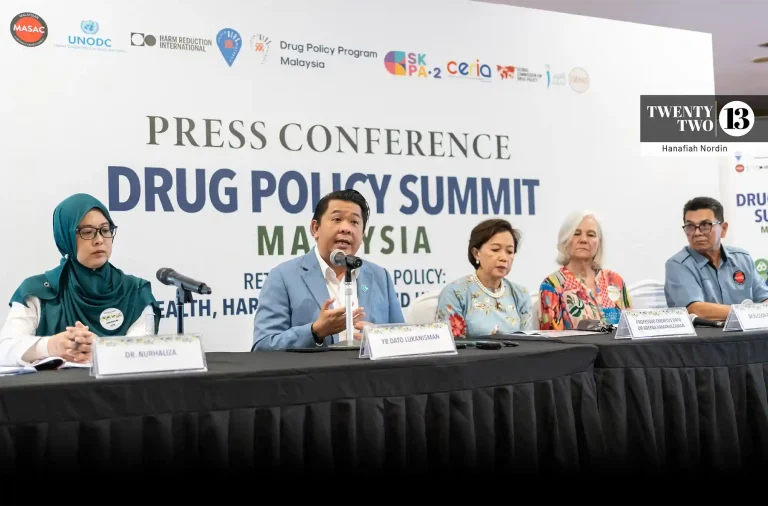
The Health Ministry is working towards amending Section 15 of the Dangerous Drugs Act 1952 (Revised 1980) to decriminalise drug use.
Deputy Health Minister Datuk Lukanisman Awang Sauni, who also chairs the National Task Force on Treatment and Legal Review, said the ministry had set up a working committee involving multiple ministries, agencies, professional bodies, expert groups and non-governmental organisations (NGOs) to review and strengthen Malaysia’s approach to drug addiction treatment and rehabilitation.
Section 15 of the Dangerous Drugs Act provides that any person who consumes or administers to himself dangerous drugs will be guilty of committing an offence under this Act. Those convicted can be fined up to RM5,000 or jailed for up to two years.
Asked about this during the Drug Policy Summit Malaysia in Kuala Lumpur earlier today, Lukanisman said: “The working committee has been discussing several articles in the current Act, but we are not yet at the stage to make a decision about any amendment. I have received notes on how to decriminalise it and will discuss this on Nov 15.”
The working group’s next meeting later this month will be its first since the amended Drug and Substance Dependants and Misusers (Treatment and Rehabilitation) Act 1983 came into force on Aug 22.
Lukanisman said Malaysia’s approach to drugs is evolving and gradually shifting from a punitive model to one focused on treatment, rehabilitation and social reintegration.
According to data released by the National Anti-Drugs Agency (AADK), there were 192,857 drug and substance users in 2024, with the majority aged between 19 and 39, accounting for 60.3 per cent (116,245 individuals).
“We are looking at a new and better policy to save addicts and give them a second chance,” said Lukanisman.
“The Health Ministry is committed to advancing this balanced, humane approach, one that integrates prevention, treatment, harm reduction and recovery within a strong public health framework.”

Dr Adeeba says criminalisation of drug use has failed.
His views were echoed by Professor Emeritus Datuk Dr Adeeba Kamarulzaman, who said that while criminalisation may appear to tackle drug use, it does more harm than good.
“It drives people underground, increases health risks, and imposes heavy social and economic burdens on society,” said Dr Adeeba, chairman of the Drug Policy Programme Malaysia.
“Unfortunately, our current drug laws often blur the line between users and traffickers. Criminalisation of drug use has failed. Punitive drug laws do not reduce drug use. Instead, they fuel stigma and discrimination, pushing people away from health services, making them less likely to seek help, and more vulnerable to diseases such as HIV, hepatitis, and overdose.”
She added that there are nearly 200,000 registered drug users in Malaysia, a 30 per cent increase from 2023.
“At the same time, about 68 per cent of inmates are held for drug-related offences, many for minor offences, including personal use,” said Dr Adeeba, who is also chair of the Malaysian AIDS Foundation.
“A study that my colleagues and I conducted at Kajang Prison between 2020 and 2023 involved interviews and testing of 1,011 prisoners. We found that 6.5 per cent were living with HIV, 39 per cent with hepatitis, 60 per cent had latent tuberculosis, and seven per cent had other infections. It is no wonder that Malaysia continues to struggle to control what was once a manageable endemic.”
Dr Adeeba said that in September 2024, Home Affairs Ministry secretary-general Datuk Awang Alik Jeman revealed that Malaysia spends RM1.15 billion annually on prison costs for drug offences.
“This is an amount that we can use to fund the hiring of 5,000 specialist doctors and help reduce waiting times at hospitals,” she said.
“Malaysia has an opportunity to shift the narrative – to move from punishment towards policies grounded in science, public health, and human rights. By investing in programmes that prioritise rehabilitation and harm reduction, we can reduce both the social and economic burdens of criminalisation, strengthen social cohesion, and provide a model for the region and the world.”
The two-day Drug Policy Summit Malaysia brings together 150 participants from 14 countries.
It will also discuss how Portugal and the US state of Oregon implemented their drug decriminalisation policies, and what Malaysia can learn from their experiences.
Portugal began decriminalising drug use in 2001. Since then, the country has recorded a 25 per cent fall in drug-related incarceration, a 75 per cent decline in drug-related deaths, and an 82 per cent reduction in the social cost of drug use.
HIV cases dropped from 1,287 in 2001 to 16 in 2019, and AIDS diagnoses among injecting users fell from 518 in 2000 to 13 in 2019. Portugal, which once had 50 per cent of new HIV cases among European Union nations, now has only 1.7 per cent.
The number of problematic drug users in Portugal fell from 100,000 in 1998 to 33,200 this year.
Malaysia had 15,736 drug users in 2009, but that number surged to 192,857 in 2024.
The summit will also discuss how Oregon’s Measure 110: The Drug Treatment and Recovery Act (passed in November 2020) lasted only until March 2024 due to rising overdose deaths, lack of engagement, and political factors.
It took Portugal five years before it saw results, but Oregon pulled the plug after only three years.
Portugal is one of 30 countries that have decriminalised drugs.
Main image: Lukanisman (second from left) speaking at the Drug Policy Summit Malaysia in Kuala Lumpur. To his left is Dr Adeeba.


