
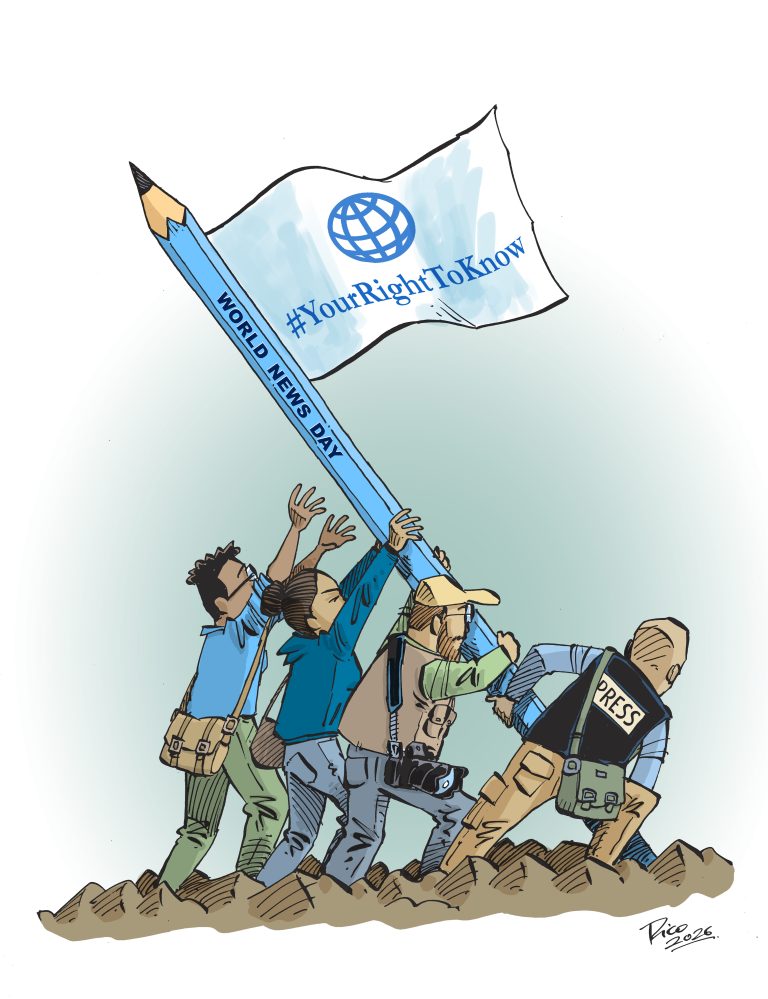
When a community is no longer well-informed, a slow social and political train crash follows. We are already on that track – but it is not too late to stop it.
A Pew Research Center survey conducted in March 2025 found that 80 per cent of American adults think Republicans and Democrats not only disagree on policies, but cannot agree on basic facts. Small wonder. The institutions Americans once relied upon for news, especially at the local level, have been dramatically weakened. Opinion increasingly presents itself as news. Some of it is good reporting; much of it is simply point of view.
The Constitution’s Framers understood the danger of concentrated power. They created three branches of government – executive, legislative and judicial – and gave each power to check the others. They also protected religion, speech and the press – different sources of expression, authority and values, each independent of government.
I spent much of my career in and close to the news business. I watched as public ownership of print and broadcast news often gave way to pressure for ever-greater returns. That led to less investment in journalism and technology just as cable and internet alternatives proliferated.
Today, artificial intelligence poses a radical rethinking of the entire process, likely transforming how information is gathered, edited and distributed. But who will produce original reporting?
AI can summarise a city council investigation. It cannot summarise an investigation that was never conducted because nobody paid a reporter to attend the meetings, develop sources, examine documents and ask questions.
Ironically, technology has made information inexpensive to distribute while destroying the economic entities that produced original reporting. Artificial intelligence (AI) is the new reality. Serious journalism should be at its centre – improving reporting while finding ways for the technology to help sustain the craft on which it depends.
Some organisations produce news that transcends geography – those focused on national, international or business news, for example – and have natural synergy with technology unbound by geography. They seem to me to be the most likely to thrive.
But what about local journalism – the reporting at the base of a democracy whose citizens still live, work, vote and govern themselves in actual communities?
I believe the road back begins with a better-informed community.
I had the privilege of leading Knight Foundation as it funded hundreds of experiments in nonprofit local news. Today, investments by the MacArthur Foundation, Emerson Collective and others are helping support local journalism. Those are important – and not nearly enough.
Producing reliable, high-quality journalism is expensive. It requires experienced reporters, editors and visual journalists who use technology responsibly to dig into public records and fact-check data. Too often, it also requires lawyers to push for public information that governments balk at sharing and to defend reporters doing their jobs.
Philanthropy needs to recognise what is at stake and invest much more substantially in independent journalism, particularly at the local level. It is the base of our democracy.
Efforts to encourage government support may also help. But such support must be carefully structured to avoid political influence. Organisations such as Rebuild Local News are exploring tax credits and other methods intended to support journalism while protecting its independence. We should keep experimenting.
Internet and AI companies have a stake in reliable and independent journalism. Their products derive enormous value from journalism they did not produce. If the organisations producing original reporting disappear, the information on which their own products depend will deteriorate. What is needed from them is not philanthropy; it is investment in the integrity of their own products.
Citizens may play the most important role. They need to think critically about the information they consume online. What is the source, and what is its policy on verifying facts? Many news outlets that report responsibly need to charge a subscription – and consumers need to support them with their dollars.
A well-functioning democracy requires informed citizens. And informed citizens require independent, consistently reliable journalism. As a nation, we need to understand what the Framers understood: journalism is essential civic infrastructure.
Alberto Ibargüen is the former publisher of The Miami Herald and El Nuevo Herald, and former president of John S. and James L. Knight Foundation. World News Day is celebrated on Sept 28 annually.



