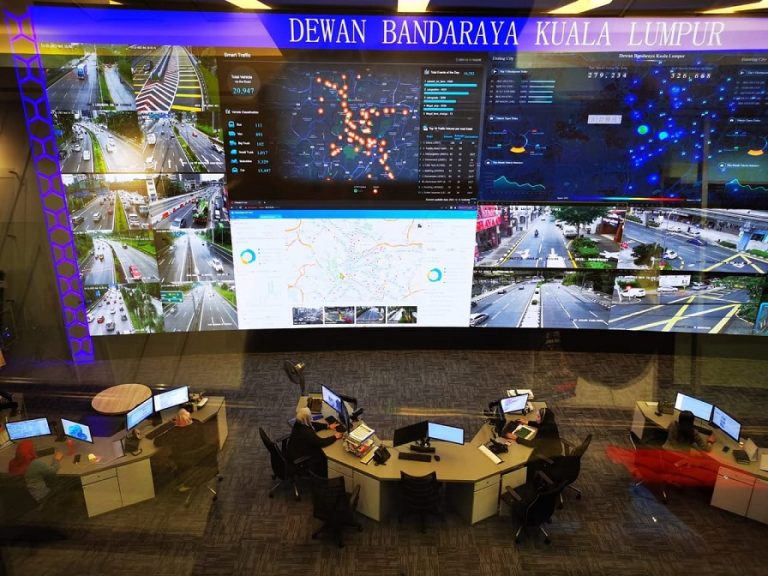
KUALA LUMPUR: In November 2023, my former colleague on the Kuala Lumpur City Hall advisory board, Datuk N.K. Thong, invited me to visit the Kuala Lumpur Command and Control Centre (KLCCC) in Bukit Jalil.
This high-tech war room, operated by Kuala Lumpur City Hall and the Royal Malaysia Police, serves as the city’s digital nerve centre.
The visit was an eye-opener.
I witnessed demonstrations of vehicle tracking and high-resolution Automatic Number Plate Recognition technology. The precision was remarkable. The system could track a specific vehicle across multiple sectors within seconds, providing a level of suspect identification previously impossible.
At the time, the city managed only 5,000 cameras. Recently, Minister in the Prime Minister’s Department (Federal Territories) Hannah Yeoh announced that the number had doubled to 10,000 integrated units.
While the expansion marks significant progress, the data shows just how far Kuala Lumpur still has to go to meet global benchmarks.
Studies suggest that the success of a smart city is defined by surveillance density rather than total volume.
Hyderabad leads the world with 79 cameras per 1,000 people, while Singapore maintains a regional benchmark of 18 per 1,000 people, with more than 128,000 units installed.
With Kuala Lumpur’s current ratio at roughly five cameras per 1,000 people, the city remains about 40,000 cameras behind its regional counterparts.
This expansion is a core component of institutional reform.
Under the Malaysia Madani framework, innovation (daya cipta) and trust (amanah) are fundamental principles. Scaling this AI-driven grid is a vital capital expenditure for Kuala Lumpur’s role as the nation’s primary financial gateway.
For international investors, the safety and technological resilience of a capital city are key currencies of trust.
A mature surveillance network also functions as a digital auditor. Beyond tracking criminals, it can improve accountability in public works.
By integrating AI, the system can verify whether road contractors meet technical specifications or monitor drainage systems and silt build-up in real time. This would allow authorities to trigger flood alerts before the city is paralysed, potentially saving millions in lost productivity.
To achieve the Kuala Lumpur Smart City Blueprint 2030 goals, the city must move away from silo mentalities and towards greater data integration.
While the issue ultimately comes down to ringgit and cents, Kuala Lumpur City Hall must prioritise significantly larger allocations for CCTV systems in future budgets.
Ten thousand eyes may be a starting point – but 50,000 eyes are what Kuala Lumpur needs to truly secure its future.
The views expressed here are the personal opinion of the writer and do not represent that of Twentytwo13.