KUALA LUMPUR: A major international law enforcement operation targeting the synthetic drug trade has led to the seizure of 650 tonnes of illicit narcotics, precursor chemicals, and pharmaceutical products, according to details released by Interpol on Oct 5.
Operation Lionfish-Mayag IV, conducted between May 18 and June 4, resulted in 7,247 individual seizures across participating nations, with an estimated total value exceeding US$1.1 billion. Officials estimate the landmark operation removed roughly 89.6 million fatal doses from consumer markets.
Seventeen countries, including Malaysia, took part in the Interpol-led initiative targeting production networks and supply routes across Southeast Asia, key transit corridors, and international destination markets.
According to Interpol, Malaysian authorities raided an active, fully equipped laboratory producing fentanyl. Officers seized a complete set of chemical precursors alongside finished liquid and powder fentanyl.
“It was the first discovery of an operational production site in the country, proving that drug manufacturing locations are actively diversifying within the region rather than relying solely on traditional transit nodes,” Interpol’s statement read.
Cannabis and cannabinoids accounted for the vast majority of total volume seized—approximately 94 per cent—driven largely by four major interdictions in the Philippines. All other illicit substances combined accounted for 39 tonnes.
Law enforcement officers confiscated roughly 8.2 tonnes of methamphetamine and Ya Ba tablets across the region, representing about 16 per cent of the total estimated monetary value.
However, for the first time in an Interpol operation targeting synthetic drugs, ketamine surpassed methamphetamine in volume, with 17 tonnes seized—accounting for roughly 40 per cent of the operation’s overall value.
Officials attribute the shift to a rise in non-medical ketamine consumption globally, driven in part by lower market prices and easier production methods compared to other synthetic drugs. Intelligence indicates large-scale manufacturing and trafficking within Southeast Asia, alongside European-sourced postal supply routes feeding markets in Australia and the United States.
Southeast Asia, and the Mekong region in particular, remains the global epicentre of synthetic drug manufacturing. Authorities in Myanmar recorded the operation’s single largest individual bust: a haul of 10.6 million Ya Ba tablets, a potent mixture of methamphetamine and caffeine.
In Indonesia, law enforcement reported seizing 1,975 litres of etomidate, an unusually large volume. Etomidate, traditionally used as a medical anaesthetic, has recently emerged in Asian markets as a recreational substance consumed through vaping devices.
Meanwhile, border control authorities in both Australia and the United States intercepted high volumes of small postal parcels. Rather than relying on physical concealment, traffickers disguised shipments using false customs declarations and commercial packaging.
Australian officials reported a steady stream of small parcels containing ketamine and cocaine dispatched from Europe. Similarly, US authorities recorded near-daily interceptions of the hallucinogen dimethyltryptamine (DMT) arriving from the same region—indicating that Europe is increasingly being used as a secondary repackaging and re-export hub.
Operation Lionfish-Mayag IV resulted in the seizure of 724 kg of DMT, the largest quantity of the hallucinogen ever recovered in a single police operation. Seized in liquid form and intended for vape cartridges, DMT is typically found in small amounts, pointing toward a growing market for vaped hallucinogens.
Other illicit substances, including natural and synthetic cannabinoids, were also seized in liquid form.
David Caunter, Interpol’s organised and emerging crime director said the surge in ketamine seizures and the growth of vape-based drugs such as etomidate and DMT show how rapidly the synthetic drug trade is evolving.
“No country can see the full picture alone. Criminal networks cross borders and our response must do the same,” Caunter said.
“Drugs devastate lives and communities and the criminals driving this trade are not slowing down. Neither can we.”
Although opioids made up a smaller fraction of the overall volume—7.3 tonnes, valued at US$12m—they carried a vastly disproportionate share of the fatal dose risk. This was driven primarily by fentanyl, which accounted for 63.7 million potential fatal doses.
The operation also uncovered a previously undocumented maritime trafficking route stretching from South America to China.
Chinese authorities intercepted 307 kg of cocaine shipped by sea, bypassing traditional trans-Atlantic routes and demonstrating that cartels are actively seeking to expand into Asian destination markets.
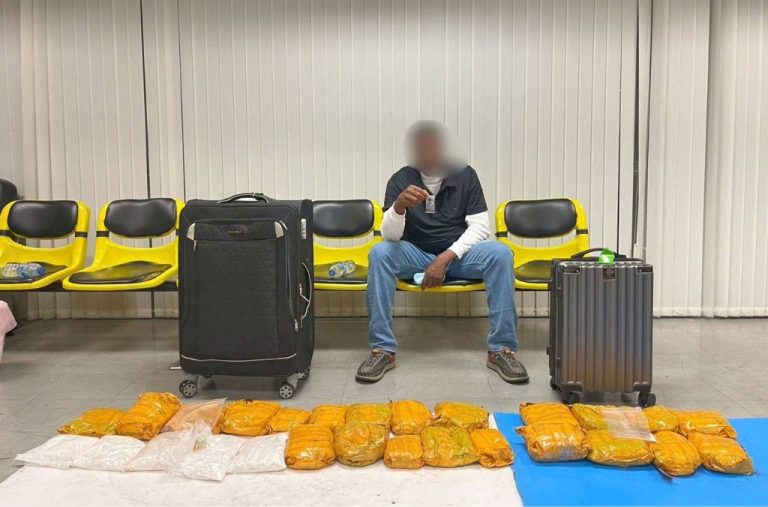
Image: Authorities in Thailand seized 21.3kg of heroin concealed in luggage – Interpol