
KUALA LUMPUR: A former Malaysian army general has proposed a comprehensive national hybrid healthcare financing model aimed at ensuring the long-term sustainability of Malaysia’s healthcare system, which is approaching a critical point.
The current system remains heavily reliant on government subsidies, while the public healthcare sector is stretched to its limits. Coupled with an ageing population, a shortage of medical specialists, and medical inflation nearing 12 per cent, Brig Gen (R) Professor Dr Mohd Arshil Moideen said the time is ripe for Malaysia to transition towards a hybrid healthcare financing system.
The proposal combines government subsidies with a complementary social health scheme, incorporating best practices from public-private partnerships as a sustainable healthcare model.
The paper, titled ‘A proposal for hybrid healthcare financial system in Malaysia: A sustainable solution to current healthcare issues’, is co-authored with Universiti Teknologi Mara’s Associate Professor Dr Khasnur Abd Malek.
At the heart of the proposal is a National Social Health Scheme (NSHS) to be administered under the Social Security Organisation (Socso). The scheme is designed to be complementary, helping to divert some patients from public hospitals to private general practitioners and private hospitals, funded through a national social insurance mechanism.
Dr Arshil said “complementary” means patients would only be referred to private facilities when public hospitals exceed defined thresholds for waiting times, overcrowding and quality of care.
With more than 25 years of experience in military medicine and humanitarian healthcare, Dr Arshil has led numerous health initiatives, including serving as joint commander of the Greater Klang Valley Special Task Force during the peak of the Covid-19 pandemic in 2021.
Speaking to Twentytwo13, Dr Arshil, who is now Head, School of Medicine & Health Sciences at Monash University, said the core of the proposal is a complementary NSHS – a hybrid model designed to supplement, not replace, the existing public healthcare system.
The paper notes that Malaysia’s current dual healthcare system is becoming increasingly unsustainable due to its heavy reliance on government subsidies and the unprecedented challenges it faces.
Despite an 11.5 per cent increase in healthcare expenditure from RM32.41 billion in 2022 to RM36.1 billion in 2023, the government has struggled to keep pace with rising healthcare costs. With medical inflation averaging between 10 and 15 per cent annually, year-on-year budget increases are no longer a viable long-term solution.
Is a new hybrid healthcare system necessary?
The proposal comes at a time when Malaysia is also grappling with a shortage of healthcare professionals, particularly specialists.
Despite being an upper middle-income country, Malaysia’s doctor-to-patient ratio stands at 1:417, below international benchmarks. The paper notes that for a developed nation, an acceptable ratio is 1:200.
The shortage of doctors contributes to long waiting times, overcrowding and compromised quality of care – conditions evident in major public hospitals nationwide. If left unaddressed, these issues could undermine patient outcomes and satisfaction, potentially leading to systemic failure.
The current system has also forced public hospitals to opt for cheaper drug alternatives. Many are no longer able to provide implants, specialised disposable items for procedures and surgeries, or the latest drugs and technologies for cancer, chronic diseases and complex surgical cases. As a result, patients are increasingly required to pay out of pocket.
“The trend of out-of-pocket payments for medical care has risen steadily in Malaysia over the past 10 years. In 2021 alone, out-of-pocket expenditure reached RM24.63 billion,” said Dr Arshil.
Citing the World Bank report for 2017–2022, the paper noted that Malaysia recorded the highest out-of-pocket health expenditure at 32.1 per cent, surpassing Indonesia’s 27.5 per cent, the UK’s 13.5 per cent and Thailand’s nine per cent.
According to the authors, high out-of-pocket costs are driven by spending on private healthcare services, limited insurance coverage, and the need to pay for specialised services, medications and implants not covered by the government. This trend suggests Malaysians are either willing to invest in their health or are compelled to do so due to inadequate coverage.
“The proposal aims to mitigate the burden of out-of-pocket payments for implants, new or unavailable drugs, specialised equipment and disposable items, while easing the workload of overburdened doctors in public hospitals and reducing long-term financial strain on the government,” Dr Arshil said.

Dr Arshil said a true understanding of our healthcare crisis demands we confront the practical, interconnected failures on the ground.
He said Malaysia is facing a catastrophic convergence of systemic flaws: an overburdened public healthcare system, a profound failure in preventive measures, and an under-optimised primary care network.
“This is dangerously compounded by limited insurance coverage that lacks a functional ‘step-up’ and ‘step-down’ continuum of care between the public and private sectors,” he added.
The authors said the proposed model would also reduce waiting times, provide optimal coverage across preventive, curative, rehabilitative and palliative care in both public and private settings, and improve the overall quality of national healthcare services.
They added that a key factor contributing to systemic strain is the mismatch between economic growth and the rising cost of living.
“Many Malaysians are experiencing slow or stagnant income growth, making healthcare increasingly unaffordable and driving over-reliance on the public system,” they said.
The proposed scheme would create a stable revenue stream by consolidating contributions from the government, employers and citizens, structured according to income levels.
Key features of the proposed model
Shared contributions: The government would fully subsidise contributions for the B40 group. Contributions for the M40 group would be shared between the government, employers and individuals. The T20 group would co-contribute with their employers.
Public-private partnerships: The NSHS would fund services across both public and private healthcare facilities, allowing overflow cases from public hospitals to be treated by accredited private providers at no additional cost to patients.
Strengthened gatekeeping: Public and private general practitioners would serve as the first point of contact to ensure efficient referrals and reduce unnecessary hospital visits.
Phased implementation: A gradual seven-phase rollout is proposed, starting with a feasibility study and a pilot programme targeting the fully subsidised B40 group before nationwide implementation.
Dr Arshil said the hybrid system would create a more resilient and equitable healthcare framework, ensuring universal access to quality care while distributing financial responsibility more sustainably.
By integrating private sector capacity and adopting a progressive contribution model, the proposal aims to future-proof Malaysia’s health security.
Proposed hybrid financial system model will integrate:
Government subsidies: Continued public funding for essential healthcare services, with emphasis on vulnerable groups, public health initiatives and strategic investments in infrastructure and workforce development. This would account for up to 70 per cent of the total healthcare budget.
NSHS: A voluntary or mandatory social insurance scheme funded by employer and employee contributions to reduce reliance on government subsidies. The authors recommend Socso or the Employees Provident Fund as the collection agency, with individual or household coverage options to keep premiums affordable.
While NSHS contributions for the B40 group would be fully subsidised and partially subsidised for the M40 group, the T20 group would be required to fully fund their contributions, on top of existing private insurance coverage.
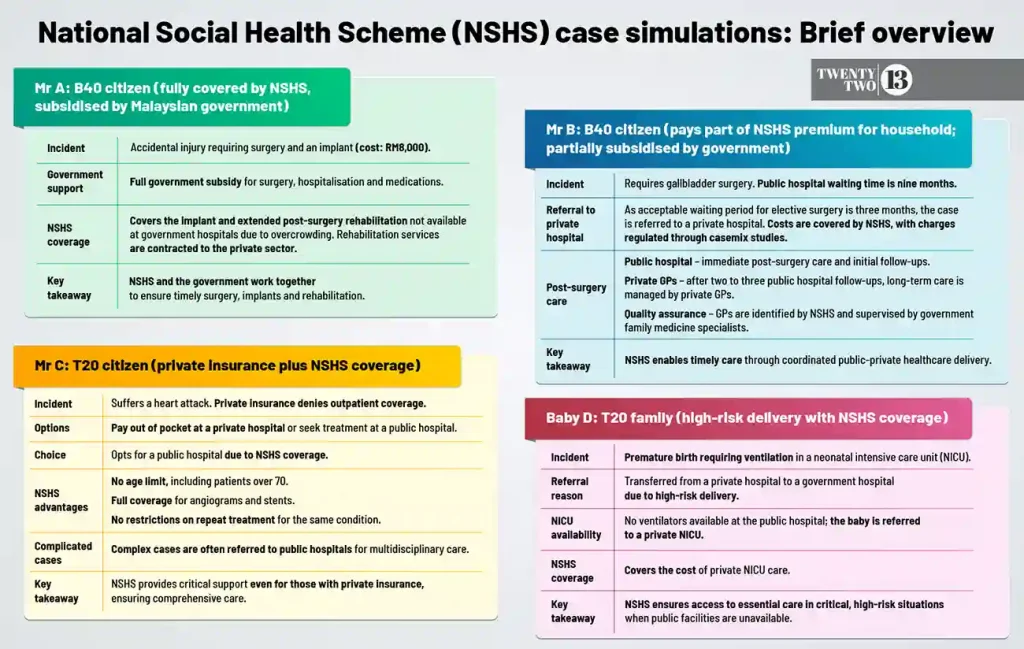
Will those with existing medical insurance opt into the NSHS?
Yes, according to the authors.
They argue that existing medical insurance packages have coverage limitations, and that private hospitals often refer complex cases back to public facilities.
Acknowledging that healthcare needs are limitless while financial resources are not, the authors said the NSHS must include:
- A defined basic package outlining covered conditions, treatments and services
- A defined service price list using case-mix based funding and diagnosis-related groups
- A cost-sharing framework with healthcare providers to regulate behaviour through incentives, limitations and penalties
- A clear opt-in versus compulsory contribution mechanism
The scheme also proposes a solidarity premium based on citizen groups, with the government providing coverage for vulnerable populations including the B40, persons with disabilities and pensioners. The authors added that the My Satria insurance scheme for Malaysian Armed Forces personnel should continue even after retirement.
Under the proposal, the M40 group would receive a 60 per cent government subsidy, with the remaining 40 per cent funded through personal contributions. The T20 group would bear the full contribution cost.