
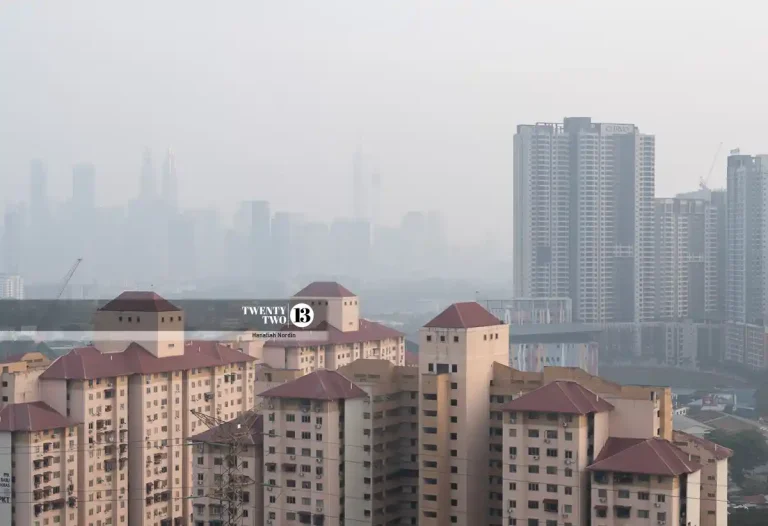
KUALA LUMPUR: For most people, the advice during haze season is simple – stay indoors, wear a mask, avoid strenuous outdoor activity and drink plenty of water.
But what about construction workers, delivery riders, traffic police, refuse collectors and cleaners? For them, staying indoors is not an option.
Respiratory specialist Dr Helmy Haja Mydin, head of The Lung Centre at Pantai Hospital Kuala Lumpur, warned that spending eight hours or more outdoors doing physically demanding work can mean breathing in much more polluted air.
“They get the highest exposure (to the haze) because they are outside for long periods. As they are working physically, it means more deep mouth-breathing that bypasses the nose entirely,” said Dr Helmy, who graduated from Newcastle University and received his Certificate of Completion of Training from the Royal College of Physicians (UK).
“A labourer doing heavy work can move many times more air through the lungs per minute than someone sitting at a desk. Same air, several times the dose.
“As such, they should wear an N95-class respirator, such as an N95, KN95 or FFP2, to provide better protection.”
But he stressed that handing workers a respirator was not enough. It must fit well, he said, adding that a poor seal around the nose or over a beard provides less protection.
Dr Helmy said employers should also change how work is carried out rather than rely on masks alone.
“What employers can do is make changes to the work, which matter more than the mask,” said Dr Helmy, who also holds a Certificate in Executive Leadership for Healthcare Professionals from Cornell University, United States.
“For instance, they could schedule the heaviest tasks to the cleanest hours of the day, usually the early morning, rotating workers indoors and increasing the frequency and length of rest breaks in filtered or air-conditioned spaces.
“Cut the total outdoor exposure time rather than relying on the equipment,” he said.
He also called for employers to provide clean-air rest areas at worksites.
“Most importantly, a clean-air rest area on site. For a construction site, that can be a container cabin with the door shut and a portable filter unit. It is not expensive.”
Dr Helmy said companies should provide adequate water and shade while identifying workers more vulnerable to poor air quality.
Companies, he said, should consider screening workers with asthma, chronic obstructive pulmonary disease (COPD) or heart disease so they can be redeployed indoors during periods of poor air quality.
“Malaysia already has guidance for this,” said the co-founder of Asthma Malaysia, a non-profit organisation dedicated to raising public awareness and optimising patient education on asthma management.
“The Department of Occupational Safety and Health (DOSH) advises that strenuous outdoor work should be minimised once the Air Pollutant Index (API) passes 100 and avoided above 200.
“DOSH can issue a stop-work order with penalties attached.”
But Dr Helmy said the issue was not whether thresholds and guidance existed, but how consistently they were applied.
“Individual advice is cheap, fast and requires nobody to agree to anything. Structural measures require money, coordination between ministries and a willingness to impose costs on business before the harm is visible,” he said.
He said workers should be assessed according to their exposure and underlying health risks rather than relying on a single API reading.
“The question, therefore, is not necessarily whether thresholds exist, but how consistently they are being applied,” Dr Helmy said.
According to the Air Pollutant Index Management System (APIMS) portal, 31 areas nationwide recorded unhealthy air quality readings as at 10am today.
The worst-affected areas were Serian IPD in Sarawak (175); Pasir Gudang (171) and Larkin (170) in Johor; Bandaraya Melaka (167) and Bukit Rambai (164) in Melaka; Nilai in Negri Sembilan (165); Johan Setia in Selangor (164); and Batu Muda in Kuala Lumpur (114).
An API reading of 0 to 50 indicates good air quality; 51 to 100, moderate; 101 to 200, unhealthy; 201 to 300, very unhealthy and 300 and above, hazardous.


