
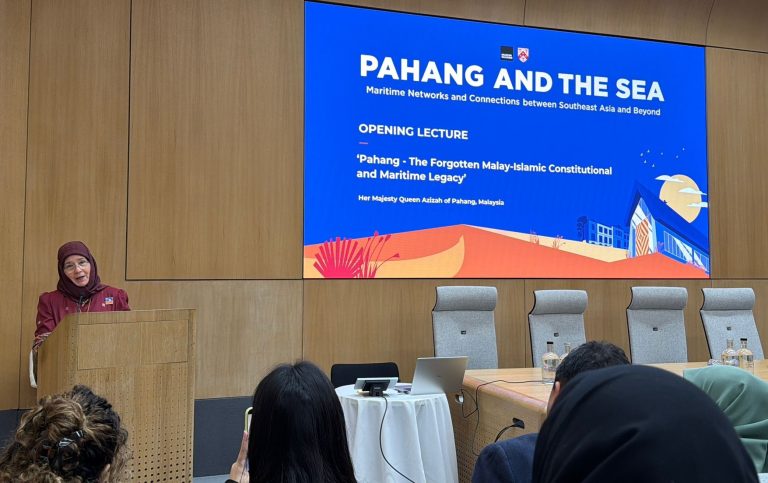
The ‘Pahang and the Sea’ workshop begins today as Tunku Azizah Aminah Maimunah Iskandariah delivered the opening lecture at St Antony’s College, Oxford, speaking about the history and significance of the Hukum Kanun Pahang.
The Tengku Ampuan Pahang, in her lecture titled ‘Pahang: The Forgotten Malay-Islamic Constitutional and Maritime Legacy’, expressed hope that the Hukum Kanun Pahang would one day be inscribed in Unesco’s Memory of the World, so that its light and legacy may continue to illuminate the future of humanity – “not as a relic but as a living testament to the intellectual and constitutional genius of our Malay civilisation.”
“Compiled during the reign of Sultan ʿAbdul Ghafur Muhyiddin Shah between 1592 and 1614, the Hukum Kanun Pahang was more than a collection of laws; it was a mirror of a kingdom, anchored in Islamic jurisprudence, Malay adat, and maritime reality,” Tunku Azizah said.
She described it as the earliest Malay-Islamic constitution – one of the oldest and most complete legal manuscripts in Southeast Asia – blending Syariah law and adat into a unified system of governance.
“It was not merely a code of law; it was a constitution, a total codification of sovereignty, justice, and faith – transforming a Sultanate into a civilisation, and the sea into an extension of the state. It governed rivers, ports, naval ranks, taxation, piracy, honesty in trade, and the duties of Sultans and subjects alike,” she said.
While the Hukum Kanun Melaka and Undang-Undang Laut Melaka are often celebrated as the legal foundations of the Malay world, Tunku Azizah said it was in the Hukum Kanun Pahang that one finds the mature expression of Malay-Islamic constitutionalism – a living Malay constitution that united faith, law, and governance.
“It was the direct continuation of Melaka’s laws, a rebirth and perfection in the Pahang context, uniting land and sea into one moral-political order. Adapted yet distinct, it embodied a legal vision shaped by Pahang’s geography and economy,” she added.
Tunku Azizah also hoped that Oxford University would recognise the Hukum Kanun Pahang as a living testament of a sovereign Malay-Islamic civilisation that continues to dignify the Malay world and offer valuable insights into lawmaking and the sea.
Also present at the event was Tengku Puteri Jihan Azizah ‘Athiyatullah.
Jointly organised by Muzium Pahang and St Antony’s College, Oxford, the workshop brings together leading scholars to rekindle global interest in Malaysia’s maritime heritage and restore Pahang’s historical standing as a maritime kingdom of regional significance.
Here’s Tunku Azizah’s full speech:
“It is a profound honour to stand before this learned audience at Oxford, a place where the world is told and retold, histories constructed and re-examined. Conveying the spirit of Pahang and Malay-Islamic constitutionalism at Oxford is indeed a landmark event.
Today, it listens to a forgotten kingdom remembered, one that knew the sea and never forgot who it was. I have come a long way from Malaysia, from the land known as Tanah Melayu, to speak of a great maritime civilisation that flourished long before the West came in search of spice or conquest. It was a world that already knew the sea, mapped the monsoon, and governed the waves with law. A civilisation of ports and pen, of trade and truth, where faith and justice sailed together, drawing merchants not with muskets but with mastery of seamanship, diplomacy, and faith.
That kingdom is Pahang, a realm whose sovereignty rested not upon conquest but upon law, whose throne was the river and whose crown was justice. A maritime kingdom that drew the attention of the West not because it was weak but because it was wondrous. Pahang was a civilisation of tide and time, dignified, deliberate, and steadfast in its own identity. While others surrendered to conquest, Pahang remained faithful to itself. It ruled not by sword but by sacred code; it governed not through fear but by faith. The sea for Pahang was never a border but a living constitution, a legal space, a court of law guarded by conscience. Its ports were not merely markets of trade but tribunals of justice. Pahang was not simply a kingdom by the sea; it was a kingdom of the sea, where law travelled with the tide and justice flowed with the current.
From the early Malay chronicles, Pahang appears under many names – Pan-huang, Pahan, Pa-hang – marking its long-standing place in regional memory as a coastal entrepôt connected to the Indian Ocean and the Laut Melayu. To understand Pahang as a maritime kingdom, one must begin with Melaka, the city that transformed the Malay world from riverine polities into oceanic empires. Known to the Portuguese as the Venice of the East, Melaka was the maritime imagination made real, its harbour crowded with Gujarati, Arab, Chinese, and Javanese ships, its legal codes written with the sea in mind.
When we speak of maritime history, particularly in the context of colonial expansion, the narrative often centres on the West discovering, conquering, and profiting from the East. But from an Asian perspective, the story began much earlier. Through trade, it was not Europe that discovered Asia, but Asia that entered Europe, through flavour, fabric, and faith. The Malay world may have lost battles in history books, but it won victories in memory, in kitchens, in galleries, and in closets. Europeans came for spices but left with our soul. We flavoured their food, draped their bodies in silk and batik, filled their cabinets with pottery and carving. The sea brought not only spices and silk but inspiration; it was Asia that filled European galleries, wardrobes, and kitchens.
By the time of Srivijaya and Langkasuka, Pahang had long been part of Malay maritime circuits, a source of gold, forest produce, and faith. During the height of the Melakan Sultanate, Pahang was both a vassal and vital corridor, its rivers linking the interior to the Straits. After Melaka fell to the Portuguese in 1511, Pahang asserted its independence, no longer an offshoot but a sovereign maritime state with its own fleets, laws, and alliances with Johor, Aceh, Pattani, and Brunei. Long before Western charts named the South China Sea, the peoples of the Malay world had already called and governed it the Laut Melayu. Before admiralty courts, there was the Sultan, whose words ruled the land and commanded the waves. These were not nameless waters but governed domains, mapped and moralised by Malay hands.
To call it by another name is to speak in a foreign tongue; to call it Laut Melayu is to speak in our own, the language of navigators, jurists, and poets who had codified the sea in their own laws and language. At the heart of this maritime state was a legal code rarely studied yet profoundly significant, the Hukum Kanun Pahang, or the Malay-Islamic constitution. Nowhere was this maritime consciousness more perfectly expressed than in the Pahang Canon, a document which extended justice and law from land to river and from river to ocean. Standing in the same league as the Piagam Madinah, the Code of Hammurabi, the Twelve Tables of Rome, the Justinian Code, and the Magna Carta in the chronicles of world constitutional history, the Hukum Kanun Pahang represents the Malay world’s contribution to the universal heritage of law and civilisation.
Compiled during the reign of Sultan ʿAbdul Ghafur Muhyiddin Shah between 1592 and 1614, it was more than a collection of laws, it was a mirror of a kingdom, anchored in Islamic jurisprudence, Malay adat, and maritime reality. The Hukum Kanun Pahang, our earliest Malay-Islamic constitution, stands as one of the oldest and most complete legal manuscripts in Southeast Asia, blending shariah and adat into one system of rule. It was not merely a code of law; it was a constitution, a total codification of sovereignty, justice, and faith — transforming a Sultanate into a civilisation, and the sea into an extension of the state. It governed rivers, ports, naval ranks, taxation, piracy, honesty in trade, and the duties of Sultans and subjects alike.
While the Hukum Kanun Melaka and Undang-Undang Laut Melaka are celebrated as the legal bedrock of the Malay world, it is in the Hukum Kanun Pahang that we find the mature expression of Malay-Islamic constitutionalism, the living Malay constitution that united faith, law, and governance. It was the direct continuation of Melaka’s laws, a rebirth and perfection in the Pahang context, uniting land and sea into one moral-political order. Adapted yet distinct, it embodied a legal vision shaped by Pahang’s geography and economy.
It defined the duties of the Orang Besar, that is the Bendahara, Temenggung, and Shahbandar. It set port taxation and naval hierarchy, and protected traders, seafarers, women, and property. It punished piracy and fraud and preserved the balance between divine justice and royal authority. The Pahang Canon became the backbone of Malay governance, its influence echoing through Johor, Terengganu, Perak, Riau, Kedah, Patani, and even Aceh. In truth, it was the earliest written expression of the Malay-Islamic Constitution, the charter of a just and sovereign civilisation.
Sultan ʿAbdul Ghafur Muhyiddin Shah, the 12th Sultan of Pahang and descendant of Melaka’s Sultanate, was the architect of Malay-Islamic constitutionalism. The Ruler who compiled and codified Hukum Kanun Pahang as the direct continuity of the Hukum Kanun Melaka and the Undang-Undang Laut Melaka. His legacy stands as the greatest written monument of the Malay world, a complete codification of sovereignty, justice, and faith long before colonial law.
In his vision, the Hukum Kanun Pahang emerged as the embryonic form of a Malay-Islamic Constitution, centuries before modern constitutional thought appeared in Europe. Under his reign, Pahang became a sovereign polity grounded in shariah, adat, and written law. Let this stand also as a reminder of Malay modernity, that the constitutional mind of our civilisation was born not of imitation, but of inheritance.
In codifying the Hukum Kanun Pahang, he created not merely a lawbook but a Malay-Islamic Constitution, integrating religious, administrative, commercial, and maritime law, extending his authority “from the river to the sea.” His achievement pre-dated European notions of modern constitutions by centuries, yet his name has been almost erased from mainstream history. If Pahang was the forgotten maritime kingdom, then Sultan ʿAbdul Ghafur was the forgotten lawgiver. He gave us our greatest inheritance, the Hukum Kanun Pahang, the blueprint of Malay-Islamic constitutionalism and the codification of justice. He deserves a place among the great lawgivers of world history.
In modern constitutional terms, he may be described as the first Malay Ruler to institutionalise a comprehensive written constitution that governed both land and sea. His decision to codify law was an act of intellect and statecraft, ensuring that Melaka’s moral and legal order lived on in Pahang. The Hukum Kanun Pahang wove shariah and adat into moral harmony, revelation with reason, divine will with the realities of governance. It affirmed that power must serve justice and justice must reflect faith. The Sultan was not a despot but a raja adil, accountable to Allah. Thus, the Hukum Kanun Pahang stands as both a historical document and a philosophical statement, the written conscience of a Ruler who believed justice to be the truest expression of sovereignty.
And today I stand before you not only as a daughter of that lineage but as custodian of its living legacy. In the Pahang State Museum rests the original complete manuscript of the Hukum Kanun Pahang, not a copy, not a fragment, but the authentic legal codex compiled under Sultan ʿAbdul Ghafur Muhyiddin Shah himself. Returned to Pahang in the 1970s after centuries of silence, this manuscript represents the oldest and most complete Malay-Islamic constitutional text known in the region; the embryonic form of a written constitution that united shariah, adat, and sovereignty into one moral and legal order.
It predates the Vatican copy of the Hukum Kanun Melaka and Undang-Undang Laut Melaka, which were later transcriptions of Melaka’s original codes. The Hukum Kanun Pahang stands as their direct continuation and completion, a unified Malay-Islamic Constitution extending justice from palace to port, land to sea. It is not imitation but inheritance; not adaptation but affirmation, the matured expression of Malay-Islamic sovereignty in written form. This is the greatest monumental asset and treasure of the Malay world, proof that centuries before colonial charters or Western constitutions, the Malay mind had already conceived a complete system of law grounded in faith, justice, and governance.
Piracy became not only a crime against the state but a sin against faith; trade an act of worship; honesty a divine command; and justice the language through which faith found earthly form. The Hukum Kanun Pahang reflected a synthesis of Islamic legal philosophy and Malay wisdom, a maritime constitution, the earliest surviving expression of Islamic maritime jurisprudence in the region, a proof that religion, law, and seafaring could move as one current.
Islam came to Pahang not by sword but by sail, brought by merchants and scholars from Gujarat, Persia, and Arabia. It was not over land that Islam first entered the Malay world, but on the wind, carried by monsoons, in the sails of merchant ships. It came not by conquest but with trade, and was anchored not in mosques first but in ports. Thus, when Pahang codified its law, it wrote not imitation but inspiration, an Islamic state in spirit centuries before the term existed. It was embedded in contracts at the harbor, in oaths sworn on the deck, in port taxes and moral codes. Every harbour had its customs, every voyage its code, every sailor his rights. It was a Magna Carta of the Malay Sea, written not in Latin, but in Malay Jawi, sung by monsoon winds.
Pahang’s geography gave shape to its law. The Sungai Pahang, the longest river in the peninsula, carried justice from the highlands to the horizon, linking goldfields and forest markets with coastal ports. These waterways did not just carry water; they carried power, trade, and identity. The Sultanate was never conquered, never erased; it survived, ruled, and traded, leaving a record of law, river, and resilience. To call Pahang a maritime kingdom is to understand “maritime” not as oceanic alone but as a flowing system from river source to ocean tide, from Jelai to Tioman and Natuna, where trade and law travelled together.
Tioman was more than an island; it was a living harbour. For centuries, ships from Champa, China, and Arabia sought refuge there, a place of rest and renewal, a workshop where sea met forest and indigenous skill produced vessels built for the monsoon. Long before iron and steam, the Malay world possessed its own shipbuilding genius. Our perahu, lancaran, and jong were masterpieces of indigenous engineering, crafted from hardwood, bound with rattan, sealed with resin, designed to breathe with the rhythm of our seas. These ships were both architecture and philosophy, floating testaments to a civilisation that understood the marriage between man and water.
No European fort ever cast its shadow on our shores. The Dutch and Portuguese passed us by, and the British came not with conquest but with diplomacy. Pahang was too stable to invade, too lawful to subdue. To command the sea was not only to sail upon it but to read its winds and guard its routes. Behind this order stood the Orang Laut and Orang Dalaman, navigators and guardians of passage and law. Often miscast as pirates by colonial chroniclers, they were the enforcers of the Sultan’s justice. Their loyalty turned water into a realm of governance, their knowledge the empire’s intelligence. Without them, no maritime kingdom could thrive; with them, Pahang’s seas became the safest in the Malay world. Pahang did not merely sail the sea, it legislated it.
Through the Hukum Kanun Pahang, the ocean itself became a sovereign space. Unlike the contested waters of the Selat Melaka and Riau, the eastern corridors of the Laut Melayu under Pahang provided haven and order. Traders found safety; waters became lines of trust. This reliability enhanced Pahang’s prestige and made it a sanctuary of law and commerce. The sea was not emptiness but the Sultan’s court in motion. Every port was subject to law; every voyage to ethics; every captain to conscience. Centuries before international maritime law, Pahang had articulated a philosophy that the sea could be governed through justice, not conquest, through civilisation, not colonisation. For sovereignty without justice was piracy, and law without faith was tyranny.
Before Europe came with cannons, it came with empty spice jars, and it was our world that filled them; gaharu and camphor, nutmeg and clove, songket and batik. They came for profit and left with wonder. The Malay world conquered not through empire but through taste, artistry, and imagination.
Pahang’s grandeur lay not only in law or trade but in memory. Deep within its rainforest lies Kota Gelanggi, the lost city of stone, guarded by legend and silence. If the coast carried our trade, the forest kept our soul. One day, when scholarship and archaeology brush away the leaves, we may find proof that Pahang’s greatness was both maritime and monumental. Even the forest remembers, as the sea remembers what textbooks forgot, the story of a kingdom that ruled not by conquest but by knowledge, dignity, and faith. Off the coast, the waters of Pulau Tioman hide the secrets of the past, anchors, ceramics, and fragments of trade, awaiting discovery by archaeology and faith alike. In time, it may be archeology not colonial archives, but the earth and the sea themselves, that will finally reveal and whisper back the full story of Pahang’s greatness.
Although Pahang once formed part of the Johor–Pahang–Riau–Lingga Empire, its maritime sovereignty was distinct and respected. Before the Bugis Rajas crossed the Straits, and before Riau became the fulcrum of diplomacy, Pahang had already carved its name across the waves as a sovereign, seafaring kingdom whose rivers, ports, and laws defined an early Malay maritime order. History often credits others, yet it was Pahang that held the tide when Melaka fell and kept the flame of maritime governance alive.
From the 18th century, the Sultanate evolved into a self-governing entity under the Bendahara house, maintaining autonomy and trade. While the Straits were contested, Pahang looked eastward toward the open ocean. Its strength was not in size but in independence and resilience.
Today, as nations debate maritime disputes stirring global tensions, borders, and laws of the sea, let us remember that centuries ago, a Malay Sultan on the east coast of the Tanah Melayu had already encoded the laws of the sea, not to govern trade alone but to shape civilisation. Pahang may not have built great fleets, but we built trust. The Hukum Kanun Pahang, the Malay-Islamic constitution, is not a relic; it is a living testament, the moral architecture of a civilisation that ruled the sea through justice, faith, and order. If Melaka was the gateway, Pahang was the anchor, its law, its legacy, and its people making it a kingdom of the sea and a quiet architect of the world we now call global.
As I stand before you today, I do not speak only as a scholar or a queen, but as the voice of a kingdom that remembers. From the river of Inderapura to the waters of the Laut Melayu, from the ink of the Hukum Kanun Pahang to the conscience of its people, this is the voice of Pahang , and the heartbeat of a Malay-Islamic constitution reborn. May this heartbeat continue to echo across our seas and generations, reminding the world that Malay sovereignty was never silence but law, faith, and civilisation in motion.
Let this be my legacy, that my children may walk taller, knowing their rivers once ran with gold, their seas with law, and their names with pride. May they remember that long before others wrote of civilisation, we already had the Hukum Kanun Pahang, the Malay-Islamic Constitution, a mandate of justice and faith, the embryonic form of a written constitution. A living testament to what Sultan ʿAbdul Ghafur Muhyiddin Shah left as his enduring legacy to the Malay world, the heartbeat of a Malay constitution reborn.
May Allah bless our pursuit of knowledge and guide us to protect what our ancestors built with wisdom and devotion, in faith and foresight. And may the Laut Melayu that once carried our civilisation carry our legacy forward; from Pahang to the world.
It is my wish that the world, not only Oxford will recognise the Hukum Kanun Pahang not as a relic of the past, but as the living testament of a sovereign Malay-Islamic civilisation that continues to dignify the Malay world and provide valuable insight into lawmaking and the sea. And it is also my hope that this manuscript, our Hukum Kanun Pahang, the Malay-Islamic constitution of a sovereign civilisation, will one day be inscribed in Unesco’s Memory of the World, so that its light and legacy may continue to illuminate the future of humanity, not as a relic but as a living testament to the intellectual and constitutional genius of our Malay civilisation.”


