KUALA LUMPUR: The Sportswriters Association of Malaysia (SAM) has called on all parties in the country’s sporting ecosystem to respect media practitioners and maintain professional communication when addressing differences of opinion and criticism.
The statement follows a public dispute involving award-winning sports journalist Rizal Hashim, Olympian Datuk Azizulhasni Awang and his former coach, John Beasley.
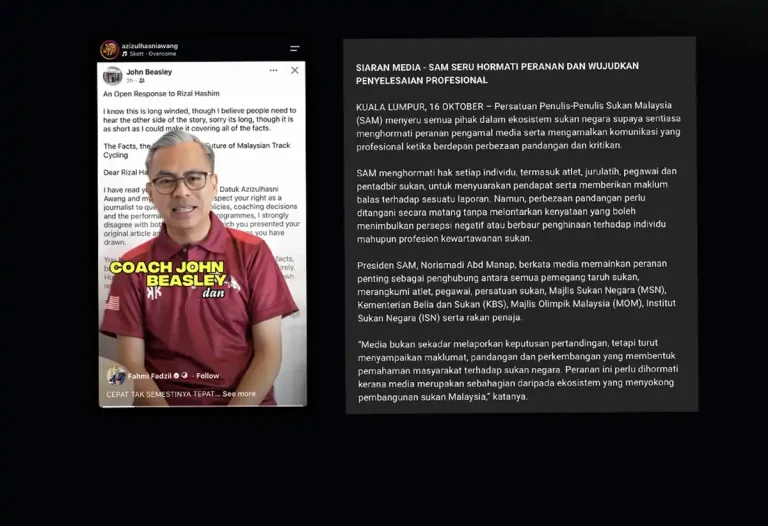
Communications Minister Datuk Seri Fahmi Fadzil has also weighed in, posting a video last night titled “Cepat tidak semestinya tepat” (Fast doesn’t mean accurate). Although Fahmi did not mention Rizal by name, articles referring to the journalist appeared in the background.
SAM president Norismadi Abd Manap said the media played an important role in connecting stakeholders across the sporting community, including athletes, officials, sports associations, the National Sports Council, the Youth and Sports Ministry, the Olympic Council of Malaysia, the National Sports Institute and sponsorship partners.
“The media do more than simply report competition results. They also convey information, opinions and developments that shape public understanding of the country’s sporting landscape. This role must be respected, as the media are an integral part of the ecosystem that supports the development of Malaysian sport,” Norismadi said.
“Professional media reporting is grounded in evidence and facts obtained through interviews, research, verification and consultation with relevant sources.
“Reports and criticism should be assessed in their proper context and on the basis of their content. Where factual inaccuracies are identified, the parties concerned should provide supporting evidence to enable appropriate corrections to be made.”
He added that while speed remained important in today’s media environment, it must not come at the expense of context, accuracy and fairness.
SAM said dissatisfaction with media coverage should be directed to the journalist or media organisation concerned.
It stressed that respecting the media did not mean agreeing with every report or opinion published. Rather, a healthy professional relationship required a willingness to accept criticism, offer explanations and recognise the right of all parties to express their views responsibly.
“Relationships built on facts, respectful communication and a willingness to seek constructive solutions are essential to the continued development of Malaysian sport.”
The dispute began after Rizal’s column in The Star, entitled ‘Longevity Does Not Necessarily Mean Legitimacy’, was published on June 28. In it, he questioned, among other things, the birth years of elite cyclists, including Azizulhasni.
Beasley responded in a lengthy Facebook post earlier this month, which Azizulhasni reposted alongside his own views.
Rizal then wrote an open letter to the pair, published on Stadium Astro.
Beasley and Azizulhasni subsequently shared their views on social media, addressing some of the matters raised by Rizal and questioning his journalistic integrity.
In his video, Fahmi urged media practitioners to prioritise accuracy and fairness, particularly when reporting on issues that could affect an individual’s reputation.
“When we are too focused on being the first to publish, we may neglect more important elements, namely context, accuracy and fairness to all parties,” he said.
Acknowledging the demands of journalism, Fahmi said: “We must also emphasise the importance of reporting every story carefully and accurately, especially when someone’s reputation is at stake.”
He added: “Whether it’s through SMS or WhatsApp, if the person doesn’t use WhatsApp, try giving them a call. Use the human touch and give them an opportunity to respond. Uphold the right of reply. And if the person or party declines to comment, simply state that in the report.
“In any issue, especially those involving reputations, listen to both sides before publishing.
“The fastest is not always the rightest.”
Rizal said he hoped all parties had taken the time to familiarise themselves with the issues, noting that neither Fahmi nor his officers had contacted him.
“I find it curious that a short video clip is now being presented as evidence, stripped of the context from which the discussion originated,” Rizal told Twentytwo13.
“Did the minister read the original opinion column published in The Star in June? More importantly, did he or his officers subsequently read the open letter published in Stadium Astro, which elaborated on many of the issues raised?
“If not, then the debate is no longer about substance. It becomes a discussion based on excerpts, reactions and social media interpretations rather than the complete argument.”
Rizal said this raised a bigger question: had media practitioners lost the right to ask difficult and pertinent questions, particularly when public funds, publicly funded programmes and public institutions were involved?
“There is also a fundamental distinction that appears to have been overlooked: an opinion column is not a news report. A columnist is expected to analyse, question, critique and offer interpretations based on available facts,” he said.
He stressed that the issue was not about one athlete, one coach or one social media post, but about governance, accountability and whether uncomfortable questions could still be asked.
“In any healthy sporting ecosystem, the answer should be yes.”
Rizal said columnists were expected to question those in power, adding that treating every uncomfortable question as an act of hostility would make accountability impossible.