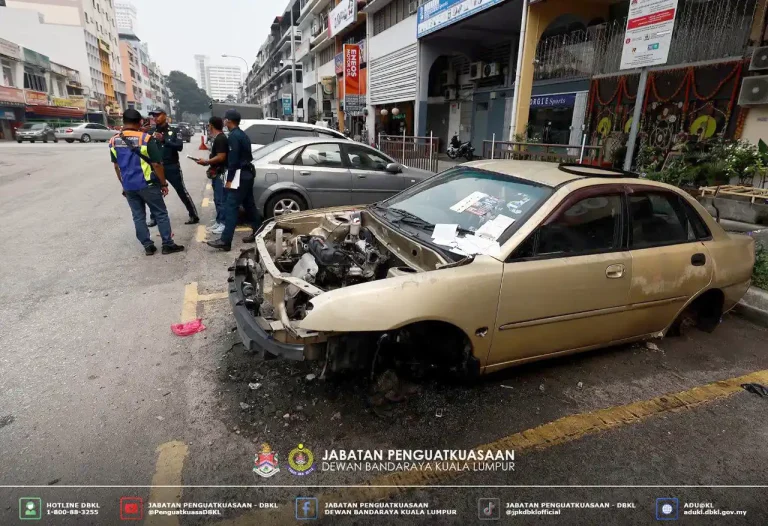
Every week, as I meet residents and business owners across Kuala Lumpur, one persistent complaint keeps coming up: abandoned vehicles.
As a former member of the Kuala Lumpur City Hall advisory board, I chaired its corporate communications committee and had access to AduKL, the council’s main public complaints portal.
Based on the number of complaints received, the single biggest headache for KL residents was zombie cars.
The public deserves to understand the legal and operational complications involved in getting rid of this menace.
These rusted, derelict vehicles sit idle by the roadside for months, sometimes years. They take up precious parking spaces, become breeding grounds for rodents and mosquitoes, and turn housing estates and commercial hubs into eyesores.
The frustration spilled into Parliament recently when Tebrau MP Jimmy Puah Wee Tse questioned the Ministry of Housing and Local Government on the federal government’s plans to clear abandoned vehicles from public roads. Minister Nga Kor Ming confirmed that the Cabinet had agreed to revise the existing guidelines, with the aim of speeding up their removal, deregistration and scrapping across local councils by the end of 2026.
I welcome this move. But solving the problem also means setting the record straight about how vehicle disposal works and why local authorities such as Kuala Lumpur City Hall have faced unfair criticism.
The truth about KL City Hall and Car Medic
A few months ago, political critics attacked City Hall over its partnership with Car Medic as an authorised vehicle disposal contractor. They claimed the council had handed enforcement powers to a private company.
Abandoned vehicles are a serious issue. To the layperson, it might seem that any scrap-metal yard could simply take them away. But vehicles contain hazardous components, including engine oil, battery acid, heavy metals and other toxic fluids, which must be handled with strict environmental precautions. This is precisely why a specialised company such as Car Medic would have been selected. Seeing the public confusion and political attacks at the time, I stepped forward to defend the council.
The actual disposal of abandoned vehicles falls under the jurisdiction of the Department of Environment (DOE). City Hall and the Road Transport Department act as enforcement agencies, instructing Car Medic to carry out the towing.
Car Medic has no statutory enforcement or judicial authority. It cannot arbitrarily tow, impound or scrap anyone’s vehicle.
Car Medic operates as an Authorised Automotive Treatment Facility licensed by the DOE under the Environmental Quality Act 1974. Its role is technical and environmental, and includes:
- Safely draining toxic motor oils, battery acids and other hazardous substances before recycling the vehicle chassis.
- Processing digital e-Deregistration with the Road Transport Department.
- Issuing official Certificates of Destruction to ensure scrapped vehicles cannot be cloned or legally returned to the road.
Entrusting disposal to a licensed facility is standard environmental management practice. The bottleneck was never the contractor. It was the law.
The legal gridlock
Back in 2024, following discussions with officials from the Transport Ministry, the police, the Road Transport Department and City Hall, the real roadblock became clear. Disposing of an abandoned vehicle in Malaysia involves navigating four distinct laws:
1. Street, Drainage and Building Act 1974: Gives local councils the power to clear obstructions from public roads.
2. Local Government Act 1976: Allows councils to engage external providers for municipal waste management.
3. Road Transport Act 1987: Governs vehicle ownership and enforcement relating to road obstructions.
4. Environmental Quality Act 1974: Regulates the disposal of toxic waste through licensed treatment facilities.
Under the Road Transport Act, a vehicle remains private property. City Hall and the Road Transport Department cannot simply crush a vehicle because it appears to have been abandoned. Historically, councils have had to publish physical notices, trace registered owners, wait for mandatory response periods and obtain court orders for forfeiture.
Storage compounds make matters worse. The Road Transport Department’s depot space in the federal capital is limited. City Hall has larger impound yards, but without court clearance or statutory forfeiture, those yards can quickly fill up. The system then stalls. Councils can tow the vehicles, but they have to hold them indefinitely while the legal processes drag on.
How to move forward
The Cabinet’s decision to update the Abandoned Vehicles Management Guidelines could change the situation. The inter-agency review focuses on several practical measures:
- Shorter legal timelines, allowing councils to declare vehicles forfeited without clogging up the court system.
- Direct e-Deregistration with the Road Transport Department once council criteria have been met, allowing contractors to recycle the chassis properly.
- Rules covering strata compounds, giving Joint Management Bodies the tools to remove derelict vehicles from private residential parking areas.
- Simple voluntary scrappage options for owners who want to dispose of old vehicles without having to first settle outstanding summonses.
The real question
The debate over zombie cars is not about who gets a towing contract. It comes down to updating outdated laws so local councils can keep neighbourhoods and public areas clean and safe.
With the Cabinet and key ministries working towards aligning the Road Transport Act, the Street, Drainage and Building Act and local guidelines by the 2026 deadline, Malaysia is finally moving away from endless impounding and towards proper vehicle recycling. This would protect local councils, uphold environmental standards and improve the quality of life for Kuala Lumpur residents.
The question now is: when in 2026 can these changes finally be implemented?
The views expressed here are the personal opinion of the writer and do not represent those of Twentytwo13.