KUALA LUMPUR: Journeys that go against the grain are often the most gruelling, but also the most worthwhile.
In 1994, Malaysian women secured a landmark victory with the passing of the Domestic Violence Act, after years of abuse had gone unaddressed due to the lack of adequate legal protection.
The Domestic Violence Act 1994 was passed following nearly a decade of intense lobbying, public campaigning and bureaucratic negotiations. It was a major win for victims and a sign of progress for Malaysian society.
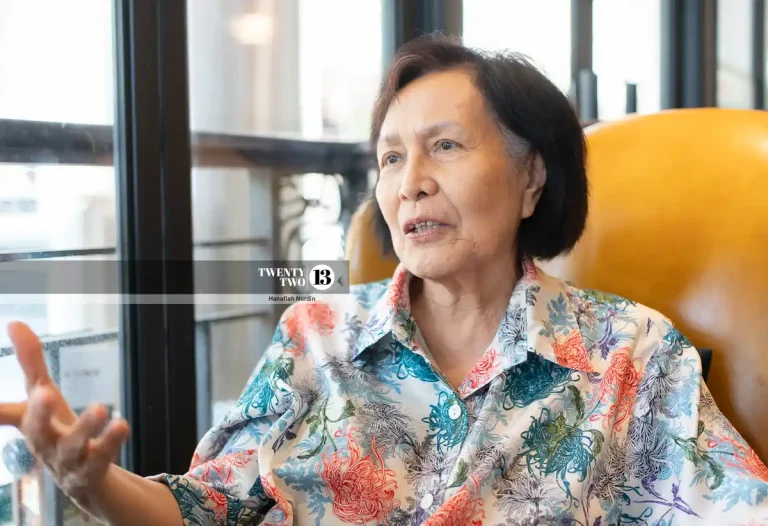
One of the key figures behind the push for the Act was sociologist, feminist activist and political figure Dr Rohana Ariffin (pic) who fought for women’s rights at a time when they were considered a foreign idea and widely condemned by the public.
Rohana, an academic who spent more than two decades teaching industrial sociology, women’s studies and poverty at Universiti Sains Malaysia’s Department of Sociology, spoke candidly about her involvement in the women’s movement, which remains an integral part of her life.
“After graduating, I had a short stint with Felda (Federal Land Development Authority), then I moved to Universiti Sains Malaysia, which was where I met some of my colleagues who would then be part of an association that helped make changes to the feminist movement in Malaysia,” Rohana told Twentytwo13 recently.
Already involved in activism in Kuala Lumpur, Rohana was keen to put her skills to use in Penang when she moved to the island.
“Due to my involvement in activism in Kuala Lumpur, some of my peers in Women’s Aid Organisation suggested I continue my work for the community in Penang, but I didn’t know anyone there at the time,” she said.
However, she soon met like-minded activists, including Annie Chan, who was then involved in a group working on family planning.
Through Chan, Rohana met the late human rights lawyer Mikki Goh, and the three became the pro-tem committee for an organisation that would go on to weather many changes and challenges.
Women’s Centre for Change Penang (WCC) was founded on July 1, 1985, originally registered as the Women’s Crisis Centre, in a small building near the Pulau Pinang Municipal Council office.
Rohana recalled that WCC’s registration process was relatively straightforward.
“At that time, the Registrar of Societies (ROS) was very open about it. So we registered the society, then known as Women’s Crisis Centre, in 1984,” she said.
In its early years, WCC operated from a small office with just one table and a telephone, but harassment soon followed.
“Even then we were harassed. We received anonymous calls asking about our organisation.
“People would call and ask, ‘What women’s association? You’re taking away the power from the men. You’re interfering with our household matters, which are none of your business,’” Rohana recalled.
Some even went so far as to insult the activists, calling them a bunch of “frustrated and deprived women”.
Rather than deter them, the harassment, name-calling and occasional threats strengthened their resolve to build on what they had started.
“When WCC was officially founded and registered, it was to support women facing domestic violence. We knew that at the time we had a strong organisation but there was no law to back us up and to protect the women we were protecting,” Rohana said.
During one of their meetings, the activists decided to join women’s groups in Kuala Lumpur that were already working on proposals for the Domestic Violence Act.
“So it was a collaboration with Kuala Lumpur and Sarawak organisations, to achieve this,” Rohana said, adding that the campaign also received support from academics at various universities.
“Contrary to what people may think, there were many progressive men at the time who supported this cause as well,” she said.
Despite vilification from various quarters, including the media, the campaign persevered. After 10 years of fighting for change, the Domestic Violence Act 1994 was passed.
Rohana recalled the struggle with pride, noting that the law was needed to protect women whose safety had long been overlooked and to provide a legal basis for action against perpetrators.
The Act would also help pave the way for further protections for vulnerable individuals and family members facing abuse and human rights violations.
Now 81, Rohana marvelled at the determination it had taken to sustain the decade-long campaign.
“I have no idea where we got the courage to persevere, but we did,” she said.
During the campaign, the activists gave awareness talks to female plantation workers and organised events at youth parks to educate the public about domestic violence.
Rohana said the road to implementing the Act was not straightforward. While there were dissenting voices, there were also supporters, including police officers who were cooperative but often stressed that no specific law addressed domestic abuse.
After the Act came into force, the activists continued conducting awareness talks, although attendance among men was often low.
“The talks were supposed to remind them that there is a law now that can be enforced. Although the police were still not well versed about it, but the law was there to be applied,” she said.
Rohana also recalled the late former Inspector-General of Police Tan Sri Haniff Omar as a police officer who was ahead of his time.
“He was very progressive in his thoughts and approach. I remember him bringing the Royal Canadian Police to one of the main hotels in KL at the time to give a talk on violence against women.
“The talk was attended by NGOs, and some of the top cops,” she said.
Rohana regarded the event as an important collaboration between the police and women’s rights activists, who shared the goal of protecting female victims of abuse.
Reflecting on today’s feminist movement, Rohana said sisterhood remained an integral part of feminism and women’s rights, but was lacking.
“We need to bring sisterhood back. We speak up when one of our female counterparts is being oppressed and mistreated. I see a lack in that nowadays. It is never supposed to be an unhealthy competition or about pitting women against each other. We need to look out for other women, especially if you are more privileged than others,” she said, stressing the importance of class consciousness.
Historically, women from different social backgrounds have faced unequal opportunities, exposure and treatment, an issue Rohana said was often overlooked.
“We must not ignore how social status affects women who are on the periphery. A person who stays in a comfortable suburban home may have different privileges compared to those who are not. The struggle is different, and the more we play a role in elevating each other, the better we are as a society,” she said.
Having spent more than two decades in academia, Rohana remains committed to intellectual development and lifelong learning.
“Feminists, activists, anyone who is in the business of pushing for change need to read. Never limit your reading. Understand history, read philosophy. Never tire of reading and learning. Knowledge is a powerful tool, and critical thinking should never be replaced with indoctrination,” she said.