The recent assault on journalist and Twentytwo13 editor Haresh Deol has raised serious questions about the motives behind the attack and its broader implications for media freedom in Malaysia. Although police have suggested that the motive is believed to be personal, the characteristics of the incident point to a more complex scenario.
The assault occurred in broad daylight in a public area. The attackers filmed the incident, and nothing was stolen. These elements are highly unusual for a typical personal dispute or opportunistic crime.
At the same time, Haresh has been reporting extensively on the sensitive “doctored documents” scandal involving heritage players and national-level sports governance. In situations where a journalist is actively exposing wrongdoing, it would be premature to dismiss the possibility of a work-related motive.
The most balanced position at this stage is to recognise that the attack bears strong hallmarks of an intimidation-style act plausibly tied to his reporting, while acknowledging that the investigation remains ongoing and further evidence is necessary.
Historically, both globally and within the region, assaults on journalists covering corruption, governance or organised crime have often been linked to powerful individuals or groups seeking to silence critical reporting. While perpetrators are not always formally identified, patterns have repeatedly shown that violence against journalists is rarely random, especially when no robbery or personal gain is involved.
In Malaysia, journalists who probe high-profile controversies or institutional misconduct face inherent risks. Intimidation is a tactic long associated with those wishing to avoid public scrutiny. Nevertheless, determining the masterminds behind such attacks is exceedingly difficult, particularly when proxies, hired individuals or “foot soldiers” carry out the assault. These layers of separation often obscure the link between the attackers and those who may have ordered the intimidation.
The fact that the assault was filmed carries serious implications for how the incident should be interpreted. When an assault is recorded and nothing is stolen, it typically indicates a deliberate attempt to send a message. Such acts aim not only to harm the victim but to signal to others – especially fellow journalists – that pursuing certain topics may invite retaliation.
Violence recorded and carried out openly elevates the attack from a criminal act to a form of symbolic intimidation. The goal is to punish the individual while discouraging others from continuing similar investigative work. This transforms the incident into something more organised and premeditated than a spontaneous altercation.
From an investigative perspective, a case of this nature demands a comprehensive and impartial approach. Investigators would first need to secure all available video footage from public and private sources, including CCTV around the scene and any recordings from witnesses. Because the assault was filmed by the perpetrators, recovery and authentication of this video will form a crucial part of the evidence chain.
Witness statements from nearby shop employees, passers-by and security personnel will be essential in reconstructing the sequence of events. Medical documentation of Haresh’s injuries will further support the nature and severity of the assault for prosecution under the Penal Code.
The next phase involves tracing and identifying suspects through facial recognition, CCTV cross-matching, vehicle registration data and analysis of mobile phone activity if devices were used during the recording. Investigators must assess all possible motives – both personal and professional – without prematurely prioritising one over the other. They must examine whether the attackers had any connections to individuals or groups who may have been affected by Haresh’s reporting.
Transparency throughout the investigative process is critical, particularly given the potential involvement of influential parties. Public confidence hinges on the integrity of the investigation, proper evidence handling and clear communication from the authorities.
The attack also raises broader concerns about press freedom and the climate in which Malaysian journalists operate. When a journalist is violently targeted, especially in such a calculated manner, it sends a chilling message to the wider media community.
Acts of violence in public settings can create fear, discourage journalists from investigating sensitive subjects and undermine the essential watchdog role of the media. Over time, this may lead to self-censorship, where journalists avoid stories that could provoke backlash. Such an environment weakens democracy, accountability and public trust.
However, strong and decisive action by authorities can counteract this chilling effect. A credible and transparent investigation, coupled with swift prosecution, sends a clear signal that violence against journalists will not be tolerated.
Authorities should also consider enhanced charges if evidence eventually shows that the assault was motivated by his reporting, including provisions related to intimidation or attempts to interfere with press freedom. Beyond this incident, Malaysia would benefit from stronger institutional protections for journalists, such as clear protocols for responding to threats, designated contact points within law enforcement and structured mechanisms for reporting intimidation.
In the long term, sustained threats and violence can profoundly alter how journalists navigate their work. Some may avoid high-risk topics, while others may leave investigative journalism altogether. This would represent a significant loss to the public and to democratic accountability.
Yet attacks like this can also galvanise solidarity among media practitioners, civil society and the public – provided that the institutional response is firm, transparent and rooted in a commitment to protect press freedom.
While it is too early to state definitively that the assault on Haresh was ordered in response to his reporting, the circumstances strongly suggest that it may not have been a random or purely personal incident. The recording of the attack, the choice of location and the absence of theft point toward an intent to intimidate.
It is therefore imperative for law enforcement to conduct a thorough and independent investigation. Ensuring justice in this case is not only about accountability for the perpetrators but about preserving journalists’ safety, defending press freedom and safeguarding the public’s right to information.
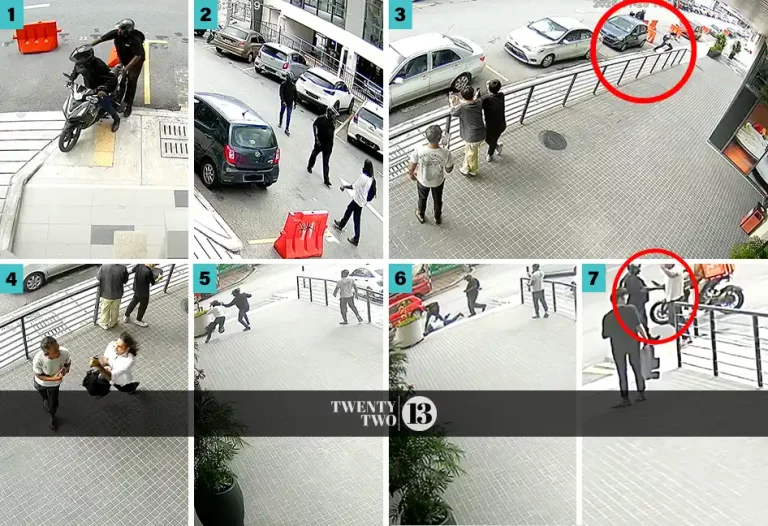
Main image: CCTV images obtained by Twentytwo13 show:
1. Two individuals parking their motorcycle outside the Tanjung Balai Group building in Bangsar Baru.
2. They approach Haresh, who is walking towards his car.
3. Sensing something amiss, Haresh (circled) runs away. A third person, wearing a white T-shirt, positions his phone as if recording the scene.
4. The man in the white T-shirt moves towards Haresh and shoulder-charges him.
5. Haresh falls to the ground, while one of the two individuals in black moves towards him.
6. Both individuals in black approach Haresh, punching and kicking him, while the man in white continues recording.
7. One of the individuals in black appears to exchange words with the man in white before both leave the scene.