
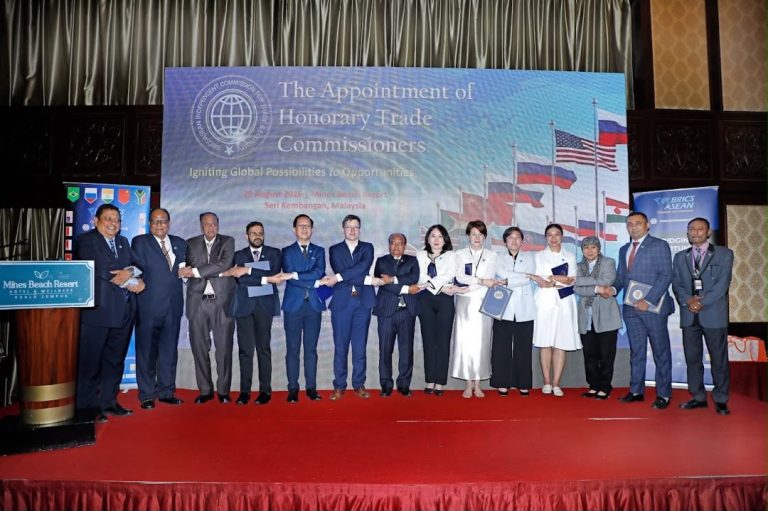
KUALA LUMPUR: The BRICS-Asean Chamber of Commerce and the recently established BRICS-Asean Independent Commission for Trade and Economy signal an ambitious new direction in international economic cooperation, creating practical bridges between businesses, investors, industries and markets across member countries, Asean and the wider global economy.
The BRICS-Asean Independent Commission for Trade and Economy is built around a simple but powerful proposition – economic cooperation must move beyond government-to-government relationships and create stronger connections between the people and institutions driving commerce.
BRICS-Asean Chamber of Commerce president Thayalan Nathan said the commission’s direction is fundamentally about removing barriers and creating a more resilient global trading ecosystem.
“Our mission is clear – to break down market barriers, champion equitable trade practices and drive sustainable economic growth,” he said.
That philosophy, Thayalan said, becomes particularly relevant as it looks towards 2030.
“The objective is not simply to create another business network but to build an ecosystem where a Malaysian company can, for example, identify an opportunity in India, an Asean investor can access a BRICS market, a technology company can find strategic partners, and capital can be connected to commercially viable projects across borders,” he explained.
The commission’s charter sets out a vision to become a premier independent, inter-regional platform for sustainable trade, investment, finance and economic integration between BRICS, Asean and global economies. Its mission encompasses bilateral and multilateral trade, cross-border investment, strategic partnerships, economic diplomacy, digital development and wealth creation.
As a facilitator, the commission aims to connect governments, corporations, investors, chambers, industries and entrepreneurs.
Thayalan believes Malaysia offers a compelling geographical and commercial base for such an initiative.
Located at the intersection of Southeast Asia’s major maritime and commercial routes, the country sits within Asean while maintaining extensive economic relationships with major global markets.
Kuala Lumpur, he said, provides a natural meeting point between Asean businesses and the broader BRICS economic landscape.
“More importantly, the founding documents establish the organisation in Malaysia through a Malaysian-registered trade organisation, giving the initiative an identifiable institutional home from which its international network can develop,” said Thayalan.
The strength of the model, however, will ultimately depend on people rather than geography.
Its trade commissioners are expected to identify opportunities, provide market intelligence, facilitate business introductions, support investment pipelines and help companies navigate international markets.
The charter requires proven involvement in international trade or investment facilitation, alignment with the commission’s objectives, and strong moral, ethical and professional standing. Two governing members of the executive council may propose and second a commissioner.

Thayalan says the selection of trade commissioners is based on professional competence and sectoral expertise.
The founding network, he said, demonstrates this sector-and-market approach.
“Commissioners have been designated across Malaysia, India, Sri Lanka, Indonesia, the UAE, Australia and other jurisdictions, with expertise spanning international business, finance, logistics, innovation, digital economy, human capital, tourism and halal diplomacy.”
Thayalan added that such diversity could become one of the initiative’s greatest strategic advantages.
He said the ambition is to transform this network into an active global commercial intelligence and opportunity-generation system – where commissioners do not merely carry a title but deliver measurable trade introductions, investment opportunities, partnerships, market access and economic projects.
Thayalan said the appointment agreement itself establishes performance expectations, including strategic partnerships, investment introductions, trade facilitation outcomes and operational contributions.
The ultimate measure of BRICS-Asean’s success will not be the number of commissioners appointed or events conducted. It will be the economic value created.
By 2030, BRICS-Asean’s strategic direction could see a mature ecosystem of trade missions, investment roadshows, sector-specific working groups, digital trade platforms, market intelligence, policy recommendations and cross-border business matchmaking – all already identified within its charter.
“In an uncertain global economy, businesses do not need more barriers. They need trusted connections, reliable intelligence, new markets and partners capable of turning opportunities into transactions,” Thayalan stressed.
“BRICS-Asean’s greatest opportunity is to become the bridge between markets that increasingly need one another. If its commissioners can convert professional networks into genuine trade, investment and strategic partnerships, Malaysia may well become more than its headquarters.”
“I believe it could become the platform from which a new generation of Asian-led international economic opportunities is connected to the world.”


