
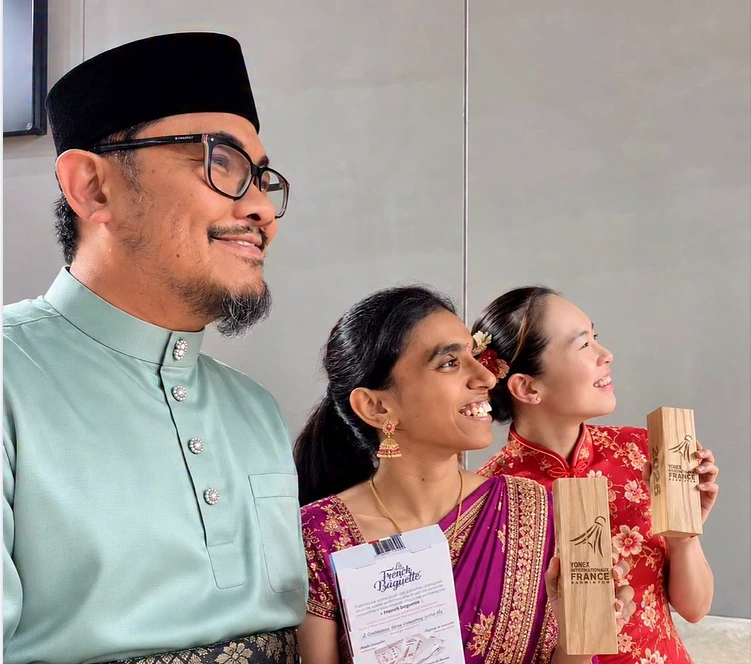
KUALA LUMPUR: It was a simple image posted on Facebook by national badminton doubles coach Rosman Razak this afternoon.
The caption carried just four words: “Terima kasih (Thank you). Kami (We) Malaysians.”
In the photograph, Rosman wore a baju Melayu complete with sampin and songkok, while women’s doubles pair M. Thinaah was in a saree and Pearly Tan in a cheongsam.
The duo had just competed in the French Open where they lost 21-10, 17-21, 16-21 to Mayu Matsumoto-Yuki Fukushima of Japan in the final yesterday.
It was an image that captured the idealised vision of Malaysian pluralism, one that required no elaborate prose to convey its point.
More than six decades after independence, the national psyche remains disproportionately starved of genuine integration. We still applaud when a fellow citizen speaks a language other than their own, marveling at fluent Bahasa Melayu from a Chinese colleague or a smattering of Hokkien from an Indian neighbour.
What ought to be the mundane baseline of our national existence is still celebrated as an exception. This is where the hypocrisy of our public policy becomes glaringly obvious. We routinely pay lip service to the unifying power of sport, yet actively undermine it in the places where foundation-building actually occurs.
When school administrators prioritise micromanaging physical education attire, such as banning shorts for young children, they signal that difference is something to be policed rather than embraced.
On Oct 15, Puncak Borneo MP Willie Mongin shared in Parliament that a teacher recently told him that some children refused to sit next to their classmates of different faiths.
Herein lies the institutional failure of the Education Ministry, Youth and Sports Ministry and the Unity Ministry.
Official strategy has relied on cosmetic initiatives such as funding one-off sports carnivals, commissioning glossy videos, and delivering boilerplate ministerial speeches on unity. Slogans aplenty, but none of them build lasting social cohesion.
If the powers-that-be are serious about social engineering, elite athletes would not merely be deployed for photo opportunities after winning medals but declared as unity ambassadors. Athletes should be invited to schools during sports days and prize giving ceremonies.
And the initiatives involving our national sporting heroes should be ongoing throughout the year.
A high-performance team comprising athletes, sports scientists, dieticians, masseurs, and administrators from every conceivable background operates on absolute trust and singular alignment. They share a water bottle not out of political correctness or for ‘likes’ on social media, but because they are locked into a common cause – the pursuit of excellence.
That is the exact operational philosophy required for Malaysia.
The image of Rosman, Thinaah, and Tan provided a glimpse of what this country looks like when it is comfortable in its own skin.
While those with narrow lenses will continue to view them through the divisive prism of race, many others will see something far simpler and infinitely more valuable; a mirror of who we ought to be every single day.


