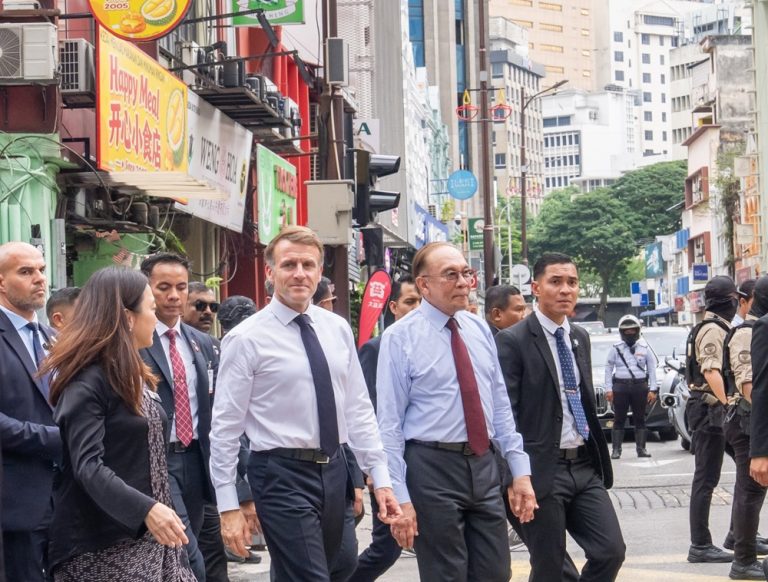
French President Emmanuel Macron’s recent official visit to Malaysia presents a defining opportunity to set new frontiers in a vital strategic partnership that transcends traditional economic and diplomatic engagement.
With increased geopolitical fragmentation, economic uncertainties and technological competition, Malaysia and France are uniquely positioned, both historically and in the future, to reinforce one another’s strategic strengths and address common vulnerabilities.
Macron’s visit is the first by a French president since François Hollande’s trip in 2017, and it is long overdue.
The proposed elevation of bilateral ties to a Strategic Partnership, alongside key deals covering defence, higher education, critical minerals and energy transition, underscores the growing recognition that both countries provide significant, underlying complementing factors to one another in strengthening deterrence, preserving security and stability, and sustaining resilience and readiness.
The strategic convergence of two middle powers
Being a permanent member of the United Nations Security Council, a nuclear power, and one of Europe’s foremost military, technological and industrial powers, France displays strategic capabilities that few nations can replicate.
Its particular strengths in aerospace, naval engineering, advanced weaponry, civilian nuclear technology, artificial intelligence, telecommunications and space systems all provide a foundation and key future factors for deeper international partnerships.
Another distinct feature is that, unlike other European powers whose Indo-Pacific presence depends primarily on external deployments, France is geographically embedded in the region through its overseas territories, including Réunion, Mayotte, New Caledonia and French Polynesia.
This extensive maritime domain and permanent regional military presence geographically give Paris enduring security interests across the Indian and Pacific Oceans, and this will be a distinct and strategic feature in complementing and supporting the overall security calculations in Southeast Asia and the wider Indo-Pacific.
Malaysia, meanwhile, sits at the intersection of one of the world’s most consequential maritime crossroads, connecting the Indian Ocean and the Pacific through the Strait of Melaka and the South China Sea.
Being among the original founders of Asean, the country has advanced manufacturing capabilities, extensive trade networks and an established semiconductor ecosystem, which will provide France with an important gateway into Southeast Asia.
With other core areas including regional connectivity, industrial scalability, proximity to critical supply chains and a growing regional role, Malaysia is a natural factor in France’s bigger Indo-Pacific ambition.
For Kuala Lumpur, Paris provides an opening to diversify strategic partnerships beyond traditional networks.
Both countries share an interest in preserving strategic autonomy, reducing excessive dependencies and maintaining a rules-based international order.
France’s Indo-Pacific strategy is driven by the increasingly strategic need to safeguard maritime security, diversify economic partnerships and solidify its position in the global centre of economic and geopolitical competition.
The underlying convergence has gained further prominence: a strategic interdependence where France seeks greater strategic reach and economic resilience in the Indo-Pacific, while Malaysia requires greater technological sophistication, defence capabilities and diversification of external partners.
Defence and security: From procurement to joint operational readiness
Defence cooperation, the optimisation of security interests, and a strong and credible joint deterrence must become the central pillar of this emerging partnership.
France has long formed a vital defence anchor for Malaysia, particularly through the Royal Malaysian Navy’s two Scorpène-class submarines, KD Tunku Abdul Rahman and KD Tun Razak.
The ongoing construction of five French-designed Gowind-based Littoral Combat Ships, supported by Naval Group’s design and combat-system expertise, further underscores the depth and strength of the defence-industrial relationship.
The Royal Malaysian Air Force also operates four Airbus A400M strategic airlifters, while French companies contribute military capacities such as propulsion, sensors and other systems to Malaysia’s defence platforms.
The next stage must focus on joint interoperability, operational readiness, technology transfer, local defence-industrial capacity and the development of long-term maintenance and support ecosystems.
France’s carrier strike group deployment during the CLEMENCEAU 25 mission has showcased the continuous capacity of French defence systems and the practical possibilities of expanded operational coordination.
Existing and past joint exercises, such as the Pégase 2023 air exercise and MALFRENCH DAGGER 2025 involving Malaysian and French air force special operations personnel, provide a strong basis and can be institutionalised and expanded to include a more sustained capacity involving regular joint maritime and air exercises, anti-submarine warfare, maritime domain awareness, and other domains including search-and-rescue operations and humanitarian assistance.
This could eventually extend to a larger ecosystem involving unmanned maritime and aerial surveillance platforms, electronic warfare, cybersecurity, counter-drone technologies and intelligence-sharing arrangements.
Equally important, Malaysia offers France a strategically located partner for maritime security cooperation for joint regional benefits in upholding the rule of law and the sanctity of international maritime law in the region, amidst heightened risks of tensions and conflicts.
Building a new economic and industrial partnership
The economic relationship is substantial, yet it remains below its huge expected potential. Bilateral trade reached RM17.78 billion in 2025, and hundreds of French-owned companies and subsidiaries operate in Malaysia, supporting approximately 30,000 jobs across different sectors.
However, more can be done, and the larger strategic opportunity lies in moving from commercial transactions towards integrated industrial ecosystems.
Malaysia’s already established capacity in aerospace manufacturing and maintenance, repair and overhaul capabilities can complement France’s expertise in aircraft engineering, propulsion, avionics and high-value systems integration.
Joint production, research facilities, specialist training and talent cultivation should be prioritised to deepen Malaysian participation in high-technology value chains.
France can benefit from Malaysia as a regional manufacturing, engineering and distribution base, while Malaysia can leverage French industrial networks to deepen its market access and technological connections across Europe.
Energy, space and the next technological frontier
France’s substantial experience in nuclear power, renewable energy systems, energy efficiency and sophisticated grid infrastructure provides a new, expertise-laden platform for Malaysia to accelerate its energy transition.
Potential collaboration can encompass and synergise solar and hydroelectric integration, grid modernisation and energy storage.
France could contribute technical expertise to Malaysia’s energy infrastructure modernisation, while Malaysian companies offer regional project experience and access to Asean markets.
Civilian nuclear technology is a strategic and future-driven frontier that should be explored through research, safety training and regulatory cooperation.
France seeks to diversify access to rare earth materials, and Malaysia’s strengths in semiconductor assembly, testing, packaging and increasingly advanced manufacturing can complement French capabilities in chip design, research, specialised materials and semiconductor technologies.
Beyond energy, space technology is the strategic new frontier of exciting ventures for Malaysia, especially as France possesses world-class expertise in satellite engineering, space science, Earth observation and launch technologies.
Priority areas that could benefit Malaysia include satellite development, climate and environmental monitoring, maritime surveillance, disaster prediction, remote sensing and space-related cybersecurity.
Space has direct applications in maritime security, food security, disaster response, connectivity and national resilience, and remains a critical frontier for the country’s new phase of economic and technological transformation.
A Malaysia-France space partnership would increase the prospect of Malaysia becoming a regional hub for satellite data applications and related research, especially in the areas of artificial intelligence, quantum technologies, digital security, advanced robotics and biomedical innovation, with far-reaching returns.
Higher education and people-to-people ties as strategic multipliers
Lasting bilateral relations cannot be sustained exclusively through defence contracts and investment agreements, but must be anchored by the solid foundation of people-to-people connectivity and cultural appreciation.
Cultural exchanges, tourism, language education, film, the arts and youth mobility, alongside deeper research and higher education synergy, provide the enriching capacity-building momentum to further build trust and openness. This will enhance this first layer of bilateral ties in areas of low politics, creating ripple effects in areas of high politics and deepening mutual understanding beyond government and corporate circles.
Malaysia’s multicultural society and longstanding position as a bridge between civilisations provide a distinctive platform for France to strengthen its societal engagement with Southeast Asia at a more personal and humanistic level.
The partnership must be sustained and developed beyond individual political leaders and electoral cycles, and must be nurtured further through institutional linkages, private-sector participation and enduring people-to-people engagement for the long-term sustenance of progressive and future-driven endurance and resilience.
In short, Paris brings technological depth, defence sophistication, industrial innovation and global diplomatic influence, while Kuala Lumpur contributes strategic and important geography, growing manufacturing and technological capabilities, regional connectivity and a fresh drive in key new economic domains.
Both can reinforce each other’s strategic strengths, reduce vulnerabilities and create opportunities that neither could realise as effectively alone.
As both countries approach the 70th anniversary of diplomatic relations in 2027, Macron’s visit should be seen and remembered not merely as another milestone in a longstanding friendship, but as the beginning of a more ambitious and far-sighted strategic transformation.
The future of Malaysia-France relations must endure current and future turbulence for a safe and prosperous future for both countries, as well as for both Europe and Asia.
Collins Chong Yew Keat is a foreign affairs, security and strategy analyst at Universiti Malaya.
The views expressed here are the personal opinion of the writer and do not represent those of Twentytwo13.