By now, most Malaysians perceive that the country’s judicial system applies the law differently across society.
This is despite the fundamental principle that no one is above the law, all are equal before it, and justice is blind to creed, status, wealth and lineage.
Yet the reality on the ground appears to contradict this principle, reinforcing the perception that some are more equal than others and enjoy privileges. This is the consequence of an uneven terrain of justice.
The common man typically bears the full brunt of the law without reprieve, while the elite have access to avenues that could circumvent its normal course.
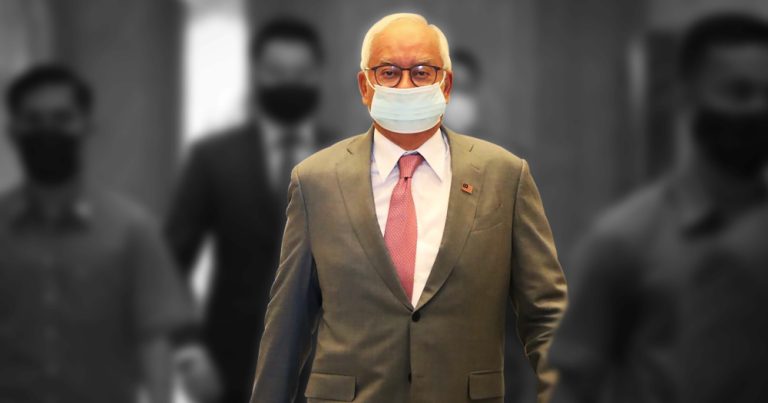
This disparity in the administration of justice has come under public scrutiny over the special considerations and privileges granted to prisoner Datuk Seri Najib Razak.
Najib was charged and found guilty at all three levels of the judiciary by nine eminent judges of misappropriating RM42 million in the SRC International case. He has also been convicted in the 1MDB case of fraud and misappropriating RM4.2 billion, and sentenced to 15 years in prison and fined RM1.1 billion. He also faces another case involving income tax evasion.
Unlike the common prisoner, Najib has thus far received two pardons.
The Pardons Board, chaired by the Agong, operates within the justice system but independently of the courts’ judicial process.
Its primary consideration is to extend mercy to eligible prisoners who meet the conditions for a pardon.
The Agong has the sole prerogative to make the final decision, as enshrined in Article 42(1) of the Federal Constitution. The provision states that the Yang di-Pertuan Agong has the power to grant pardons, reprieves and respites for all offences tried by court-martial and all offences committed in the Federal Territories of Kuala Lumpur, Labuan and Putrajaya. The Ruler or Yang di-Pertua Negeri of a state has the power to grant pardons, reprieves and respites for all other offences committed in his state.
In considering a pardon, the Agong takes into account the board members’ deliberations and recommendations, which would likely encompass the gravity of the offence, its impact on society and the sanctity of the justice system.
Ultimately, the decision rests solely with the Agong, who may choose whether to heed the board’s recommendations.
In Najib’s case, the previous Agong reduced his SRC sentence from 12 years in prison and a RM210 million fine to six years’ imprisonment and a RM50 million fine.
At the time, the public was not privy to the Pardons Board’s deliberations or recommendations and could only speculate on the rationale behind the sentence reduction and fine remission.
However, the minutes of the second pardon have since been released, revealing that board members were unanimous in recommending that Najib continue serving his sentence in Kajang Prison rather than be transferred to house arrest.
The Agong, however, chose not to heed the recommendation, granting Najib the special privilege of serving the remainder of his sentence under house arrest despite there being no provision for such detention in the penal system, as pointed out by retired Federal Court judge Harmandar Singh Dhalliwal, a Pardons Board member.
For most Malaysians, Najib’s crimes are serious because he squandered the nation’s wealth for personal and political gain, leaving the public saddled with billions of ringgit in repayments that could otherwise have gone towards their welfare. He has also thus far shown no remorse for his crimes.
It is extraordinary that he is being pardoned while other cases remain pending. One involves the 1MDB fraud, with total liabilities of RM54.1 billion, for which he was sentenced to 15 years in prison and fined RM1.2 billion. Another is the RM1.6 billion tax case.
The intricacies of Malaysia’s judicial system may elude the layman, but he understands the difference between right and wrong and can recognise when justice is meted out differently to the common man and the privileged.
When he sees the rich and powerful, having committed serious and heinous crimes, receiving reprieve while a destitute person bears the full brunt of the law for stealing food to feed his family, he begins to question whether justice is truly blind.
The basic tenet of the law is that if you commit a crime, you pay for it. But the severity of punishment or reprieve should depend on the circumstances.
The law must be applied equally to all, irrespective of colour, creed, status, wealth or connections, to engender trust in the justice system. Yet human weaknesses such as greed, lust, avarice and the pursuit of power can turn the law into a mockery, leaving justice on uneven terrain.
The views expressed here are the personal opinion of the writer and do not represent those of Twentytwo13.