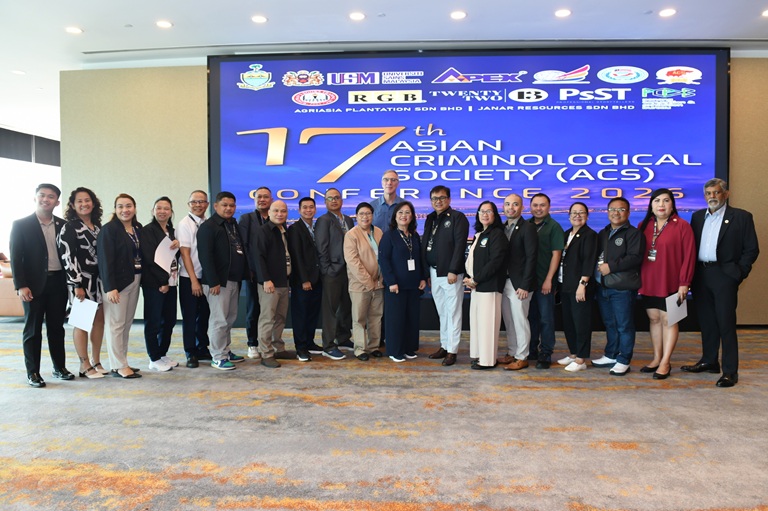
GEORGE TOWN: The 17th Asian Criminological Society Conference 2026, held from July 15–17, marked a significant milestone for a community united by a common purpose in charting a critical roadmap for the future of regional justice.
The conference, themed “Contemporary Insights on Crime Trends and Patterns: The Impact of Criminology”, attracted more than 200 local and international delegates, including criminologists, legal experts, scholars and academics from across the region.
It was organised by Universiti Sains Malaysia’s Centre for Policy Research, the Asian Criminological Society, the Penang government and the Malaysia Crime Prevention Foundation (Penang). Twentytwo13 was the official media partner.
Organising chairman Datuk Dr P. Sundramoorthy said the event, which brought together individuals from diverse legal traditions and academic backgrounds, fostered healthy debate and knowledge-sharing while challenging conventional wisdom, reflecting the vital role of modern criminologists.
“Criminology is not about defending existing systems, it is about questioning whether those systems serve justice,” he said.
“We leave as something much greater than mere delegates attending a conference. We leave as a community, bound by a common purpose, united by scholarship and justice.”
Professor Dr Jianhong Liu, chairman of the General Assembly of the Asian Criminological Society, thanked all participants.
“This includes speakers, delegates and students who made the effort to attend this prestigious conference and helped make it an event filled with insightful and innovative ideas that can shape the future.”
Meanwhile, Asian Criminological Society president Professor Dr Gerry Cano expressed hope that the event would serve as a catalyst for regional experts.
“I hope what has unfolded here is only the beginning as we push for Asian criminologists to contribute equally to the global body of knowledge in criminology, the social sciences and criminal justice,” Cano said.
The final day of the conference featured two keynote addresses and a panel discussion on the impact of prohibition on public health and the criminal justice system.
Among the keynote speakers was Professor Dr Selvakumar Manickam, director of the Centre for Cyber Security at Universiti Sains Malaysia.
Selvakumar spoke on “Sovereign Shields and Digital Battlegrounds: Redefining Criminology in the Age of National Cyber Infrastructure and Transnational Cybercrime”.
He highlighted how a cybercriminal operating from one continent could disable a hospital thousands of kilometres away, while a state-sponsored hacker could infiltrate a nation’s energy grid without crossing a single border.
“A ransomware syndicate may consist of programmers in one jurisdiction, infrastructure providers in another, laundering specialists elsewhere and victims spread across dozens of countries,” Selvakumar said, underscoring the complexity of modern cybercrime.
The conference also heard from Dr Emeline C.H. Smith of the University of Glasgow, who delivered a keynote address titled “Criminology from the Periphery: Rethinking Crime in a More Than Human World”.
The event concluded with a panel discussion on the impact of prohibition on public health and the criminal justice system. Moderated by economist Dr Suresh Narayanan, the session featured entrepreneur Datuk Seri Abdul Rafique Karim, sociologist and activist Dr Rohana Ariffin, and veteran journalist R. Nadeswaran.
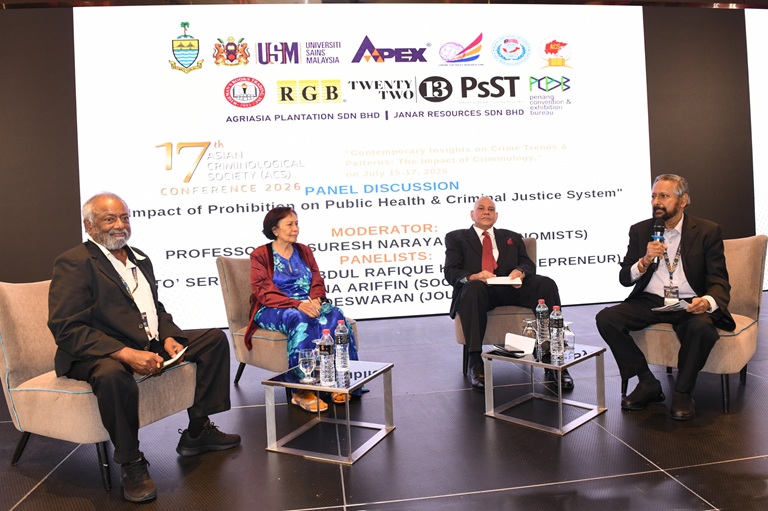
From left: Nadeswaran, Rohana, Abdul Rafique and Suresh.
Speaking on the regulation of vaping, Abdul Rafique argued that prohibition has historically created consequences far more damaging than the behaviour or product it seeks to eliminate. He said prohibition fuels a highly lucrative illicit market while diverting valuable law enforcement resources.
Offering a different perspective, Rohana said prohibition had played an important role in the formulation of the Domestic Violence Act, amendments to rape laws and the introduction of the Sexual Harassment Code. However, she noted that institutional change is rarely straightforward because it involves political systems, adding that not everything can be negotiated and prohibition remains necessary in dealing with such cases.
Nadeswaran, meanwhile, addressed prohibition within the media landscape.
“I am fine with law-based restrictions. Laws can be changed, but some of these restrictions are politically motivated, or imposed by decree or unwritten rules,” he said.
“Who are the chief censors of news here?” he asked, explaining that censors are usually political appointees. He added that such restrictions are often not formal policy but are instead enforced by editors acting in their own self-interest.