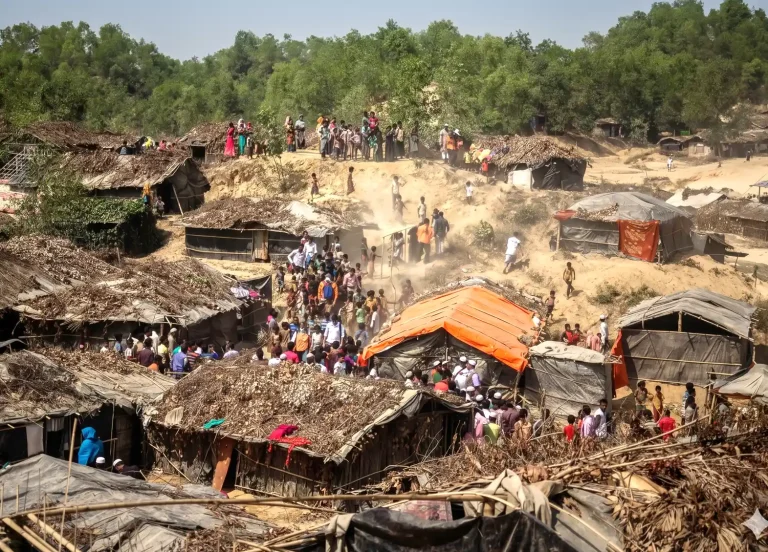
KUALA LUMPUR: Malaysia can do more to address the Rohingya crisis, including engaging China to demonstrate its commitment to finding a solution to a long-standing issue that continues to affect the region.
Charles Santiago, co-chair of the Asean Parliamentarians for Human Rights, said Malaysia should push for a regional response to a crisis that has largely been borne by neighbouring countries such as Thailand, Indonesia and Bangladesh.
His remarks came after Prime Minister Datuk Seri Anwar Ibrahim met Bangladesh Prime Minister Tarique Rahman in Kuala Lumpur yesterday. Anwar said both countries planned to use the Asean platform to seek a solution to the issue, including engaging Myanmar authorities.
Described by the United Nations as “the most persecuted minority in the world”, more than one million Rohingya are living in camps in Bangladesh’s Cox’s Bazar region, home to the world’s largest refugee settlement. An estimated 200,000 are also in Malaysia.
Although the issue received little attention during the Asean Summit in Kuala Lumpur last year, Santiago said it was not too late for Malaysia, through Asean, to engage China, given Beijing’s growing influence in Myanmar and its support for the junta.
“We missed a great opportunity when the Rohingya issue was not put on the agenda for discussion. We lost an important moment to push for some form of intervention and solution to the Rohingya problem in Malaysia, Cox’s Bazar and Rakhine state.
“But it’s not too late. Both Anwar and Tarique acknowledged that the issue is critical and that is a good start.
“Having visited Cox’s Bazar, spoken to the Bangladeshi government and participated in forums on the Rohingya issue, I believe the critical player here is China. China needs to crack the whip on the situation in Rakhine state.
“But China is playing a double game in Rakhine. It is supporting both the Arakan Army and the ruling junta. It is providing both sides with arms, funding and legitimacy.
“There was a point, two years ago, when Bangladesh and China agreed on a plan for safe resettlement, but it never materialised.”
While the Rohingya have suffered decades of violence, discrimination and persecution in Myanmar, the largest exodus from the Rakhine state began in 2017 after a massive wave of violence erupted forcing more than 750,000 people – half of them children to seek refuge in Bangladesh.
Santiago said the root of the problem remained in Rakhine, where both the Arakan Army and the junta were using the Rohingya as pawns, resulting in deaths, including those of children.
“This is forcing the Rohingya out of Rakhine and into Cox’s Bazar. From there, some continue to Malaysia, while others come directly from Rakhine.
“As such, China needs to get its act together. This is why Malaysia should have made arrangements with China when it chaired Asean. We could have invited China to discuss the matter with Bangladesh.”
Santiago said he had also discussed the issue with Bangladesh economist and statesman Muhammad Yunus.
“Yunus said this is essentially an Asean problem and there is a limit to how much Bangladesh can manage on its own.
“There are about 1.5 million people in Cox’s Bazar and the area is bursting at the seams. Funding is insufficient, food supplies are stretched, drug abuse is rising and tensions are increasing.
“Malaysia should engage China. While the Philippines and China are not seeing eye to eye at the moment, Manila’s special envoy to Asean could help facilitate the process.”
Main image: Refugees at Cox Bazaar, Bangladesh. Image by Samsul Said.