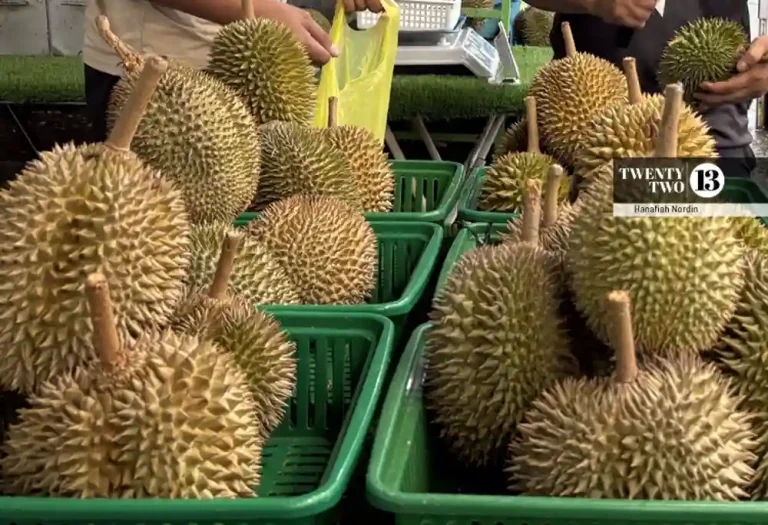
ALOR SETAR: The durian trees are flowering on cue, but beneath the promise of a good harvest lies growing unease.
Across Kedah and Penang, orchard owners are facing a convergence of extremes – a prolonged dry spell, rising fuel costs, and tighter consumer spending – that could make this one of the most challenging seasons in recent memory.
For growers like Ahmad Luqman Hakim Nor Azlan, the warning signs are already clear. The manager of Chu Tiah Durian Orchard in Jitra expects yields to fall below 2024 levels, as persistent heat stretches into April – beyond the usual end of the dry season in March.
“Some trees have started fruiting, but without sufficient water, the young fruits will simply drop,” he said, describing a critical phase where consistent irrigation determines whether fruit survives to maturity.
The stakes are high. His father, Nor Azlan Jan, owns seven orchards with about 5,000 trees, including premium Musang King and Black Thorn varieties.
The risks are not new. Last year, extreme heat linked to El Nino halved production of high-grade durians, with daily yields dropping from about 1,000 fruits to roughly 500. This year, conditions may be even more severe and prolonged.
Operating costs have also surged, driven largely by higher diesel prices following the Middle East conflict. For orchards without grid electricity, water pumps powered by generators have become significantly more expensive.
“Previously, we spent about RM40 for three days of diesel. Now it is around RM120 for the same period,” Luqman said.
More frequent irrigation – in some cases every two days – has further increased fuel consumption. Even orchards connected to the grid face higher bills as pumping hours rise under commercial tariffs.
“It is a very challenging year – yields are expected to fall while costs keep rising,” he added.
The dry spell in northern Malaysia has been unusually intense. Several districts in Kedah have recorded heatwave conditions, while others were placed under heat alerts, with some schools temporarily closed after Hari Raya due to extreme temperatures.
In inland areas such as Baling, orchard owner Mohamad Zairul Zafies Zainol Abidin said there was virtually no rain for more than a month during a crucial flowering period.
“Many of the flowers dried up and fell off. Even when we irrigate, the trees are still affected by the heat. We really depend on rain,” he said.
Water scarcity has compounded the problem. Many orchards rely on hill water sources that have dwindled, leaving younger trees particularly vulnerable to prolonged stress.
Last year, excessive rain cut yields by about 30 per cent. This year, a longer and harsher dry season threatens even greater losses.
The impact extends to Penang, where growers in Balik Pulau are also feeling the strain. Mohd Azwan Abd Rahim, who manages a 13-hectare orchard in Sungai Ara, said river and stream levels have dropped, limiting irrigation.
“Rain has started recently, but it is not enough for the trees’ needs,” he said.
After producing about one tonne of durians daily last season, Azwan expects output to fall by 40 to 50 per cent this year, with Musang King among the most affected.
The broader impact is reflected at larger operations. Mohd Amin Zakariya, operations manager of ZNS Green Agro Farm in Sik, said dry conditions can initially trigger heavy flowering, but prolonged heat disrupts fruit set.
“The flowers may be plentiful, but the young fruits will not hold,” he said. “Without proper irrigation, fruit quality will decline.”
Water sources in many areas have dried up, and in severe cases even mature trees have succumbed to heat stress.
Pest activity has also increased, with fruit borers and flies thriving in hotter conditions and further affecting quality.
At ZNS, irrigation systems have helped sustain production, but costs have surged. Diesel alone now reaches about RM200 a day to run high-capacity pumps, with fuel prices exceeding RM6 per litre. Electricity and fertiliser costs have also risen.
“This is a critical period. If the dry weather continues until the end of April, the situation will become more serious,” Amin said.
He pointed to 2014 as a warning, when delayed rainfall caused production to plunge nationwide and shifted pricing to a per-kilogramme basis.
If conditions persist, some growers may prioritise tree survival over yield, sacrificing this season in hopes of recovery next year.
Lower output and higher costs are expected to push prices up, but that raises concerns over demand.
“With fuel prices rising, consumers are more cautious with spending. We worry demand may weaken,” Amin said.
A mismatch between supply and demand could result in oversupply, particularly for premium varieties.
Larger operators may mitigate this by processing excess fruit into frozen products or paste, but smaller growers have far less room to absorb losses.
Penang Fruit Farmers Association chairman Kie Kim Hwa said growers may be forced to lower prices as quality declines.
“At the same time, we are facing higher costs due to diesel and electricity use for irrigation. That is the price we must pay in dealing with harsh weather,” he said.
Kie added that many farmers are not expecting strong profits and would be relieved just to cover costs.
“We hope the Agriculture Department can provide some assistance, although we understand the impact of higher fuel prices is global,” he said.
For now, all eyes remain on the skies. Across Kedah and Penang, growers are hoping the rains arrive in time to salvage what remains of a season already under strain.