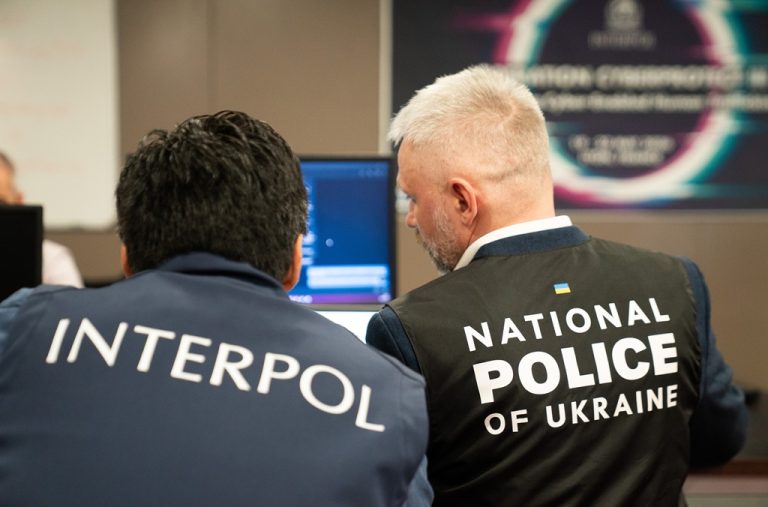
LYON: Law enforcement officers from seven European countries have joined forces in a four-day “hackathon” to target human traffickers using subscription-based adult websites to exploit vulnerable people.
Operation CyberProtect III, which ran from 19 to 22 May, was co-organised by Interpol and the Organisation for Security and Co-operation in Europe (OSCE). The operation generated dozens of new leads, resulting in the identification of 34 suspicious cases, 18 suspect profiles, and 27 potential victims.
Police personnel from Germany, the Netherlands, Romania, Spain, Sweden, Ukraine and the United Kingdom took part in the initiative.
Interpol said organised crime networks are increasingly using content subscription services, commonly associated with sexually explicit material, to recruit and sexually exploit women, minors, and vulnerable adults.
Victims are often lured with promises of high earnings before being funelled into exploitative content production. In February, Interpol issued a “Purple Notice” warning that criminal groups were masquerading as legitimate modelling agencies to entrap victims.
“Once engaged, they take control of the victim’s account, retaining the majority of the victim’s earnings, while applying escalating psychological pressure and coercion to compel victims to produce increasingly explicit content,” an Interpol statement said.
Criminal groups are also using online platforms to market coaching programmes that teach men how to profit from exploiting women via these sites. Law enforcement officials refer to this emerging trend as “e-pimping”, where traffickers use digital tools to orchestrate exploitation at scale.
David Caunter, Interpol’s director of organised and emerging crime, said the collaborative approach had uncovered critical intelligence on how subscription platforms are being “weaponised”.
“Every suspect and victim identification generates immediate investigative leads and strengthens our ability to dismantle these criminal networks and protect those at risk,” Caunter said.
During the operation, 14 officers worked side by side to detect red flags across websites, social media, messaging apps, and subscription platforms.
The paywalled architecture of these websites and their use of coded language allows traffickers to evade detection. Investigators also face hurdles due to jurisdictional fragmentation and the difficulty of gathering digital evidence.
Beyond generating immediate leads, Operation CyberProtect III highlighted several emerging tactics used by traffickers:
Geographic targeting: A high prevalence of advertisements featured female models from South America, identifying it as a key region of origin for real-life and virtual exploitation.
- Encrypted recruitment: Recruiters are using encrypted messaging platforms to target potential victims, often requesting nude images without age verification.
- Buying and selling producers: Content producers are being bought and sold between managers for significant sums. One messaging group involved in this activity contained up to 28,000 adverts.
- Alternative payments: Traffickers are using cryptocurrencies and digital tokens—such as “diamond emojis” that can be converted into virtual cash—as payment systems. Rates as low as $3 (£2.40) were detected for 25 minutes of private video.
- AI exploitation: Artificial intelligence is being used to generate fake profiles to complement human-led content operations.
The operation was supported by a coalition of tech platforms and NGOs, including Europol, Meta, TikTok, Cybercrime Atlas, Diaconía, Group-IB, S2W, Stop The Traffik, and the Dutch National Rapporteur on Trafficking in Human Beings and Sexual Violence against Children.
Image: Interpol