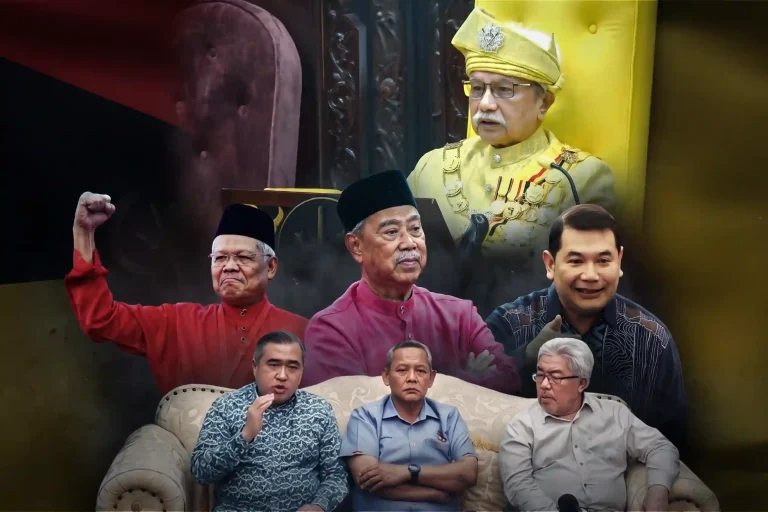
To mask their pursuit of power, politicians often frame their actions as serving the rakyat or preserving stability.
They present themselves as altruistic, free of vested interests, guided only by the nation’s welfare. In reality, such claims are often little more than rhetoric designed to project nobility and secure continued support.
Recent developments have stripped away that facade.
The ongoing Perikatan Nasional (PN) dispute between Tan Sri Muhyiddin Yassin and Datuk Seri Hamzah Zainuddin is not rooted in ideology or competing visions for the nation. It is a struggle for control – a contest for leadership positions divorced from the needs of the people.
The fallout has split Bersatu into rival camps aligned with Muhyiddin and Hamzah. Both continue to manoeuvre for dominance, each claiming majority support.
Hamzah, having been sacked, is left without a clear power base and is searching for political relevance. Muhyiddin, meanwhile, remains party president.
A similar contest is unfolding in Parti Keadilan Rakyat (PKR), involving Datuk Seri Rafizi Ramli.
Once a key figure in government, Rafizi has emerged as a sharp critic of Prime Minister Datuk Seri Anwar Ibrahim and the Madani administration. His stance hardened after losing the party’s deputy presidency to Nurul Izzah Anwar, prompting him to raise concerns about nepotism.
He later resigned as Economy Minister, reportedly over policy differences.
Given his capabilities, Rafizi could have contributed meaningfully to addressing the economic challenges faced by the rakyat. Instead, his departure and subsequent criticism have shifted focus from governance to political contestation.
He has since renewed his attacks on corruption, particularly targeting Malaysian Anti-Corruption Commission chief Tan Sri Azam Baki, reviving an adversarial stance dating back to the 2018 general election.
While calls for reform are not new, they often resurface in ways that blur the line between principle and political positioning.
The most complex episode, however, is unfolding in Negeri Sembilan, where political manoeuvring intersects with the state’s unique monarchical structure.
Unlike other Malay states, Negeri Sembilan practises an elective monarchy, with four Undang – Sungai Ujong, Jelebu, Johol and Rembau – selecting the Yang di-Pertuan Besar.
The state’s royal institution has long been regarded as stable and dignified. That stability was shaken when the Undang moved to depose Tuanku Muhriz Tuanku Munawir, citing alleged misconduct.
The public has not been informed of the nature of the allegations.
The Undang subsequently named Tunku Nadzaruddin Tuanku Jaafar as the new ruler.
However, Menteri Besar Datuk Seri Aminuddin Harun rejected the move, citing procedural irregularities. Among them was the participation of a former Undang who no longer held authority, having been dismissed and replaced.
The dispute quickly escalated. The Undang declared a loss of confidence in Aminuddin, while 14 Umno state assemblymen withdrew their support for him.
This opened the possibility of a shift in power, with Umno potentially forming a new state government with backing from Perikatan Nasional representatives.
Such a move raises serious questions. Umno has long positioned itself as a defender of the royal institution. Yet its actions in this episode appear to contradict that stance.
The party’s response has also been inconsistent.
President Datuk Seri Ahmad Zahid Hamidi said he was unaware of the assemblymen’s decision, a position difficult to reconcile with the magnitude of its implications. Deputy president Datuk Seri Mohamad Hassan is also likely to have been aware of developments.
These contradictions point to deeper issues within the party, not least a persistent desire to reclaim dominance.
Having governed for decades, Umno appears uneasy operating as a junior partner. Its actions suggest a willingness to reposition itself, even at the risk of political instability.
The Negeri Sembilan episode exposes a broader pattern of opportunism and shifting loyalties.
On one hand, support is withdrawn from the Menteri Besar. On the other, the same administration is not decisively opposed. Such contradictions create confusion and undermine public trust.
Statements framed as acting in “good faith” sit uneasily alongside moves that could destabilise an elected government.
This is not political dynamism. It is a contest for power that risks eroding institutional integrity.
Some may view these developments as signs of a vibrant democracy. Others see them as evidence of a political culture driven by self-interest, where principles are secondary to positioning.
In many cases, the ends appear to justify the means.
The views expressed here are the personal opinion of the writer and do not represent that of Twentytwo13.