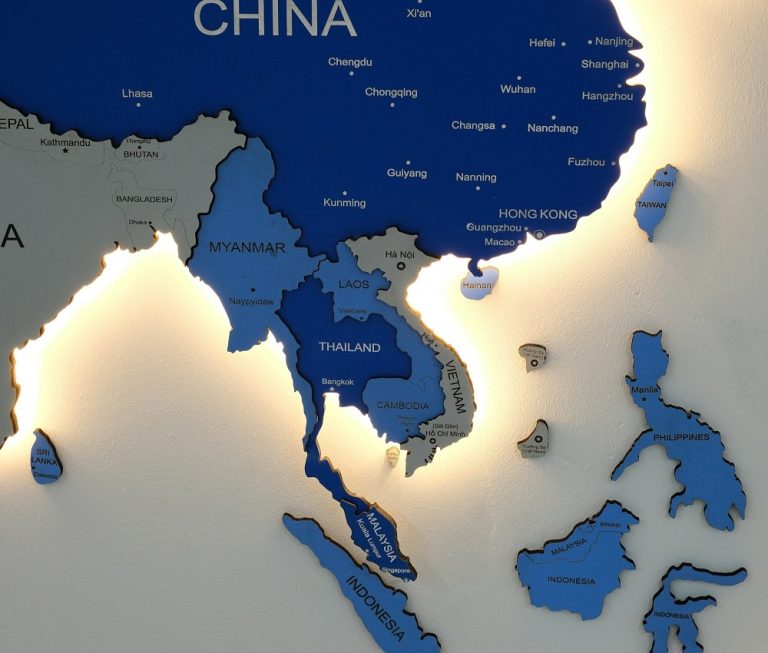
The Indo-Pacific has emerged as the defining arena of global politics. Spanning two oceans and home to billions of people, the region accounts for nearly 60 per cent of the world’s economy.
But its significance extends well beyond trade and growth. It is now the frontline of an intensifying strategic contest between the United States and China, transforming what was once known primarily as the Asia-Pacific into a region where security, power and survival are increasingly intertwined.
China’s rise has been assertive and, for many of its neighbours, unsettling. Through the Belt and Road Initiative, economic leverage and increasingly assertive actions at sea, Beijing has expanded its influence while raising concerns among regional states. Countries that once depended primarily on traditional alliances are now exploring more flexible forms of cooperation.
The QUAD, AUKUS and SQUAD reflect this shift. Rather than relying solely on rigid military treaties, these arrangements allow countries to cooperate on security, intelligence, technology, infrastructure and maritime awareness while retaining greater strategic flexibility. The question, however, is whether such partnerships can generate enough collective strength to deter aggression or whether they will remain largely symbolic.
In a world without a global referee, survival comes first. Smaller nations cannot depend on goodwill alone. They must find ways to balance against threats while avoiding unnecessary escalation. Some pursue hard balancing by strengthening their militaries, increasing defence spending and conducting joint exercises. Others favour soft balancing through diplomacy, informal coalitions and international law.
The Indo-Pacific’s emerging model combines both. The QUAD, for example, brings together infrastructure and economic initiatives with maritime security cooperation and military exercises. This combination can strengthen deterrence without forcing participating states into the kind of rigid commitments associated with traditional alliances.
Yet balancing is never straightforward. When one country strengthens its defences, others may interpret the move as a threat, creating security dilemmas and potentially triggering arms races. Smaller states also face the risk of being abandoned by partners or being drawn into conflicts they do not want.
Flexible partnerships can help manage these risks. They allow countries to share intelligence, coordinate defences and demonstrate collective resolve while retaining room for independent decision-making. Deterrence ultimately depends on convincing a potential aggressor that the cost of taking action will outweigh the benefits. This is where the DIME framework – diplomatic, informational, military and economic tools – becomes relevant.
Diplomatically, the United States anchors these networks by weaving together relationships that demonstrate collective resolve. China, meanwhile, promotes its own “Asian Security” concept, arguing that regional security should be managed without outside powers.
Informationally, initiatives such as the Indo-Pacific Partnership for Maritime Domain Awareness use satellite technology to improve visibility of maritime activity and expose illegal operations. This can raise the costs of coercive behaviour and reduce the ability of states to operate in the shadows.
Militarily, joint patrols and exercises improve readiness and interoperability while helping regional states respond to China’s expanding military capabilities. Economically, frameworks such as the Indo-Pacific Economic Framework seek to strengthen supply chains, reduce vulnerabilities and give smaller states greater resilience against economic coercion.
Together, these tools create a broader deterrent posture that goes beyond military power alone.
Each major player has a distinct role in this evolving security network. The United States remains the anchor, moving beyond its traditional hub-and-spoke alliance structure towards a web of overlapping partnerships. Rather than acting as a direct frontline defender everywhere, Washington can project influence by sharing advanced military technology, strengthening maritime awareness and supporting regional security initiatives.
This is where the concept of the buck-catcher becomes useful. In international relations, a buck-catcher is a state that assumes a significant share of the burden of balancing against a rising or aggressive power rather than leaving that responsibility to others. Different states can assume different buck-catching roles according to their vulnerabilities, capabilities and strategic cultures.
Japan, facing direct security concerns because of its proximity to China and dependence on vital sea lanes, has become a proactive buck-catcher. It pioneered the Free and Open Indo-Pacific concept and is expanding its military capabilities, including long-range strike systems.
Australia, despite its substantial economic relationship with China, has adopted a staunch buck-catching role through AUKUS. Its investment in nuclear-powered submarines and other advanced capabilities strengthens its ability to contribute to maritime security across the region.
India, meanwhile, represents a more cautious buck-catcher. It participates in the QUAD but continues to emphasise strategic autonomy and avoids formal alliances. Its contribution is also visible in areas such as cybersecurity, supply-chain resilience and other forms of soft balancing.
This diversity demonstrates that strategic partnerships do not require uniform commitments. Flexibility allows each state to contribute according to its vulnerabilities, capabilities and strategic culture. Japan’s urgency, Australia’s willingness to assume greater security responsibilities and India’s strategic caution can all fit within a broader network designed to balance China’s growing power while preserving national sovereignty.
But significant challenges remain. Flexible partnerships lack the binding commitments that underpin formal alliances, potentially weakening their credibility during a crisis. The participating countries also have different priorities. The United States seeks to prevent Chinese dominance; Japan is focused on sea lanes and territorial disputes; Australia is concerned about threats to its northern approaches; and India remains determined to protect its strategic autonomy.
Without stronger institutional mechanisms, these networks could prove fragile when tested by a major crisis. The absence of formal obligations may leave governments hesitant to act when the costs of intervention become significant. That uncertainty could, in turn, weaken the very deterrence these partnerships are designed to create.
Even so, strategic partnerships represent a pragmatic response to the realities of the Indo-Pacific. They offer a way to combine hard and soft balancing, apply diplomatic, informational, military and economic tools, and accommodate different national interests without demanding identical commitments.
They may not replace traditional alliances, but they can complement them by providing a more flexible security architecture. The Indo-Pacific is therefore not simply a battleground for great-power rivalry. It is also a testing ground for new approaches to managing power, competition and stability.
For smaller states, these partnerships are ultimately about more than strategy. They are about survival. Flexible cooperation offers a middle ground between choosing sides and standing alone. It allows countries to strengthen their defences without surrendering strategic autonomy, deter aggression without deliberately provoking war, and build resilience without becoming trapped in rigid commitments.
The Indo-Pacific’s strategic story is therefore not only about rivalry. It is also about adaptation. As great-power competition intensifies, the states that can build effective partnerships while preserving their independence may be best placed to navigate an uncertain future and sustain stability in one of the world’s most contested regions.
Colonel Hairil Razman Mohamad is a course member of the National Resilience Course at the National Centre for Defence Studies (PUSPAHANAS).
The views expressed here are the personal opinion of the writer and do not represent those of Twentytwo13.