Thailand and Cambodia today signed a peace accord to end months of deadly border clashes.
Thai Foreign Affairs Minister Sihasak Phuangketkeow said the peace accord signed between Thailand and Cambodia was the outcome of decisions made by the two nations involved in the conflict.
Asked by Twentytwo13 whether US President Donald Trump, who witnessed the signing of the historic accord, should be credited for the breakthrough, Sihasak said: “Everybody was praising Trump and (Malaysian Prime Minister Datuk Seri) Anwar (Ibrahim), but in the end, it is on the two countries.
“No one can impose a solution on us. Others may have ideas or suggestions, and that helps, but in the end, it is for our two countries to decide.”
The conflict erupted in early July after a series of deadly incidents between Cambodian and Thai forces along their long-disputed border, reigniting long-standing grievances over territorial claims and military posturing. The clashes quickly escalated into artillery exchanges and troop mobilisation near sensitive zones, prompting mass evacuations from nearby villages and towns.
On July 28, both nations agreed to an immediate and unconditional ceasefire following successful mediation by the Malaysian government in Putrajaya. The ceasefire was reached during a special meeting chaired by Anwar and attended by Cambodian Prime Minister Hun Manet and Thailand’s then acting Prime Minister Phumtham Wechayachai. Representatives from the United States and China were also present, signalling rare joint support from both superpowers for regional peace.
The peace accord was signed today between Thai Prime Minister Anutin Charnvirakul and Hun Manet, witnessed by Trump and Anwar.
During the ceremony, Trump said his involvement in the Thai-Cambodia conflict was “one of the first few wars” he engaged in after being sworn in as President.
“This is a momentous day for the people of Southeast Asia as we sign a historic agreement to end the military conflict between Cambodia and Thailand,” Trump said, when delivering his remarks at the signing of the peace accord during the 47th Asean Summit and Related Summits at the Kuala Lumpur Convention Centre (KLCC) today.
“We are honoured to have played a part in this. They were going at it… but I want to congratulate the two courageous leaders who took this monumental step.”
“I also want to thank the Prime Minister of Malaysia, Anwar. I told him, you have two nations fighting next to you, we need a neutral place… and I told him if we get this out, I’m coming to your country – and I told the truth.”
Trump added that there had been “a lot of killings”, and he was glad his administration helped stop the fighting. “Anwar played a very important role in convening a meeting in KL. Because of America’s commitment to stability and peace, my administration immediately began working to prevent the Thai-Cambodia conflict from escalating.”
Trump said he was at Turnberry, Scotland, when he got involved. “We held phone calls with both leaders, the three of us, then the four of us… a lot of phone calls. It was a beautiful day, and Turnberry is a beautiful place. But I said this was more important than playing golf.
“It cost me a lot of fun – I could have had a lot of fun – but this was more fun than anything, because you are saving people, saving countries.”
He said the Thai-Cambodia war was the eighth conflict his administration had ended in as many months, adding that he was “pleased to have ended this war”.
Hun Manet, meanwhile, thanked Trump for his “tireless efforts” in making the peace accord a reality, reiterating his earlier pledge to nominate Trump for the Nobel Peace Prize.
Speaking to the press after the signing, Sihasak described the peace accord as “an important step forward” and stressed that both nations shared a joint responsibility to their people, especially those living along the border.
“We have always wanted to resolve the dispute bilaterally. This time, we had the facilitation of the United States and Malaysia, but their role was to help ensure the discussion remained bilateral,” he said.
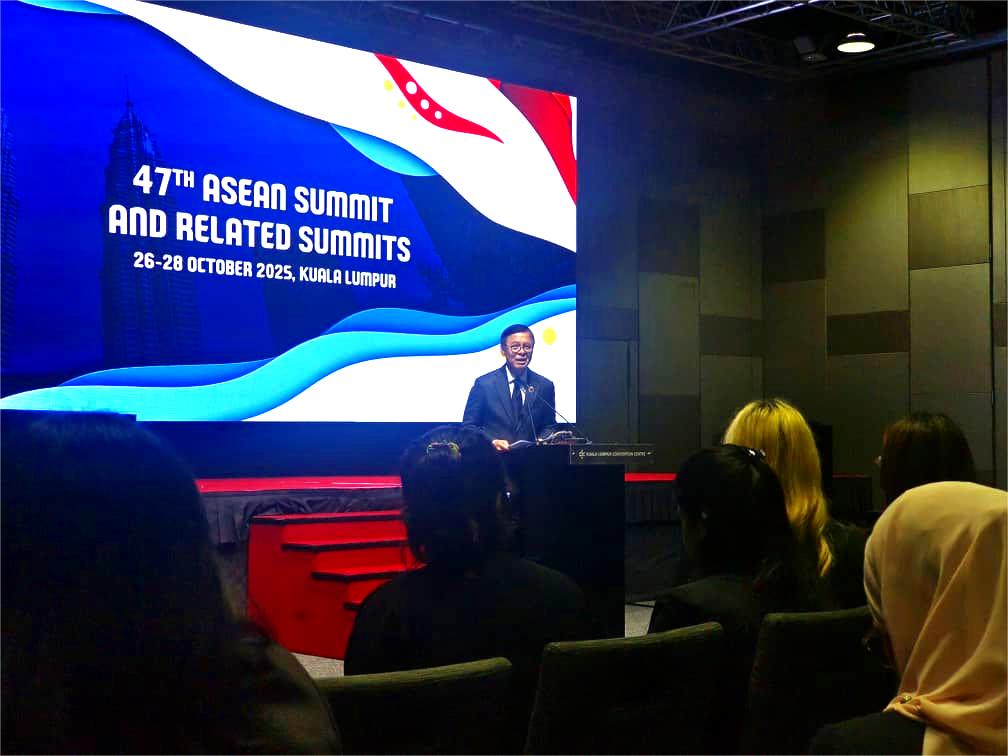
Thai Foreign Affairs Minister Sihasak Phuangketkeow speaking to journalists after the signing ceremony.
“I headed the policy-level discussions. The United States and Malaysia were present at the beginning, but once negotiations began, they were conducted bilaterally. So this is not mediation by third parties – it is facilitation by third parties.”
Sihasak said the declaration reflected the will of both Thailand and Cambodia to resolve their differences peacefully, in line with Thailand’s long-standing position of seeking solutions through bilateral mechanisms and dialogue.
He said the joint declaration outlined a roadmap for peace and addressed key issues such as border tensions, the removal of heavy weapons, demining efforts, curbing illegal activities like scam operations, and managing border encroachments.
“Thailand has said that once we begin implementing these measures, we are prepared to release the 18 Cambodian soldiers detained by Thai authorities. We believe both sides share the responsibility to act on what has been agreed to bring peace and security to our people, especially those along the border, so that we can renew ties and contact between communities.”
Main image: United States President Donald Trump and Prime Minister Datuk Seri Anwar Ibrahim witness the signing of the Cambodia-Thailand peace deal between Cambodian Prime Minister Hun Manet and Thai Prime Minister Anutin Charnvirakul, in conjunction with the 47th ASEAN Summit and Related Summits today. Image: Bernama.