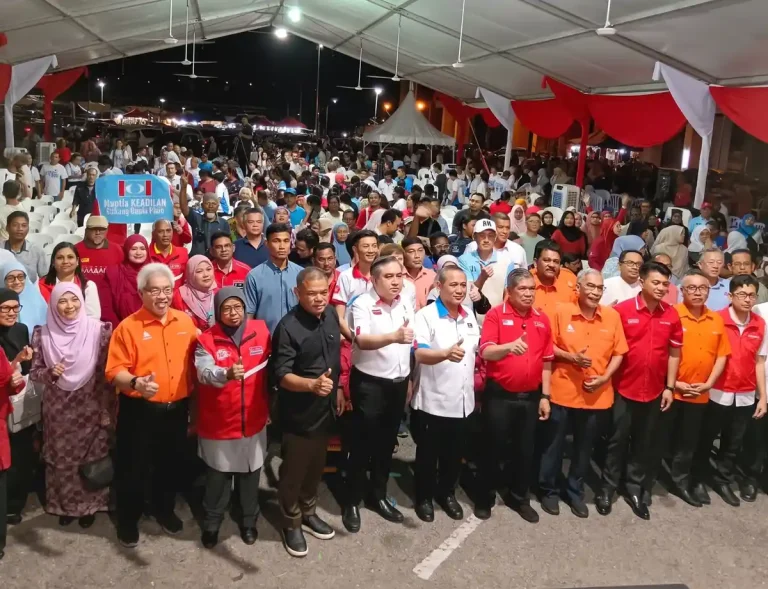
KUALA LUMPUR: The chants of “Tolak Umno” reverberating through a Pakatan Harapan (PH) ceramah in Paroi last week may have lasted only minutes, but political observers say they exposed a far deeper problem simmering beneath Negeri Sembilan’s uneasy political truce — lingering distrust between PH and Barisan Nasional (BN) grassroots despite their cooperation in government.
While top leaders from both coalitions have agreed to preserve the Negeri Sembilan unity government following the recent Menteri Besar crisis, analysts believe the hostility displayed openly at the rally reflects unresolved tensions that could resurface ahead of the next state elections in Melaka and Johor, and eventually the 16th General Election (GE16).
The situation became even more precarious after Menteri Besar Datuk Seri Aminuddin Harun urged PH supporters to prepare for the possibility of a snap state election, signalling that the political ceasefire brokered at the national level may not necessarily guarantee long-term stability on the ground.
The latest developments follow weeks of political turmoil involving Aminuddin’s position, the Negeri Sembilan monarchy dispute, and the withdrawal of support from 14 Umno assemblymen who had earlier declared they no longer backed the Menteri Besar.
Although Umno and PH leadership later reached a compromise to maintain the existing unity government, the agreement stopped short of offering unconditional support for Aminuddin himself.
Political analysts say that distinction is crucial.
Fragile peace beneath the surface
Pacific Research Centre principal adviser Dr Oh Ei Sun said the chants reflected frustration among PH supporters towards their partner in the state administration.
“As Negeri Sembilan Umno has recently been truculent and impertinent toward PH despite intervention from its senior party leadership, it is understandable that such slogans would be shouted out of frustration,” he told Twentytwo13.
Professor James Chin of Monash University Malaysia described the current truce as fragile and tactical rather than genuinely reconciliatory.
“It is merely a temporary truce while the dispute involving the throne is still ongoing. Once the conflict involving the Yang di-Pertuan Besar is resolved, then a political settlement can be discussed,” he said.
Chin stressed that the crisis had not fundamentally damaged trust between Umno and PH because there had always been little trust between Umno and DAP in Negeri Sembilan.
“The bottom line is that Umno believes it is stronger now, even though research suggests the party is actually weakening. PH is more realistic; they know they are losing support,” he added.
Azmi Hassan, a senior fellow at the Nusantara Academy of Strategic Research, concurred that the political drama in Negeri Sembilan was unlikely to end despite the truce.
“PH wants Datuk Seri Aminuddin to remain as Menteri Besar, while Umno has signalled that it is unwilling to continue supporting him in the post,” he told Twentytwo13.
“As such, it is difficult to see this issue remaining unresolved for the next two years until the current state government’s term expires.”
However, he said there may be a silver lining in the fact that the situation is unfolding in Negeri Sembilan rather than in Melaka or Johor, where Umno is widely perceived to be stronger than PH.
“In Negeri Sembilan, however, both sides are regarded as being on relatively equal footing based on the results of the state election three years ago. That balance of power could ultimately strengthen cooperation between PH and BN, as both coalitions are seen as mutually dependent on one another in the state.”
MB hints at possible snap polls
Amid the uncertain political climate, Aminuddin has begun openly preparing his supporters for the possibility of a fresh mandate.
Speaking during the PH ceramah in Paroi on Wednesday night, the Menteri Besar urged party machinery to remain prepared for a possible snap state election should the political situation deteriorate further.
The remarks came despite the recent understanding reached between PH and Umno leadership to maintain the current state government.
Analysts said the statement suggested Aminuddin himself was not fully convinced the current truce could hold in the long term.
“I think sooner or later there has to be a state election to break the stalemate. And the rally is a way for PH to shore up its image and retain its support, albeit at the expense of confronting BN,” said Oh when asked about the possibility of snap polls.
He said the level of distrust among supporters had raised questions about the possibility of PH and BN cooperating in future elections.
“At this point, it remains unclear whether BN and PH will team up or go their separate ways heading into the next state elections. But each side wants to demonstrate its political leverage at this stage,” he said.
Chin pointed out that Aminuddin would retain his political authority as long as he remained in office.
“As the office-holder, he retains legislative authority. As long as he holds power, his political authority remains intact,” he said.
Chin added that Umno believed it was now in a stronger political position, signalling the party was prepared to enter future elections without forming a pact with PH.
“Generally speaking, Umno believes it can perform better on its own, and I suppose the BN assemblymen in Negeri Sembilan think they can ride this sentiment. But I do not think Umno is getting stronger. In fact, I believe it is Pas that is gaining strength, not Umno,” he said.
Despite the widening cracks, Azmi nevertheless believed BN and PH leaders would eventually reach a consensus to counter the growing threat posed by Perikatan Nasional.
“If both sides possess comparable strength, any direct clash without electoral cooperation in the next general election would negatively affect both Pakatan Harapan and Barisan Nasional,” he said.
“This is why I say there is wisdom behind what is happening. It serves as a reminder that BN and Pakatan Harapan need each other.”
The situation, he added, differs significantly from Johor or Melaka, where Barisan Nasional and Umno may feel more politically dominant and therefore less reliant on Pakatan Harapan.
“So, while the issue may appear difficult to resolve, there is still a silver lining behind what is taking place in Negeri Sembilan,” Azmi said.
The Menteri Besar’s warning also came shortly after the DAP central executive committee instructed party machinery nationwide to prepare for the possibility of snap elections in Negeri Sembilan, Melaka and Johor should the respective state assemblies be dissolved in the near future.
In a statement issued by secretary-general Anthony Loke, DAP reaffirmed its support for Aminuddin while stressing the party would not agree to any proposal to replace him following what it described as a failed attempt to topple the unity government.
Political observers said DAP’s decision to specifically mention Melaka and Johor suggested concerns that the Negeri Sembilan crisis could eventually spill over into broader PH-BN relations in other Umno strongholds.
Budget vote could become defining moment
Beyond the current political truce, analysts say Aminuddin’s longer-term survival may ultimately depend on whether he can still command enough support inside the legislative assembly.
The October state assembly sitting — during which the Negeri Sembilan government is expected to table its 2027 Budget Bill — is widely seen as a potentially decisive test of political confidence.
Under Westminster convention, defeat of a government budget is generally treated as equivalent to losing majority support in the legislature.
The budget vote could become the real political battlefield if tensions between Umno and PH remain unresolved by then.
If the Budget Bill fails to pass, it would effectively mean the government no longer commands majority confidence, triggering either the resignation of the Menteri Besar or a request for dissolution.
Civil society raises broader concerns
Civil society movement Aliran meanwhile warned that the Negeri Sembilan crisis had revealed deeper structural weaknesses within Malaysia’s political system.
In a statement, the group said the episode demonstrated how fragile coalition arrangements could become when political expediency overtook institutional clarity and democratic accountability.
Aliran stressed that constitutional processes and democratic norms must remain paramount amid competing political and royal claims.
“The rakyat should not become collateral damage in elite political struggles,” the group said.
It also urged all political actors to avoid exploiting the monarchy or customary institutions for partisan political purposes.
The group further warned that continued instability risked eroding public trust in democratic institutions and governance.
Monarchy dispute still unresolved
Despite the temporary easing of tensions between Umno and PH leadership, the wider Negeri Sembilan monarchy dispute remains unresolved.
The crisis began after former Sungai Ujong Undang Mubarak Dohak and three other Undang announced the removal of Yang di-Pertuan Besar Tuanku Muhriz Tuanku Munawir in April.
However, the state government subsequently rejected the move, arguing Mubarak himself had already been lawfully removed from his customary position last year.
On Tuesday, Mubarak, along with three other Undang and the Shahbandar of Sungai Ujong, Badarudin Abdul Khalid, filed an originating summons to suspend enforcement of a decision made during a special meeting of the Negeri Sembilan Dewan Keadilan dan Undang (DKU) on April 17.
They named the DKU, DKU secretary Raja Norazli Raja Nordin, and the Negeri Sembilan state government as defendants.
Through the summons, the applicants are seeking a declaration that, as members of the DKU, they are entitled to receive a copy of the minutes from the special DKU session held on April 17 at Istana Besar Seri Menanti.
The constitutional uncertainty deepened further following the appointment of 29-year-old accountant Muhammad Faris Johari as the new Datuk Klana Petra, Undang Luak Sungai Ujong, during an adat ceremony held at Telaga Undang on April 22.
The appointment was announced by Waris Nan Tua Klana Hulu together with customary leaders and heirs, who said the selection was conducted according to the Teromba dan Salasilah Negeri Sungai Ujong 1910 and Adat Perpatih principles without external interference.
Negeri Sembilan’s Council of Customary Chieftains (Datuk-Datuk Lembaga Adat Sungai Ujong) has disputed the move, claiming the appointment is invalid and violates the state’s customary laws.
The overlapping disputes involving the palace, adat leadership and political administration have now created one of the most complex constitutional crises in Negeri Sembilan’s modern history.
For now, the unity government may still be intact on paper. But the chants of “Tolak Umno” in Paroi suggest the deeper political battle over trust, legitimacy and the future of PH-BN cooperation may only just be beginning.