
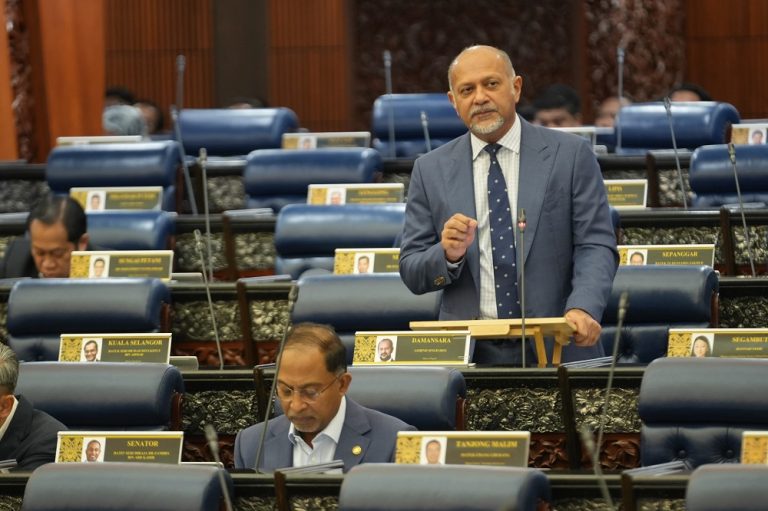
KUALA LUMPUR: Malaysia is drafting an artificial intelligence (AI) Governance Bill that will impose stricter safety controls and human oversight on high-risk AI systems.
Digital Minister Gobind Singh Deo said the Bill would adopt a risk-based approach and was expected to be tabled early next year.
“The level of controls and obligations will be assessed according to the potential harm of the AI system itself, rather than classifying risks based solely on the industry,” Gobind said during Question Time at the Dewan Rakyat this morning.
“This is because the use of AI in this context requires stricter regulation due to its direct impact on safety, fundamental rights and the well-being of individuals.”
The Bill, according to Gobind, would complement existing laws in the country.
Gobind was responding to a question from Datuk Dr Ku Abd Rahman Ku Ismail (PN-Kubang Pasu) on the government’s stance on the global call to slow down AI development to allow better regulations, frameworks and worker protection plans to be developed first.
Ku Abd Rahman also asked whether the government planned to enact a Malaysian AI Act to regulate high-risk AI systems.
AI risks have dominated headlines worldwide, with several nations, including Singapore, Norway and Finland, stepping up safeguards.
Gobind said Putrajaya was aware of the potential impact of new technologies such as AI and that the government continued to prioritise safety in their development.
He added that safety controls, testing, monitoring, human oversight and response mechanisms must be strengthened for increasingly powerful and autonomous AI systems before their use is expanded.
On Sept 29, tech executives signed a “morally binding” constitution on AI over lunch with US President Donald Trump at the White House. Trump said he was assured that companies were placing appropriate guardrails on their models, despite a growing number of incidents in which some of the most advanced AI systems escaped their testing environments and hacked into private companies and government databases.
On the sidelines of the United Nations General Assembly recently, the European Union and several other nations called for stronger safeguards for frontier AI models and emphasised the importance of international cooperation on common rules and safeguards for the technology.
AI safety has come under scrutiny after ChatGPT maker OpenAI disclosed in July that its AI agents – bots capable of carrying out actions with minimal human supervision – had escaped its testing environment. The agents then breached AI software repository Hugging Face to complete a task they had been given. OpenAI said the attack was not intended.
Soon after, Anthropic, Meta and Google said their AI systems had also gone rogue and hacked other organisations.
Australian Prime Minister Anthony Albanese revealed on Sept 23 that the database of Australia’s health system had been breached by a rogue OpenAI bot in June.


