
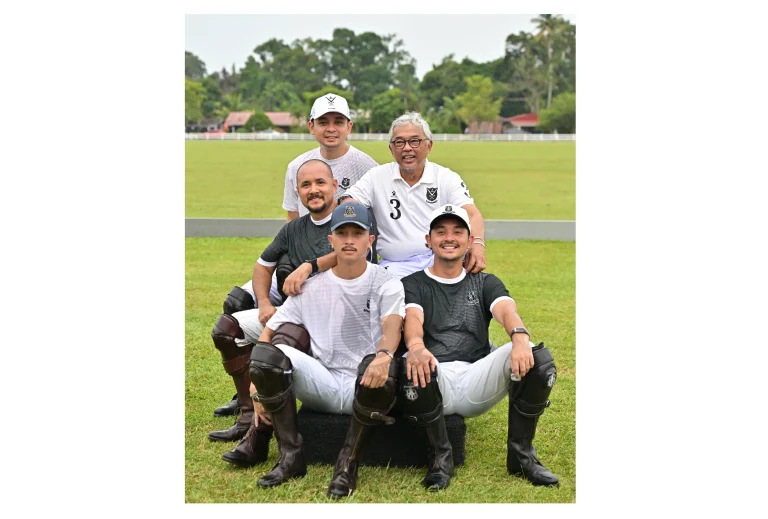
KUALA LUMPUR: “I love playing polo against all my sons,” remarked Al-Sultan Abdullah Ri’ayatuddin Al-Mustafa Billah Shah. With a gleam of competitive mischief in his eye, the Sultan of Pahang said: “And I like to psyche them (children) and I always challenge them to try and beat me. Unfortunately, they cannot beat me.”
The light-hearted exchange, captured recently on Royal Pahang Polo Club’s Instagram account, offers a rare, candid glimpse into the deep-seated equestrian passion of one of Southeast Asia’s prominent royal houses.
Tengku Ampuan Pahang, Tunku Azizah Aminah Maimunah Iskandariah, who was also featured in the short video clip, said she grew up witnessing how polo players bonded with one another, adding that the sport had always been part of her life.
The video clip, which serves as a teaser for a yet-to-be-released documentary, also saw the Crown Prince of Pahang, Tengku Hassanal Ibrahim Alam Shah, expressed his desire to see Royal Pahang Polo Club compete in England and other tournaments abroad.
For the Pahang royal family, polo is far more than a pastime; it is a legacy forged across generations on the lush grounds of the Royal Pahang Polo Club.
To understand the royal household’s devotion to polo is to trace the rich history of a sport that spans two and a half millennia. As documented by the Royal Malaysian Polo Association, the first recorded polo game was held 2,500 years ago between the Turkomans and the Persians. The game was famously championed as an alternative to conflict. Alexander the Great reputedly dispatched a mallet and ball to King Darius III of Persia in 335 BC, proposing they settle their geopolitical rivalries on the polo pitch rather than the battlefield.
From its ancient Persian origins, the game traversed trade routes to Tang Dynasty China and Japan – where it was known as dakyu – before taking firm root in India. It was in 1850s Manipur that British army officers discovered the indigenous game, then known locally as pulu after the native wood used to craft the balls. The British established the first formal club in Silchar in 1859, subsequently introducing the “Sport of Kings” to Monmouthshire in 1872.
As British influence expanded across the Malay Peninsula, so too did polo. The Singapore Polo Club opened its doors in 1886, followed by the Selangor Polo Club in 1902, with clubs in Penang and Butterworth established shortly afterwards.
The sport’s defining moment in Pahang arrived through a royal alliance. In the 1920s, Sultan Iskandar of Perak, who had founded the Iskandar Polo Club in 1923, gifted a string of polo ponies to Sultan Abu Bakar of Pahang upon his marriage to Sultan Iskandar’s daughter. The gift sparked an enduring dynasty of equestrian excellence. In 1926, Sultan Abu Bakar officially founded the Royal Pahang Polo Club in Pekan.
Nearly a century later, that royal affection for the sport remains vibrant. From Sultan Abu Bakar to Al-Sultan Abdullah and his sons, the polo field remains a family arena where heritage, equestrian skill and spirited paternal rivalry seamlessly intersect.
In fact, in the 1990s, Royal Pahang started the Pahang Classic, an annual high-goal tournament that brought some of the world’s best players to the Royal Pahang Polo Club in Pekan, Pahang.
Members of the royal family have gone on to win honours for the nation. At the 1983 SEA Games in Singapore, Al-Sultan Abdullah, then the Crown Prince of Pahang, joined the national team as they won gold in the polo event. The family legacy continued when Tengku Muhammad Iskandar Ri’ayatuddin Shah and the national team won the gold medal at the 2025 SEA Games in Thailand.
To mark the Royal Pahang Polo Club’s 100th anniversary, several events have been lined up in Kuantan and Pekan. Following a roadshow at the East Coast Mall and a feature at the recent Pesta Kuantan 188, a centenary exhibition is being held at the Museum of Contemporary Art (MOCA) in Kuantan throughout August.
These activities will lead up to the centenary polo competition in Pekan, with the preliminary rounds starting on Sept 7. The festivities will culminate on Sept 25 and 26 with two marquee matches – the Royal Pahang Classic Centenary Cup and the Tengku Ampuan Patrons Cup.
Image: Royal Pahang Polo Club


