“Now can find girlfriend!”
That was the cheeky reply from Ee Ting Sang when asked what he planned to do now that he was finally a Malaysian citizen.
He burst into laughter at the shocked expression of former journalist and editor Sheila Rahman Natarajan, who was also present during the interview.
Sheila was the driving force behind helping Ting Sang and his four siblings – Si May, 18, Ting Fok, 17, Ting Kat, 16, and Ting Choi, 13 – gain their ‘freedom’ after receiving their MyKad, Malaysia’s national identification card, recently.
“I always told them to focus on their studies. Love can come later,” said Sheila.
“They were stateless until recently. I didn’t want them to bring another child into this world who would also have to endure the hardship of being without a country.”
Sheila’s advice is something Ting Sang takes to heart.
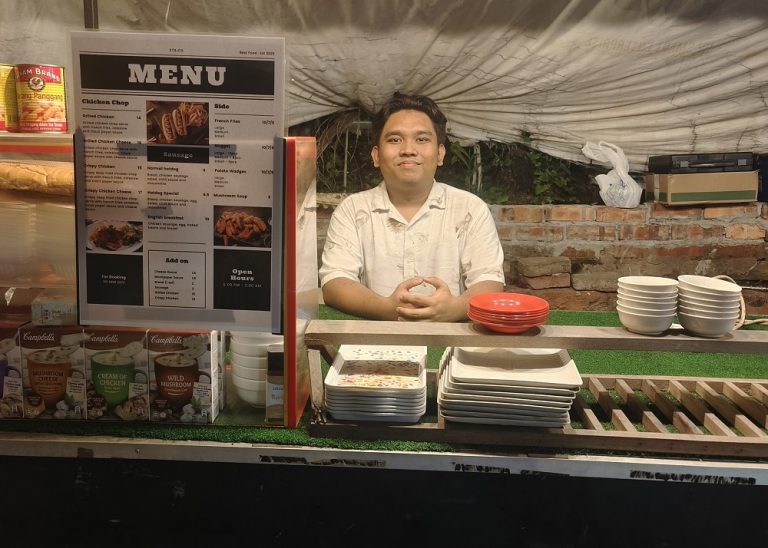
“I was only joking about finding a girlfriend. My priority now is to earn as much as I can to help my siblings and father,” said the 20-year-old, who now runs a food stall in Bandar Menjalara, Kepong, about 15km from Kuala Lumpur.
It’s the same neighbourhood where he was born and raised – and where Sheila and the local ‘aunties and uncles’ stepped in to change his family’s life.
“I was 10 when my mother left,” recalled Ting Sang.
“That was 10 years ago. As my siblings and I were undocumented, we never went to school. We hardly left our room and never dared to go beyond our housing area.
“My father, Ee Sun Seng, worked long hours to support us. I wanted to help, but there weren’t many options for a child my age. The only place that would hire me was a mamak restaurant.”
Sheila and the neighbourhood ‘aunties and uncles’ not only helped provide for the family, but also connected the siblings with the Dignity for Children Foundation – a non-governmental organisation in Sentul, Kuala Lumpur, that offers holistic care and education for urban poor children.
“I was 15 when I first stepped into a school. I couldn’t read or write. I couldn’t speak English. But everyone made me feel welcome,” said Ting Sang.
“My teachers never gave up on me. After years of working in a mamak restaurant, a whole new world opened up.”
A confined life
Before the ‘aunties and uncles’ entered their lives in 2017, Ting Sang and his siblings lived a confined existence within their small room – a world defined by four walls and a nearby playground.
“We lived in fear, even though we were born in Malaysia to a Malaysian father,” said Ting Sang. “Whenever we saw someone approaching, we’d run away – even from the ‘aunties and uncles’ who later became our extended family.
“At that stage, we just wanted to keep our heads down and avoid attention.”
But Sheila and her neighbours couldn’t bear to see the children aimless and out of school.
“Kids their age – six to 12 – should be in school getting an education. We were angry to see them ‘goofing off’ around the neighbourhood,” said Sheila, recalling the first time she noticed them.
“Being kepochi (busybodies), we tried to find out why. It was only after gaining their trust and speaking to their father that we learned they were undocumented.”
That discovery set Sheila and her ‘gang’ on a mission to help the siblings secure citizenship.
Attending school was something Ting Sang had always dreamed of but never imagined possible.
“There was a school nearby, and I’d see kids my age in uniforms with schoolbags, laughing as they went to class. I wanted that,” he said softly.
“I never thought it could happen. But a few years later, my siblings and I got the chance to study – thanks to the Bandar Menjalara ‘aunties and uncles’. We owe them everything.”
Before Sheila’s intervention, the siblings had never been to a supermarket, a cinema, or even seen the sea – things many children take for granted.
“A couple of years ago, I was in an e-hailing car with friends when we hit a roadblock,” recalled Ting Sang.
“The police officer asked for our MyKad. My friends showed theirs immediately, but I froze. When I said I didn’t have one, he started questioning me. Luckily, by then, we had submitted our citizenship applications. I had the documents with me.”
After what felt like an eternity, the officer let them go.
“I apologised to my friends and the driver for the delay, but they told me not to worry,” he said.
“Still, I developed a phobia about leaving the neighbourhood. Today, I don’t have to worry anymore.”
Education brings hope
Ting Sang recently graduated from Dignity, where he not only caught up academically but also discovered new skills through its Skills Training and Employability Programme (STEP), which covers cooking, budgeting, and teamwork.
His passion for food started during the school’s annual bazaar, where his team sold pisang goreng (banana fritters).
“We were the first stall to sell out. The recipe was mine,” he said proudly.
“That’s when I thought of starting a food business. Before Dignity, I never imagined enjoying cooking or budgeting – but now I understand how important it is to calculate costs and set the right prices to make a profit.
“I love the energy of preparing food, serving people, and creating new dishes. For now, I run a Western food stall in my neighbourhood – but I have big plans.”
He also interned at PichaEats, a social enterprise that empowers refugee communities through food.
“I learned how to run a food business and work in a professional kitchen,” said Ting Sang.
“That experience really helped when I started my own stall.
“I had other job offers before PichaEats, but I couldn’t accept them then because I didn’t have my MyKad.”
Earlier this week, the siblings hosted a thanksgiving dinner for the aunties and uncles who helped make their citizenship dreams come true.
Ting Sang planned the dinner and even assisted the chef in preparing traditional Malaysian dishes. The evening was extra special as it also marked his brother Ting Kat’s 16th birthday.
“I’m so happy we could have this dinner and birthday celebration with my father and our aunties and uncles. We are one big happy Malaysian family,” said Ting Sang, grinning.
“My stall is in this restaurant, but I closed it today to focus on this dinner. Now that I’m a Malaysian, I can dream big.
“From this small stall, I hope to one day open my own restaurant – to provide for my family and maybe even help others who were once like me.”
From being stateless to becoming an entrepreneur, Ting Sang’s story – and that of his siblings – is a testament to what’s possible when a community refuses to give up on its own.