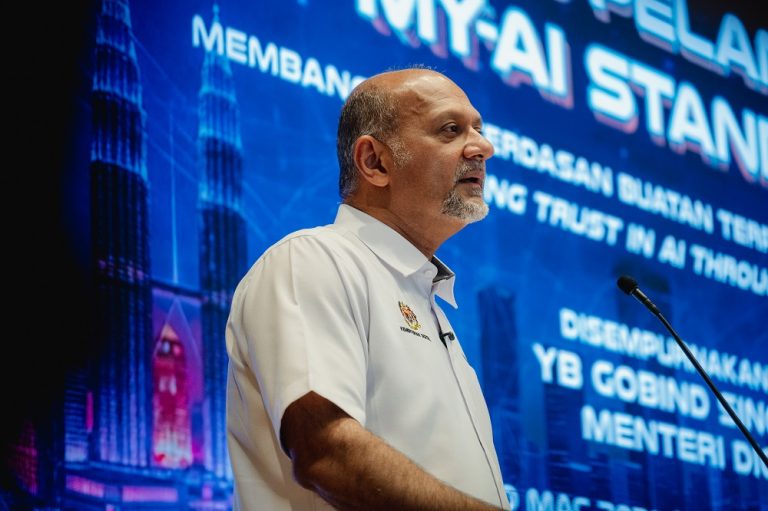
KUALA LUMPUR: With the rollout of MY-AI Standards – a platform aimed at building digital trust and guiding the development of artificial intelligence (AI) – Malaysia is asking not just what AI can do, but how it should be governed.
Launched last month, the initiative is designed not merely as an online portal but as a “trust infrastructure” to support the development, implementation and enforcement of AI standards across the country.
Over the last two years, the Digital Ministry has introduced measures to strengthen AI governance, including establishing the National AI Office (NAIO) as a central authority and developing specialised legislation to combat AI-related crimes. NAIO also coordinates AI initiatives across government, industry and society.
MY-AI Standards complement a series of ongoing initiatives, including the Digital Trust and Data Security Strategy 2026-2030, the Malaysia AI Action Plan 2026-2030, the AI Governance Bill, the National AI Code of Ethics and expanded AI literacy programmes.
Digital Minister Gobind Singh Deo explained the human perspective underpinning governance.
“The purpose of the education system is to instil standards that shape how we think and behave,” he said.
“Examinations are used to assess the extent to which a student understands these standards. As individuals develop, they find themselves governed by laws within a country, through accepted practices, and through international frameworks that define acceptable conduct in a global society.”
Similarly, AI systems must be guided by clear standards and supported by institutions capable of enforcing them.
“If we are moving towards a world where systems can ‘think’ for themselves – because they are fed information – we must ensure from the outset that standards are clearly defined,” Gobind added.
“This is necessary to build technology that behaves in a way that is appropriate and aligned with our values.”
A key part of this process is training. Policymakers must examine how systems are trained, establish clear standards and introduce mechanisms to test compliance. Agencies must also be prepared to address situations where technology fails to comply.
Built on a “trust by design” approach, MY-AI Standards ensures AI systems are transparent, auditable and aligned with recognised frameworks.
The platform also aims to catalyse industrial development, benefiting sectors ranging from micro, small and medium-sized enterprises (MSMEs) to national critical infrastructure.
This comes as AI tools are increasingly adopted across finance, communications and public services, raising concerns over misuse, deepfakes and accountability. (https://twentytwo13.my/gobind-newly-launched-my-ai-standards-to-anchor-trusted-ai-development-address-deepfake-risks/)
“It has been a challenging period, but there is now a clear focus on governance. This includes standards, regulation, legislation and the building of institutions. It also involves engaging stakeholders, including industry, to determine what is required before fully defining these standards,” he said.
At the regional level, Malaysia is working with Asean partners, acknowledging each country has its own requirements while highlighting the importance of trust in cross-border interactions.
Globally, the country is expanding participation in international standard-setting platforms, including ISO and IEC.
“Standards ultimately define direction. When we understand the problem, we can develop the right frameworks – including enforcement mechanisms – to address it effectively,” Gobind said.
While the framework is still evolving, the priority is translating standards into effective enforcement and real-world adoption, ensuring innovation grows alongside accountability, ethical alignment and public trust.