
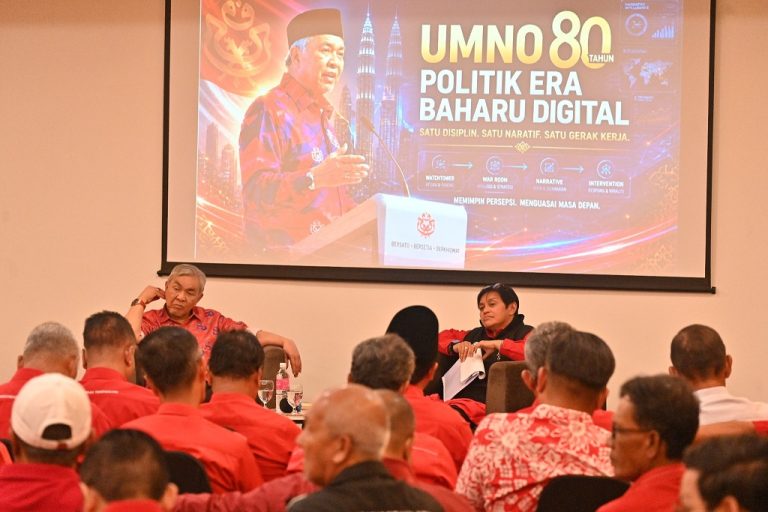
The United Malays National Organisation (Umno) will celebrate its 80th anniversary on May 11.
At 80, Umno has the distinction of being not only the oldest political party in Southeast Asia, but also one of the most successful political parties in the world.
Although Umno is no longer the dominant force in Malaysian politics, it should not be overlooked that its president is currently the deputy prime minister, while six of its senior leaders are full ministers in the cabinet.
Despite losing power in the 14th General Election in 2018, Umno found itself back in the driver’s seat following the collapse of the short-lived Pakatan Harapan (PH) government in 2020 after Tun Dr Mahathir Mohamad’s sudden resignation, and the subsequent resignation of Tan Sri Muhyiddin Yassin as Malaysia’s eighth prime minister in August 2021.
Umno later returned to the pinnacle of power when its then vice-president, Datuk Seri Ismail Sabri Yaakob, became Malaysia’s ninth prime minister.
However, Umno’s ability to remain in power did not translate into electoral success.
In the 15th General Election in 2022, the party suffered the worst defeat in its history, winning only 26 out of 222 parliamentary seats. Its performance in subsequent state elections has also been underwhelming.
The perennial question occupying the minds of many political observers is whether Umno will remain committed to the current political arrangement or contest independently under the Barisan Nasional (BN) banner, potentially triggering three-cornered fights involving its present allies in the Madani government.
There is little doubt that Umno’s political strategy will determine how the party fares in the coming state elections in Melaka and Johor, as well as in the 16th General Election.
Beyond political strategy, Umno must come to terms with the reality that Malaysia’s political landscape has changed tremendously.
Gone are the days when Umno could flex its political muscle and claim to be the sole defender of Malay interests. That mantle is increasingly being appropriated by Parti Islam Se-Malaysia (Pas).
More importantly, under the current political configuration, Umno is no longer the primus inter pares it once was during BN’s dominance.
It is no secret that political power comes with considerable prerogatives.
During its glory days, Umno held substantial stakes in the corporate world through its business arm, Fleet Group. Today, however, the party’s political clout is no longer what it once was.
Given the shift in its political fortunes, Umno is finding it increasingly difficult to dispense material incentives to its members.
Appointments to government-linked companies (GLCs) and statutory bodies are largely reserved for the prime minister, who is also the president of Parti Keadilan Rakyat (PKR).
This is not to say that Umno is entirely without influence. Through ministries headed by Umno ministers, the party is still able to distribute some political largesse to its members.
On the political front, the coming together of parties with vastly different political persuasions following the 15th General Election to form the unity government has not been without challenges.
Although the top leadership of Umno and the Democratic Action Party (DAP) has displayed a degree of unity, grassroots members from both parties remain at odds over numerous issues, ranging from language and education to the organisation of the Rain Wave Water Festival 2026, largely due to ideological incompatibilities.
DAP chairman Lim Guan Eng appeared to echo the sentiments of many within his party when he described Umno as an unreliable partner in the unity government, particularly in light of the political crisis precipitated by Umno in Negeri Sembilan.
The political path Umno chooses to follow will undoubtedly determine how the party fares in future elections.
However, at 80, one thing is certain – the strains and stresses the party has endured over the decades may yet enable it to weather future political turbulence with relative ease.
The views expressed here are the personal opinion of the writer and do not represent that of Twentytwo13.


