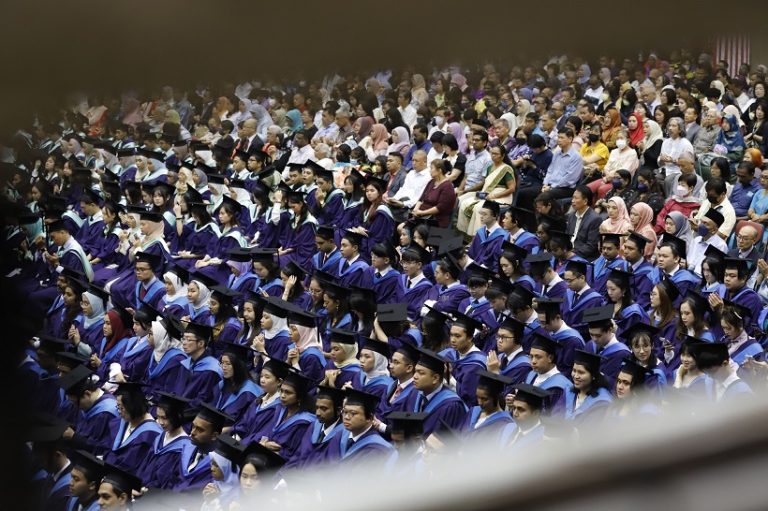
Over the past few weeks, my social media feed has been filled with news of convocation ceremonies at universities across the country.
As an academic, I have experienced these ceremonies from different perspectives – as a graduate receiving my scroll and as a member of the academic community participating in my own institution’s ceremonies.
As convocations become increasingly visible and accessible to the public through platformed media, I have also become an observer of the public discourse surrounding them.
I am accustomed to the solemnity of convocation ceremonies. That was how my alma mater conducted its commencement ceremonies: quiet, dignified and serious.
When I first joined academia in Malaysia, I was pleasantly surprised by the elaborate ceremonial nature of convocations here. Yet, despite their elaborate proceedings, the solemnity was preserved.
I came to appreciate this solemnity, which I believe affords everyone involved, particularly graduates, the time and space to reflect on their academic journey and look ahead to their next endeavour.
Convocation is steeped in academic tradition, reflected in the academic regalia and its colours, the ceremonial mace, the academic procession and, of course, the conferral of degrees. It is one of society’s rites of passage. The solemnity of the occasion is, in my opinion, itself an acknowledgement of its significance.
In the age of platformed media, convocation ceremonies are no longer confined by institutional boundaries of time and space. They can now be watched, experienced and debated by the wider public.
In the social media discussions I have followed, comparisons have been made between institutions, with expressions such as “paling best and happening”, “entertaining” and “long and boring” used to describe their ceremonies.
These comparisons were particularly evident in discussions surrounding a university that staged a mini-concert as part of its convocation ceremony this year.
What interests me is not so much whether a concert is appropriate at a convocation ceremony. After all, musical accompaniment has long been part of my own institution’s ceremonies, and I find it quietly pleasant. It provides a backdrop to the proceedings, complementing the ceremony without taking centre stage.
What deserves closer scrutiny, however, is the underlying expectation that such an occasion should be entertaining. Have we reached a point where even an occasion of such symbolic significance must entertain us?
The growing presence of entertainment in our lives is hardly new.
Entertainment is no longer simply an activity we engage in during our leisure time. It has increasingly become a cultural logic that shapes how we organise, experience and evaluate various aspects of our lives. We not only seek entertainment but also increasingly judge events by their entertainment value.
Social media has brought institutions and the wider public closer together. Institutional practices once largely experienced within their own communities are now open to public scrutiny and evaluation.
In seeking visibility, institutions also expose themselves to public evaluation on terms they may not necessarily dictate. The criteria used by the public to judge these practices may have little to do with their original institutional purpose.
The discussions surrounding this year’s convocation ceremonies offer a glimpse into this phenomenon. Calls by some members of the public for other universities to adopt similar practices suggest that entertainment may be becoming an expectation rather than merely a welcome addition to the ceremony.
Institutions, particularly those seeking to remain visible and relevant, may increasingly find themselves having to negotiate between the expectations of the “watching public” and the fulfilment of their institutional duties.
But should institutional relevance necessarily mean accommodating the prevailing logic of entertainment?
This is not to suggest that solemnity precludes joy or celebration, or that entertainment has no place in a convocation ceremony. Rather, entertainment can complement the occasion without becoming its organising logic.
There is value, I believe, in preserving occasions in our social lives that allow us to experience something beyond entertainment. This may be increasingly difficult in a culture where boredom has become almost taboo.
Yet we need occasions that give us the time and space to reflect, appreciate the significance of an achievement, and acknowledge the people and sacrifices behind it. These are occasions steeped in tradition. They may not always be exciting, but that does not make them any less meaningful.
Dr Azrina Husin is an associate professor at Universiti Sains Malaysia.
The views expressed here are the personal opinions of the writer and do not necessarily represent those of Twentytwo13.